Money-Back Guarantee · 30 days Free Worldwide Delivery
446,261artworks 30,640artists 4,753museums 32languages
Country
Currency
Language
Atelier · Est. 2015 · Paris, France
AllPaintingsStore
allpaintingsstore.com
Account Wishlist Cart

sir john greig latham gcmg pc qc

1877 - 1964

Quick Facts

  • Also known as: John Latham
  • Gift suitability: other-none
  • Top 3 works:
    • Seein
    • Nineteen sixty-four
    • The Moral High Ground
  • Born: 1877, Melbourne, Australia
  • Nationality: Australia
  • Works on APS: 4
  • Museums on APS:
    • Modern Art Oxford
    • Modern Art Oxford
    • Modern Art Oxford
    • Modern Art Oxford
    • Modern Art Oxford
  • More…
  • Art period: Modern
  • Room fit: living room
  • Copyright status: Under copyright
  • Top-ranked work: Seein
  • Lifespan: 87 years
  • Died: 1964

Art Quiz

There is only one correct answer for each question.

Question 1:
Sir John Latham held several prominent positions throughout his life. Which of the following was NOT one of them?
Question 2:
Besides his legal and political career, Latham also pursued what other passion?
Question 3:
During World War II, Latham took a leave of absence from the High Court to serve as Australia's ambassador to which country?
Question 4:
What was Latham’s initial profession before entering politics and law?
Question 5:
Latham's artistic works often explored what kind of themes?

A Life Interwoven: Law, Politics, and the Unexpected Art of Sir John Latham

Sir John Greig Latham (1877-1964) occupies a unique space in Australian history – not merely as a pillar of its legal and political systems, but as an artist who quietly pursued creative expression alongside a demanding public life. While widely recognized as the fifth Chief Justice of Australia, a role he held with distinction for nearly two decades, Latham’s artistic endeavors reveal a contemplative mind grappling with complex societal issues and philosophical questions. Born in Melbourne, his early life demonstrated a remarkable aptitude for both arts and law at the University of Melbourne, laying the foundation for a multifaceted career that defied easy categorization. He wasn't simply a man *of* the law; he was a thinker who translated his intellectual rigor into diverse forms of expression. His journey from barrister to parliamentarian, diplomat, and finally, Chief Justice, was punctuated by an enduring passion for art – a pursuit often undertaken in the quiet moments stolen from the pressures of public service.

Navigating the Currents of Public Life

Latham’s path into the heart of Australian governance began with service during World War I in the Royal Australian Navy, followed by his entry into Parliament in 1922 as an independent member for Kooyong. He quickly ascended through the political ranks, aligning himself with the Nationalist Party and serving as Attorney-General under both Stanley Bruce and Joseph Lyons. His leadership of the opposition from 1929 to 1931 marked a period of significant political transition, skillfully guiding the Nationalists into the newly formed United Australia Party. This demonstrated his pragmatic approach to politics – an ability to adapt and navigate shifting alliances while remaining committed to his principles. A particularly unusual chapter unfolded during World War II when, in 1940, he accepted a leave of absence from the High Court to become Australia’s inaugural ambassador to Japan—a delicate and challenging diplomatic posting at a time of escalating global conflict. This appointment underscored his willingness to serve his country in unconventional ways, demonstrating both courage and diplomatic finesse. His return to the bench as Chief Justice in 1935 cemented his legacy as one of Australia's most respected legal minds, a position he held until 1952.

The Emergence of an Artistic Voice

Amidst these weighty responsibilities, Latham cultivated a compelling artistic practice. He was not a formally trained artist; rather, his work emerged from a deeply personal need to explore ideas and emotions through visual form. His output encompassed both painting and sculpture, characterized by abstract forms and thought-provoking themes. It’s tempting to speculate on direct influences – the modernist movements gaining traction during his lifetime likely resonated with his intellectual curiosity—but Latham's artistic development appears largely self-directed, shaped by his unique perspective as a legal scholar and public servant. His background in law undoubtedly informed his conceptual approach to art, prioritizing ideas and interpretations over purely representational depictions. He wasn’t interested in merely *showing* the world; he sought to provoke thought about its underlying structures and moral complexities.

Themes and Reflections in Latham's Art

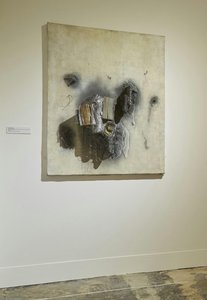
Latham’s artworks frequently delved into societal issues, ethical dilemmas, and the intricacies of human existence. Pieces like “Latter Day Observer” invite contemplation on contemporary society, prompting viewers to question their own roles within it. “Nineteen Sixty-Four,” a striking sculpture study, offers a unique perspective on form and space, while “Seein’” explores the subjective nature of perception and reality. Perhaps most poignant is “The Moral High Ground”, which directly confronts ethical considerations and societal values—themes that clearly resonated with his legal background and public service. These works aren’t simply aesthetic objects; they are visual essays, born from a lifetime of observing human behavior and grappling with complex moral questions. They reveal an artist deeply concerned with the state of the world and humanity's place within it.

A Lasting Legacy: Beyond the Bench

Sir John Latham’s significance extends far beyond his contributions to law and politics. He represents a rare confluence of intellectual rigor, public service, and creative expression—a testament to the power of a curious mind refusing to be confined by conventional boundaries. His art provides a fascinating glimpse into the inner world of a man who shaped Australia's legal and political landscape while simultaneously engaging with profound philosophical and aesthetic questions. He challenges us to consider the interconnectedness of seemingly disparate fields, demonstrating that law, politics, and art can all serve as vehicles for understanding ourselves and the world around us. His legacy continues to inspire those interested in the intersection of these disciplines, reminding us that a truly well-lived life is one characterized by intellectual curiosity, unwavering integrity, and a willingness to explore the full spectrum of human experience. He was, ultimately, a man who lived many lives within one.