Eelvaade
 Saada
Saada Jaga
Jaga
 Teave teose kohta

 Laadi alla
 Sarnased teosed
 Röntgenuuring
 Slaidietendus
Saint Bartholomew
 Oil On Panel
- International Gothic
 1317
1317- Late Medieval
 30.0 x 22.0 cm
 Loe lähemalt
Käsitsi valmistatud õlimaalireproduktsioon
Meie kunstnike poolt tellimusel valmistatud käsitsi maalitud õli-kainaste teos teie soovitud suuruses ja raamis. ( Osta print Osta pilt)




P118B $10

P118H $10

P118W $10

P438Z $10

P508JH $12

P508YH $12

P805H $10

P805Z $10

P919BZ $10

P919G $10

P919XJ $10

P959ZH $10

P968JZ $12

W106C $8

W218G $10

W218JH $8

W218Y $10

W307PJ $10

W316G $10

W316PJ $8

W316Y $10

W398PJ $8

W4111J $10

W500HY $15

W500JH $15

W692G $12

W849H $8

W940BG $15

W953PJ $8




Vali meie eelmääratud suurused, mis vastavad teose algupärastele proportsioonidele.

Sa võite sisestada oma mõõtmed konkreetse raami või ruumi sobivuse tagamiseks. Kui teie valitud suurus ei vasta originaalpildi proportsioonidele, siis kärvime kunstiteost või laiendame maali täiendavate käsitsi maalitud elementidega. Enne tootmise algust saadetakse teile heakskiitmiseks digitaalne eelvaade.
Palun pidage meeles, et ekraanil kuvatav eelvaade ei kajasta tegelikku kärpimist või laiendamist. Ainult eelvaade näitab täpselt lõplikku kompositsiooni.
Kuigi on saadaval kohandatud suurused, soovitame originaalproportsioonide säilimiseks valida mõõdud eelmääratletud nimekirjast.
Pärast tellimust saadab AllPaintingsStore.com meeskond kliendile e-posti juhised ning esitab eelvaate kavandi.
Maailmline tarne 3–4 nädala jooksul tavalise 5 nädala asemel. (15 august). Kvaliteedis kompromisse ei tehta.

Tasuta ekspresssaatmine üle maailma

Kõrgekvaliteediline linakangas

Täielik transpordikindlustus

Tollimaksude tagastamise garantii

Värvitoime täpsuse garantii

60-päevane tagastusõig: ainult tootmisdefektide korral

100% raha tagasi garantii

Hulgusoodustus
 Klaasivalik on saadaval ainult suuruses kuni 110 cm

Saint Bartholomew
Reproduktsiooni tehnika
Reproduktsiooni suurus
-


Kogusumma
$ 258
Teose kirjeldus
A Saintly Portrait: Unveiling Simone Martini’s *Saint Bartholomew*
This captivating panel depicts *Saint Bartholomew*, a work originating from the workshop of the celebrated Sienese artist Simone Martini in 1317. One of seven known panels originally forming part of an altarpiece – likely either a predella or a register above the main scenes – it offers a fascinating glimpse into late medieval religious art and devotional practices. The panel’s history traces back to the collection of Johann Anton Ramboux, a German painter and collector in the 19th century, highlighting its enduring appeal across centuries.Style & Technique: A Bridge Between Traditions
The painting exemplifies the transition from the Byzantine-influenced style prevalent in earlier Italian art towards the emerging Gothic aesthetic. While based on cartoons (preparatory drawings) created by Simone Martini himself, the execution was entrusted to his skilled assistants. This collaborative approach was common in workshops of the period. The work displays a refined elegance characteristic of Sienese painting, with delicate modeling and graceful lines. Oil paint on wood panel allows for rich color and subtle gradations, though past cleanings have unfortunately altered some of the original hues – notably resulting in an anomalous brown tone across parts of the composition. The style leans towards a nascent realism, evident in the attempt to render facial features with greater naturalism than earlier depictions.Subject & Symbolism: An Apostle’s Identity
Saint Bartholomew is traditionally identified as Nathanael, one of the twelve apostles. He is often depicted holding the knife by which he was martyred – a symbol absent here but frequently associated with his iconography. Instead, this panel focuses on portraying him as a learned figure, an emphasis underscored by the open book in his left hand. This symbolizes knowledge, scripture, and Bartholomew’s role as a disseminator of faith. His dignified pose and contemplative expression convey wisdom and spiritual authority. The dark background serves to isolate and emphasize the saint, drawing the viewer's attention to his serene countenance.Historical Context: Sienese Art & the International Gothic
Simone Martini was a pivotal figure in the development of the *International Gothic* style – an artistic movement that flourished across Europe in the 14th century. This style is characterized by its elegance, refined detail, and emphasis on decorative elements. Martini’s work bridged the gap between the Byzantine traditions of his predecessors, like Duccio di Buoninsegna (thought to be Martini's teacher), and the more naturalistic tendencies that would define Renaissance art. The panel’s original placement within an altarpiece underscores its function as a devotional object intended to inspire piety and reverence in worshippers.Emotional Impact & Interior Design Considerations
Despite its relatively small size (30 x 22 cm), *Saint Bartholomew* possesses a powerful emotional resonance. The saint’s serene gaze invites contemplation, offering a moment of quiet reflection. The painting's subdued color palette and dignified composition make it suitable for a variety of interior settings. It would complement both traditional and contemporary spaces, adding a touch of historical elegance and spiritual depth.- Consider pairing this reproduction with muted wall colors to enhance its subtle beauty.
- Its size makes it ideal for smaller niches or as part of a curated gallery wall.
- The religious subject matter lends itself well to contemplative spaces like libraries or studies.
Sarnased teosed


Kunstniku elulugu
Simone Martini (c.1284–1344) – A Sienese Master of Elegance and Grace
Simone Martini, born around 1284 in Siena, Italy—though precise birthdates remain elusive—stands as a cornerstone figure in the transition from medieval to Renaissance art. He wasn’t merely a painter; he was an architect of elegance, a master of line and color who infused his works with a courtly refinement that distinguished him from contemporaries like Giotto di Bondone. Historical accounts regarding Martini’s formative years are fragmentary—scholarly debate centers on whether he apprenticed under Duccio di Buoninsegna, the dominant Sienese artist of his time, or if Florence and Giotto exerted a more profound influence—yet Martini undeniably forged an artistic path uniquely his own.
Origins and Education – The Seeds of Style
The exact circumstances surrounding Simone’s upbringing are shrouded in obscurity. Tradition suggests he was born in Siena’s Sant’Egidio district, possibly the son of Martino Senese, a craftsman specializing in preparing arriccio—the initial plaster layer applied to wall surfaces destined for fresco painting—though corroborating evidence remains scant. Regardless of his precise origins, Martini’s artistic training undoubtedly commenced within Duccio di Buoninsegna’s workshop, where he absorbed the stylistic precepts of Sienese Gothic.
The Siena Workshop – Collaboration and Patronage
Martini’s formative years were marked by close association with Memmo di Filippuccio, another artisan active in San Gimignano—a partnership that fostered not only professional growth but also exposure to the burgeoning artistic culture of Tuscany. Crucially, Martini secured his first major civic commission in 1311: the frescoing of the *Maestà* for Siena’s Palazzo Pubblico—a monumental undertaking that cemented Duccio’s legacy and established Martini as a rising talent.
The Maestà – A Synthesis of Tradition
The *Maestà*, completed in 1315, represents a pivotal moment in Martini’s artistic trajectory. It served as an homage to Duccio’s own masterpiece—a stylistic echo that underscored Martini’s commitment to established Sienese conventions. Yet, Martini transcended mere imitation; he innovated through meticulous attention to detail and the incorporation of groundbreaking techniques—particularly the use of metallic pigments and punching—resulting in a painting that embodies both grandeur and exquisite refinement.
International Gothic – Influence and Artistic Vision
Martini’s stylistic hallmark is undeniably International Gothic, a movement characterized by its delicate beauty, elongated figures, flowing drapery, and opulent ornamentation. This aesthetic was profoundly shaped by artistic currents originating from France—specifically the illuminated manuscripts and ivory carvings of Parisian ateliers—which Martini skillfully assimilated into his own distinctive vision.
Later Career – Avignon and Artistic Circles
Martini’s renown extended beyond Siena, attracting commissions from papal patrons in Avignon—a city at the epicenter of European power during the thirteenth century. His presence within Francesco Petrarca’s intellectual circle further enriched his artistic milieu—a connection underscored by Vasari’s account of Martini’s portrait of Laura de Noves—demonstrating Martini's ability to capture not only physical likeness but also the essence of beauty and inspiration.
Legacy – An Enduring Influence
Simone Martini’s contribution to European art history is undeniable. He championed International Gothic style, disseminating its aesthetic principles across the continent and shaping the artistic sensibilities of subsequent generations. His frescoes in San Francesco d’Assisi exemplify his mastery of large-scale decorative painting—a testament to Martini's unparalleled command of color, form, and compositional harmony. Martini died in Avignon in 1344, leaving behind a legacy that continues to inspire awe and admiration centuries later—a beacon of elegance and artistic innovation.

Simone Martini
1284 - 1344 , Itaalia
Lühikesed faktid
- Artistic Movement Or Style: International Gothic
- Artists Who Influenced This Artist:
- Duccio di Buoninsegna
- Francesco Petrarca
- Date Of Birth: c. 1284
- Date Of Death: 1344
- Full Name: Simone Martini
- Nationality: Italian
- Notable Artworks:
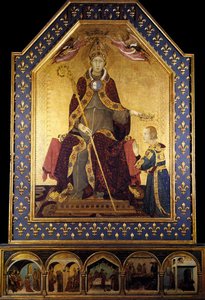
- Saint Louis Crowning Robert
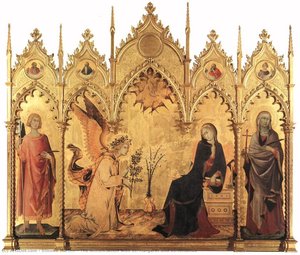
- Annunciation (Uffizi)
- Consecration of Chapel
- Place Of Birth: Siena, Italy
Seotud artiklid

Simone Martini: Innovation, Spirituality & Courtly Refinement in Sienese Painting
Explore the captivating world of Simone Martini, a pivotal figure in Sienese painting & the International Gothic style. Discover his innovative techniques, spiritual depth, and lasting influence on early Renaissance art.

The Enduring Legacy of Oil on Canvas: Technique, History & Aesthetic Impact
Explore the rich history & techniques of oil painting – from Renaissance masters to Impressionism. Discover pigments, layering methods, and why this timeless medium endures. Expert insights for artists & art enthusiasts.

The Enduring Power of Painting: A Historical & Contemporary Exploration of Form and Emotion
Explore the rich history & enduring techniques of oil painting with AllPaintingsStore. Discover masterpieces, learn about art collecting, and find authentic handmade reproductions crafted by skilled artists.

Oil on Canvas: A Historical & Technical Exploration of a Timeless Artistic Medium
Explore the rich history & enduring techniques of oil painting on canvas. Discover the science behind its longevity, conservation practices, and contemporary relevance. Expert insights for art enthusiasts.

Lõuendi püsivus ja väljendusvõime: Tehnika, ajalugu ja kaasaegne praktika
Avastage lõuendi püsivuse ja väljendusvõime saladused! Ajaloolised tehnikad, kaasaegsed lähenemised ja ekspertide nõuanded maalikunsti austajatele. Lugege nüüd!