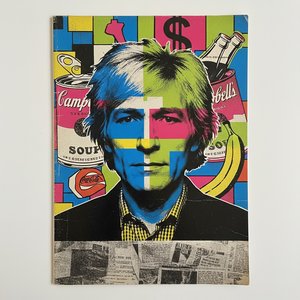
1968. Acrylique sur toile.

§ 1Catalogue data


Cette œuvre est protégée par le droit d'auteur
L’œuvre d'art présentée sur cette page est protégée par le droit d'auteur, ce qui signifie que nous ne pouvons légalement créer ou vendre de reproduction identique. Cette protection est appliquée en vertu d'accords internationaux tels que la Convention de Berne et par les lois nationales, notamment celles énoncées par le Loi américaine sur le droit d'auteur - Titre 17.
En tant qu'alternative respectueuse et légale, nous proposons des œuvres d'art personnalisées, peintes à la main et inspirées de l'original. Nos artistes talentueux et professionnels étudient avec soin le style, l'ambiance et l'essence artistique de l'œuvre originale pour créer une pièce nouvelle et unique qui évoque la même émotion — tout en restant une création originale en soi.
Cette méthode est pleinement conforme aux réglementations sur le droit d'auteur car elle ne repose pas sur la copie ou la duplication de l'œuvre protégée. Il s'agit plutôt d'une réinterprétation créative — une nouvelle peinture qui s'inspire de l'original sans pour autant lui être identique.
 En savoir plus
§ 2Abstract
Description de la pièce
Andy Warhol's "Flash—November 22" dénonce la désensitisation à la tragédie médiatique et réinterprète les images clés de l'assassinat de JFK avec une esthétique Pop Art emblématique.
Biographie de l'artiste
Explorez l'œuvre emblématique d'Andy Warhol (1928-1987) – sérigraphies de Marilyn, Campbell's Soup Cans et culture des célébrités. Découvrez son impact durable sur l'art chez AllPaintingsStore.
§ 3Commentary
A Fragmented Reflection on Loss: Decoding Andy Warhol’s ‘Flash—November 22, 1963’
Andy Warhol’s ‘Flash—November 22, 1963’ isn’t a painting in the traditional sense; it's a visceral reaction captured in eleven screenprints, a fragmented memorial to a nation irrevocably altered. Created in 1968, five years after the assassination of President John F. Kennedy, this series isn’t about the event itself, but rather about *how* we consumed that event – through the relentless churn of mass media. Warhol doesn’t offer grief; he presents its packaging, the way tragedy was filtered and disseminated to a stunned public. The work stands as a chilling commentary on desensitization, the blurring lines between reality and representation, and the burgeoning power of image-making in shaping collective memory.
The Echoes of a News Bulletin
The title itself, “Flash—November 22, 1963,” evokes the urgent language of news bulletins, the staccato bursts of information that interrupted everyday life. Warhol deliberately sourced his imagery from campaign posters, newspaper photographs, and advertisements – the very materials that flooded homes across America in those days of mourning. He wasn’t interested in creating a heroic portrait or a solemn elegy; instead, he replicated the visual noise surrounding the assassination, presenting Kennedy's image alongside that of Lee Harvey Oswald, the Presidential Seal, even the gun used in the shooting. This deliberate juxtaposition is deeply unsettling. The repetition inherent in the screenprinting process further amplifies this effect, mimicking the relentless replay of images on television screens and in newspapers. Each print feels less like an individual artwork and more like a frame from an endless loop, a haunting echo of that fateful day.
Pop Art’s Confrontation with Tragedy
Warhol's choice of subject matter was particularly provocative for the Pop Art movement, which had largely focused on consumer culture and celebrity iconography. While his earlier works celebrated the vibrancy of everyday objects like Campbell’s Soup cans and Coca-Cola bottles, ‘Flash—November 22, 1963’ plunged into a far darker territory. It challenged the notion that art should be purely aesthetic or celebratory, forcing viewers to confront uncomfortable truths about violence, loss, and the manipulative power of media. Warhol himself confessed his initial detachment from the event, stating he was more disturbed by the *way* television dictated public emotion than by Kennedy’s death itself – a sentiment that permeates every print in the series.
A Legacy of Discomfort and Reflection
‘Flash—November 22, 1963’ remains profoundly relevant today. In an age saturated with information and increasingly reliant on visual media, Warhol's work serves as a prescient warning about the dangers of passive consumption and the erosion of genuine emotional connection. The series doesn’t offer answers or closure; it presents a fragmented, unsettling portrait of a nation grappling with trauma. It is a powerful reminder that images are not neutral representations of reality but rather constructed narratives that shape our perceptions and influence our understanding of the world. Owning a reproduction of this work isn’t simply acquiring an iconic piece of art history; it’s inviting a dialogue about memory, media, and the enduring impact of tragedy.
- Artist: Andy Warhol
- Born Year: 1928
- Death Year: 1987
- Birth City: Pittsburgh
- Birth Country: United States of America
Warhol’s artistic journey began in Pittsburgh, Pennsylvania, where he experienced a formative illness—Sydenham's chorea—that profoundly shaped his life and artistic vision. This neurological condition forced him to spend considerable time indoors, fostering an intense inner world where drawing became a crucial outlet for expression.
His early exposure to art supplies and popular imagery – comic books and movie magazines – instilled in him a fascination with visual culture that would become central to his distinctive style. Warhol excelled at the Carnegie Institute of Technology, graduating in 1949 with a degree in Pictorial Design, before embarking on a transformative move to New York City.
Driven by ambition and fueled by an unwavering belief in the power of art, Warhol established himself as a commercial illustrator, honing his skills and gaining invaluable experience in crafting compelling visual narratives. This initial foray into the creative realm provided him with a foundation for his later groundbreaking achievements.
Additional Research:
Warhol’s fascination with celebrity extended beyond mere admiration; he actively sought to explore its complexities and contradictions, reflecting on its influence on society and culture. His artistic explorations encompassed diverse mediums—painting, sculpture, photography, and filmmaking—demonstrating his versatility as an innovator.
Questions et réponses
Où puis-je acheter une impression de «Flash—November 22» de Andy Warhol ?
Vous pouvez commander une impression de «Flash—November 22» de Andy Warhol directement sur sa page Tirage d'art fine art : une impression d'art sur toile de coton ou sur papier canvas d'archive.
Quelle taille d'impression est recommandée pour « Flash—November 22 » ?
Pour «Flash—November 22», un format d'impression de Grand format est recommandé. D'autres tailles sont disponibles avec les mêmes proportions.
«Flash—November 22» de Andy Warhol est-il une composition en portrait, en paysage ou carrée ?
«Flash—November 22» de Andy Warhol présente un format Format carré. Le format décrit les proportions de la composition.


 Passer au format impression


 Pour les œuvres ou reproductions dont un côté mesure plus de 105 cm (environ 41 pouces), le cadre sera expédié sous forme de kit démonté. Cette méthode garantit une livraison sécurisée et prévient tout dommage pendant le transport.