Aperçu en situation
 Envoyer
 Partager
 Détails de l'œuvre
 Guide
Guide

 Télécharger l'image
 Articles similaires
 Radiographie
 Diaporama
 Questions et réponses
 Statistiques
The actor (12)

 Lire la suite
Giclées et impressions d'art
Impressions giclées ou sur toile de qualité musée, avec une production rapide et des finitions au choix. ( Commander la reproduction peinte à la main Passer au format numérique)




P118B €10

P118H €10

P118W €10

P438Z €10

P508JH €12

P508YH €12

P805H €10

P805Z €10

P919BZ €10

P919G €10

P919XJ €10

P959ZH €10

P968JZ €12

W106C €8

W218G €10

W218JH €8

W218Y €10

W307PJ €10

W316G €10

W316PJ €8

W316Y €10

W398PJ €8

W4111J €10

W500HY €15

W500JH €15

W692G €12

W849H €8

W940BG €15

W953PJ €8




Choisissez parmi nos formats prédéfinis qui respectent les proportions originales de l’œuvre.

Saisissez la largeur et la hauteur souhaitées pour qu'elles s'adaptent à votre cadre ou à votre mur. Une impression peut être recadrée, mais jamais agrandie au-delà de l'image originale ; ainsi, un format de forme différente entraînera la perte d'une partie de l'image. Nous vous envoyons une maquette numérique pour approbation avant toute impression. L'image présentée sur cette page ne montre pas le recadrage réel — seule la maquette le permet.
Livraison dans le monde entier () en 2 semaines au lieu des 4/5 semaines habituelles. (8 novembre)

Livraison express gratuite dans le monde entier

Toile de lin de qualité supérieure

Assurance transport complète

Garantie de remboursement des droits de douane

Garantie de fidélité des couleurs

Politique de retour de 100 jours (uniquement en cas de défaut)

Garantie de remboursement à 100%

Offre de tarifs dégressifs
 L'option verre n'est disponible que pour les dimensions inférieures à 110 cm.

The actor (12)
Giclées et impressions d'art
Format de la reproduction
-


Prix total
€ 58
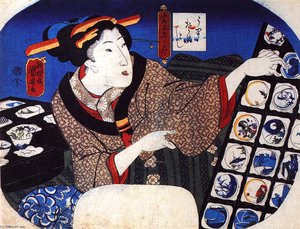
A Window Into Edo Japan: Kuniyoshi's "The Actor" – A Symphony of Color and Drama
Utagawa Kuniyoshi’s “The Actor,” executed in 1847, stands as a quintessential example of *shunga*, the Japanese erotic woodblock print genre that flourished during the Edo period (1603-1868). More than just a depiction of theatrical performance, this triptych delves into themes of beauty, masculinity, and fleeting moments captured in exquisite detail—a testament to Kuniyoshi’s mastery of technique and his profound understanding of Japanese aesthetics. Produced by Ichimura Uzaemon XII for the prestigious Gobuji Chūshingura series, commissioned to commemorate the heroic tale of samurai loyalists defending Edo Castle against Tokugawa forces, “The Actor” embodies the spirit of its time—a fascination with idealized figures and a celebration of artistic virtuosity.- Subject Matter: The print portrays Ichimura Uzaemon XII as Tada Kurodo Yukitsuna, a prominent Kabuki actor known for his dramatic performances and captivating stage presence. Kuniyoshi meticulously captures Yukitsuna’s posture—a deliberate pose designed to convey nobility and strength—emphasizing the importance of gesture and expression within Japanese theater traditions.
- Style & Technique: Kuniyoshi employed a bold, expressive style characteristic of *shunga*, utilizing thick black outlines and vibrant colors achieved through multiple blocks of pigment applied to the wood surface. The artist’s masterful use of tonal gradation—particularly in the background—creates depth and atmosphere, transporting viewers into the theatrical space depicted.
- Historical Context: “The Actor” reflects the Edo period's obsession with idealized beauty and heroic narratives. Gobuji Chūshingura itself was a popular tale celebrating samurai loyalty and courage, mirroring broader societal values during this era. Kuniyoshi’s inclusion of tattoos—a symbol of honor and warrior identity—further reinforces these themes, demonstrating his awareness of cultural conventions.
- Symbolism: The intricate patterns adorning Yukitsuna's kimono serve as visual metaphors for status and refinement—elements central to Edo society’s hierarchical structure. Furthermore, Kuniyoshi’s careful composition directs the viewer’s gaze towards Yukitsuna’s face, highlighting the importance of facial expression in conveying emotion and embodying character within Kabuki performances.
- Emotional Impact: Despite its erotic undertones—a common feature of *shunga*— “The Actor” transcends mere sensuality to evoke feelings of admiration for beauty and contemplation on the ephemeral nature of human experience. Kuniyoshi’s artistic vision captures a moment frozen in time, inviting viewers to appreciate the artistry and cultural significance of Edo Japan.
Questions et réponses
À quel mouvement artistique appartient « The actor (12) » ?
« The actor (12) » est une œuvre issue du Ukiyo-e. Ce mouvement définit la tradition artistique à laquelle l'œuvre appartient.
Où est-il recommandé d'exposer le format Square de « The actor (12) » ?
Avec son format Square, une reproduction de « The actor (12) » est idéale pour un(e) Living Room.
Quelle émotion les couleurs de «The actor (12)» de Utagawa Kuniyoshi dégagent-elles ?
«The actor (12)» de Utagawa Kuniyoshi allie une palette Neutrals à un ton Reflective.
Œuvres similaires


Biographie de l'artiste
Biographie et contributions artistiques
Utagawa Kuniyoshi, un artiste japonais renommé, est né le 1er janvier 1798 au Japon et est décédé le 14 avril 1861. Il était l'un des derniers grands maîtres du style japonais d’ukiyo-e de gravures sur bois et de peinture, et membre de l’école Utagawa.Première vie et formation
La première vie de Kuniyoshi a été marquée par son aide dans l’entreprise de teinture de soie de son père, où il a développé un sens des couleurs et des motifs textiles. À l'âge de sept ou huit ans, il fut impressionné par les estampes de guerriers ukiyo-e et les images d’artisans, ce qui influença plus tard son propre travail.Carrière artistique
Les talents artistiques de Kuniyoshi ont été reconnus à l'âge de 12 ans, ce qui a conduit à son apprentissage auprès du célèbre maître imprimeur ukiyo-e Utagawa Toyokuni. Il est devenu l'un des principaux élèves de Toyokuni et a reçu le nom de "Kuniyoshi" en 1811. Son premier travail publié, les illustrations pour kusazōshi gōkan gobuji chūshingura, une parodie de l'histoire originale de Chūshingura, a marqué ses débuts en tant qu’artiste indépendant.Œuvres notables et contributions
- Cent huit héros du Suikodène populaire (tūszoku suikoden gōketsu hyakuhachinin no hitori) : Cette série, basée sur le conte chinois Shuihu Zhuan, a mis en valeur le style unique de Kuniyoshi et est devenue extrêmement populaire à Edo.
- Le fantôme de Taira no Tomomori à la baie de Daimotsu (taira tomomori borei no zu) : Ce travail a démontré la capacité de Kuniyoshi à évoquer un sens efficace de l'intensité de l'action dans sa représentation des combats.
- Le pont de Gōjō (gōjō no bashi no zu) : Cette trilogie de 1839 a mis en valeur le style thématique de Kuniyoshi, qui satisfaisait l'intérêt du public pour le macabre, l'excitant et le bizarre.
Influence et héritage
Le travail de Kuniyoshi incorporait des aspects de la représentation occidentale dans la peinture de paysage et la caricature. Son influence sur l’art ukiyo-e est évidente dans son mélange unique d’éléments japonais traditionnels avec des techniques occidentales.- voir l'autoportrait de Kuniyoshi du recueil shunga (ukiyo-e) sur AllPaintingsStore.
- explorer davantage les œuvres d’Utagawa Kuniyoshi sur AllPaintingsStore.
- en savoir plus sur Utagawa Kuniyoshi sur Wikipédia.
Conclusion
Utagawa Kuniyoshi reste une figure importante de l’art ukiyo-e japonais, connu pour ses sujets divers et son mélange innovant de techniques traditionnelles et occidentales. Son héritage continue d'inspirer les artistes et les passionnés d'art. **Important :** Cet article est basé sur les informations fournies par AllPaintingsStore.com et wikipedia.org, en se concentrant sur la biographie de Kuniyoshi, sa carrière artistique, ses œuvres notables, son influence et son héritage.
Utagawa Kuniyoshi
1797 - 1861 , Japon
L'essentiel de l'artiste
- Artistes Influents: ['Utagawa Toyokuni']
- Date De Décès: 14 avril 1861
- Date De Naissance: 1er janvier 1798
- Lieu De Naissance: Tokyo, Japon
- Mouvement Artistique: Ukiyo-e
- Nationalité: Japonaise
- Nom Complet: Utagawa Kuniyoshi
- Oeuvres Notables:
- Cents héros du Suikoden
- Fantôme de Taira no Tomomori
- Pont Gōjō
Articles connexes

Ukiyo-e: The Art of the Floating World and the Legacy of Japanese Woodblock Masters
Explore the profound history of Ukiyo-e, from Hokusai's iconic waves to the vibrant culture of Edo Japan. Discover the intricate craft of woodblock printing and the enduring legacy of these Japanese masterpieces through our expert art history guide.

L'Héritage de l'Ukiyo-e : Maîtrise Technique et Magie de la Gravure sur Bois Japonaise
Découvrez l'histoire et la technique fascinante de l'Ukiyo-e, de Moronobu à Hiroshige. Explorez ce voyage au cœur du Japon d'Edo.

Utagawa Kuniyoshi: A Master of Japanese Ukiyo-e – Narrative Innovation & the Fusion of Tradition with Popular Culture
Explore the captivating world of Utagawa Kuniyoshi, a master of Japanese ukiyo-e woodblock prints. Discover his innovative warrior scenes, vibrant landscapes & lasting legacy in 19th-century art history.

Floating Worlds: A Definitive Guide to the Mastery and Philosophy of Japanese Ukiyo-e Woodblock Prints
Explore the profound beauty of Ukiyo-e. Discover the history, philosophy, and legendary masters of Japanese woodblock prints, from Hokusai to Kuniyoshi, in this expert guide to the 'Floating World'.

Les 25 chefs-d'œuvre iconiques de Katsushika Hokusai : l'art éternel du Japon
Explorez les 25 chefs-d'œuvre de Hokusai et l'âme de l'ukiyo-e. Découvrez ces trésors sur AllPaintingsStore.com.