

1873. Acrilico su tela, 50.0 x 34.0 cm.

§ 1Dati del catalogo

- 50.0 x 34.0 cm


§ 2Astratto
Descrizione del reperto
Edouard Manet's Polichinelle è un quadro simbolico del Realismo francese del XIX secolo, noto per la sua rappresentazione innovativa della vita quotidiana e l'uso audace della luce.
 Espandi i dettagli
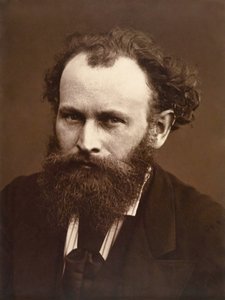
Biografia dell'artista
Manet ha unito Realismo e Impressionismo con Olympia. Scopri le opere rivoluzionarie di questo maestro parigino.
§ 3Commento
Polichinelle
Édouard Manet’s *Polichinelle*, completed in 1873, stands as a cornerstone of Impressionism and a testament to the artist's unwavering commitment to portraying modern life with unflinching realism. Measuring 50 x 34 cm, this oil on canvas masterpiece resides within the Staatsliche Museen zu Berlin’s collection, offering visitors an unparalleled opportunity to contemplate one of Manet’s most celebrated works.Composition and Technique
The painting depicts a man in costume—likely a clown or jester—positioned onstage against a dark backdrop. His outstretched arms hold a ball and a hat, capturing a moment of theatrical gesture that transcends mere representation. Manet meticulously rendered the textures of the fabric, utilizing loose brushstrokes to convey both volume and luminosity – a hallmark of Impressionist technique. The artist’s masterful handling of light is particularly noteworthy; subtle gradations illuminate the man's face and torso, creating an atmosphere of intimacy despite the formal setting. This deliberate choice contrasts sharply with the academic conventions prevalent at the time, marking Manet as a pioneer in challenging established artistic norms.Realism Revisited
Manet’s approach to *Polichinelle* echoes his earlier explorations into realism, evident in works like *Le Déjeuner sur l'herbe* and *Olympia*. He eschewed idealized depictions of figures, opting instead for an honest portrayal of human presence—a bold decision that provoked considerable debate within the Parisian art world. The artist’s attention to detail extends beyond surface appearances; he captures subtle nuances of expression and gesture, conveying a sense of psychological depth rarely achieved by his contemporaries. This stylistic influence is palpable in *A Good Glass of Beer* and *The Masked Ball at the Opera*, demonstrating Manet's consistent dedication to capturing the essence of everyday life with uncompromising accuracy.Historical Context and Artistic Legacy
Painted during a period of significant artistic upheaval, *Polichinelle* reflects the burgeoning Impressionist movement’s rejection of traditional academic painting. The work aligns itself with the broader cultural shift toward valuing observation and sensory experience—a reaction against the rigid formalism championed by the École des Beaux-Arts. Manet's influence extended far beyond his immediate circle, inspiring subsequent generations of artists to embrace innovation and challenge conventions. His unwavering belief in portraying reality as it is perceived – rather than as it should be – solidified his position as a pivotal figure in shaping modern art history.- View the painting Polichinelle by Edouard Manet on AllPaintingsStore
- Discover the works of other notable artists, such as Rovi Jesher SaleGumba, on AllPaintingsStore
- Learn more about the Staatliche Museen zu Berlin and its collection on AllPaintingsStore
The Polichinelle painting is a significant work in the oeuvre of Edouard Manet, showcasing his unique style and attention to detail. As a masterpiece of Realism, it continues to captivate art enthusiasts and inspire new generations of artists.
Domande e risposte
In che anno è stata realizzata "Polichinelle"?
"Polichinelle" risale al 1873. Questa data colloca l'opera all'interno della carriera di Édouard Manet e del suo periodo storico.
Quali sono le dimensioni dell'originale "Polichinelle"?
"Polichinelle" misura 50 x 34 cm nella sua forma originale. Le dimensioni originali sono un utile riferimento per scegliere la dimensione di una riproduzione.
"Polichinelle" presenta forti contrasti chiaroscurali?
Il contrasto chiaroscurale di "Polichinelle" è registrato come Equilibrato. Il contrasto descrive quanto marcata sia la differenza tra le aree chiare e quelle scure.


 Passa alle stampe


 Per opere d'arte o riproduzioni con un lato superiore a 105 cm (circa 41 pollici), la cornice verrà spedita in forma di kit smontato. Questo metodo garantisce una consegna sicura e previene danni durante il trasporto.


