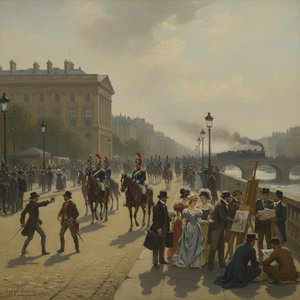
Adrien Henri Tanoux: A Parisian Painter of Exotic Sensuality
Adrien Henri Tanoux, a name perhaps less familiar than many of his contemporaries in the late 19th and early 20th-century French art scene, nevertheless possessed a distinctive voice and a captivating vision. Born in Marseille in 1865 and passing away in Paris in 1923, Tanoux’s artistic journey is one marked by evolution, experimentation, and a profound fascination with the allure of the Orient—a subject that would ultimately define his most celebrated works. While initially trained within the academic framework of the École supérieure d'art et de design Marseille-Méditerranée and later at the prestigious École nationale supérieure des beaux-arts in Paris under the tutelage of Léon Bonnat, Tanoux quickly transcended mere imitation, forging a unique style that blended realism with a sensualism rarely seen in his time.
Bonnat’s influence is undeniable; the emphasis on clear draughtsmanship and a balanced composition—traits inherited from the older master—forms the bedrock of many of Tanoux's early works. However, it was his subsequent travels, funded by the Conseil supérieur des Beaux-Arts in 1895, that proved pivotal. This journey to the East ignited a passion for Orientalist painting, a genre already gaining prominence but often characterized by romanticized and sometimes problematic depictions. Tanoux, however, approached this subject matter with a nuanced sensitivity, moving beyond simplistic stereotypes to capture the quiet dignity and inherent beauty of its inhabitants.
The Rise of the Odalisque
Tanoux’s most enduring legacy lies in his series of paintings depicting “odalisques”—a term that encompassed female servants and concubines within Ottoman harems. These weren't simply eroticized figures; rather, they were presented with a remarkable degree of psychological depth and vulnerability. He eschewed the overtly provocative poses favored by some of his peers, instead opting for languid postures, introspective gazes, and an atmosphere of quiet contemplation. Works like “Namouna” (1894), a dramatic portrayal of opulent Moorish interiors featuring nude figures, exemplify this approach—a bold statement that challenged conventional artistic norms while simultaneously celebrating the beauty and mystery of the East.
The influence of Japanese prints is also evident in Tanoux’s work. The flattened perspective, simplified forms, and emphasis on decorative elements found in Ukiyo-e art subtly informed his compositions, particularly in his depictions of interiors and landscapes. This fusion of European academic training with Eastern artistic principles created a distinctive visual language that set him apart from his contemporaries.
Technique and Style
Tanoux’s technique was characterized by a masterful command of light and shadow, often employing *impasto*—thickly applied paint—to create a tactile surface that seemed to shimmer with life. His color palette leaned towards muted tones – ochres, browns, and deep blues – lending his paintings an air of timelessness and atmospheric depth. He was particularly adept at capturing the subtle nuances of skin tone and fabric texture, imbuing his figures with a remarkable sense of realism. The use of diffused light, reminiscent of Impressionism but grounded in a more classical approach, further enhanced the evocative quality of his work.
Later Works and Legacy
As he matured as an artist, Tanoux’s subject matter broadened beyond the confines of the harem, exploring genre scenes depicting domestic life and intimate moments. Paintings like “La Belle Orientale” (1896) showcase a shift towards a more lyrical and melancholic aesthetic, while works such as "At the Well" (1897) demonstrate his continued ability to capture the beauty of everyday life with remarkable sensitivity. Despite not achieving widespread fame during his lifetime, Adrien Henri Tanoux’s contribution to French art is significant. His unique blend of academic training, Orientalist fascination, and artistic innovation ensures that his paintings continue to captivate viewers today, offering a glimpse into a world of exotic sensuality and quiet contemplation.
His works are now held in prestigious collections across France, including the Musée des Beaux-Arts de Nice, Musée de Grenoble, and Musée Cantini, testament to the enduring appeal of this often-overlooked master of French painting.


 続きを読む
続きを読む


 プリント版に切り替え


 いずれかの辺が105 cm(約41インチ)を超えるアートワークまたは複製画の場合、フレームは分解されたキットの状態でお届けいたします。この方法は、輸送中の破損を防ぎ、安全に配送するために採用しております。