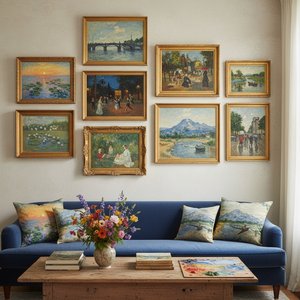
油彩絵具.

§ 1カタログデータ


§ 2抽象
作品解説
Experience Claude Monet's 'La Corniche Sun'! This stunning oil painting captures a serene mountain landscape with vibrant colors and light, reflecting the Impressionist master’s unique style.
 詳細を表示
詳細を表示
アーティストの略歴
印象派の巨匠クロード・モネの世界を探索しましょう。「睡蓮」や「積みわら」といった象徴的な風景画を通じて、移ろいゆく光と色彩を見事に捉えた彼の作品は、今なお人々を魅了し続けています。
§ 3解説
La Corniche Sun: A Glimpse of Monet’s Impressionistic Paradise
Claude Monet's La Corniche Sun isn’t merely a depiction of a landscape; it’s an immersion into the very essence of light and perception, a cornerstone of the Impressionist movement. This captivating oil painting reproduction, available on AllPaintingsStore.com, offers a profound window into Monet’s revolutionary approach to capturing the fleeting beauty of nature – a philosophy that fundamentally altered the course of art history. The scene unfolds in a sun-drenched valley nestled amongst rolling hills, a tranquil tableau punctuated by the gentle presence of two figures strolling along a dirt road, seemingly lost in the serenity of their surroundings. It’s a moment frozen in time, imbued with an atmosphere of peaceful contemplation and bathed in the golden hues of a late afternoon sun.
Monet's genius lay not just in his ability to render visual reality but in translating his *experience* of it onto canvas. He sought to capture the ‘impression’ of a scene – the way light dances, colors shift, and shadows play – rather than meticulously recreating every detail. This is vividly demonstrated here through Monet’s signature technique: short, broken brushstrokes applied with rapid succession. These strokes aren't meant to define forms precisely; instead, they create an overall sense of luminosity and movement, mimicking the way our eyes perceive light and color in a natural setting. Notice how he uses pure, unmixed colors placed side-by-side, allowing the viewer’s eye to blend them optically – a key element of Impressionism that creates a vibrant, shimmering effect.
The Artist and His Philosophy
Born Oscar-Claude Monet in 1840, Claude Monet was a pivotal figure in the development of Impressionist painting. His artistic journey began with a deep connection to nature, fostered by his mentor Eugène Boudin, who instilled in him the vital principle of “plein air” – painting outdoors directly from observation. This commitment to capturing immediate sensations profoundly influenced Monet’s work, driving him to reject the academic traditions of the time and embrace a more subjective, expressive approach. As documented on AllPaintingsStore.com, Monet's philosophy wasn’t simply about replicating what he saw; it was about conveying how he *felt* when he looked at the world – his emotions, his memories, his fleeting impressions.
Monet’s work resonated deeply with the intellectual and artistic currents of the late 19th century. He challenged established conventions by prioritizing personal perception over objective representation, paving the way for modern art movements that followed. His dedication to capturing the ephemeral qualities of light and color profoundly impacted artists like Renoir, Degas, and Pissarro, establishing Impressionism as a dominant force in the art world.
A Glimpse into Monet’s World
The painting's setting – a mountainous valley near Monaco – provides context for understanding Monet’s artistic choices. He frequently depicted landscapes he found inspiring, often returning to the same locations repeatedly to study their changing moods and atmospheric conditions. This dedication to observation is evident in his “Series” paintings, such as those of Rouen Cathedral, where he captured the same subject under vastly different lighting conditions throughout the year. La Corniche Sun, with its warm light and sense of tranquility, reflects Monet’s desire to capture a moment of idyllic beauty – a fleeting glimpse of harmony between humanity and nature.
Beyond its aesthetic qualities, the painting holds symbolic resonance. The two figures on the path suggest a connection to the natural world, inviting viewers to share in their peaceful contemplation. The sun itself acts as a unifying element, bathing the landscape in a radiant glow and symbolizing life, energy, and renewal. Interestingly, this scene was painted during a period of personal reflection for Monet, following the loss of his beloved wife Camille, suggesting an underlying theme of remembrance and solace.
Bringing Impressionism Home
AllPaintingsStore.com offers a remarkable opportunity to own a high-quality reproduction of La Corniche Sun, allowing you to bring this masterpiece into your home or office. These hand-painted reproductions faithfully capture the nuances of Monet’s brushwork and color palette, providing an authentic representation of his artistic vision. Considered alongside works like “Peupliers au bord de l'Epte Sun” and “Hôtel de Roches Noires, Trouville,” this painting exemplifies Monet’s enduring legacy as a master of light, color, and the evocative power of nature. For those interested in exploring Monet’s life and work further, the California Palace of the Legion of Honor provides an extensive collection of European art, including many examples of his celebrated oeuvre.
Q&A
クロード・モネ作「la corniche sun」の来場者の属性(統計データ)はどこで確認できますか?
クロード・モネ作「la corniche sun」に関する統計情報は、作品の閲覧統計ページでご確認いただけます。こちらでは、作品の月間訪問数、アーティストの作品への訪問数、および最近の訪問者の国別・言語別の内訳をご覧いただけます。
「la corniche sun」のプリントは、どのような用途でのご利用がおすすめですか?
クロード・モネ作「la corniche sun」の推奨される用途はアクセントカラーですが、それ以外の使い道でもお楽しみいただけます。
クロード・モネ作「la corniche sun」は、どの時代に制作されたものですか?
クロード・モネ作「la corniche sun」は19世紀時代の作品です。この時代背景が、本作の歴史的な文脈を形作っています。


 プリント版に切り替え


 いずれかの辺が105 cm(約41インチ)を超えるアートワークまたは複製画の場合、フレームは分解されたキットの状態でお届けいたします。この方法は、輸送中の破損を防ぎ、安全に配送するために採用しております。