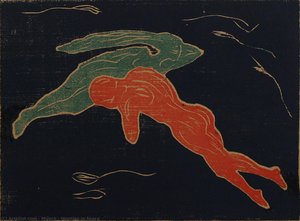
1896. Acrylic On Canvas.

§ 1カタログデータ


§ 2抽象
作品解説
 詳細を表示
§ 3解説
Hans Jaeger: A Study in Somber Reflection
Edvard Munch’s “Hans Jaeger,” painted in 1896, stands as a cornerstone of Expressionism—a movement that sought to convey raw emotion and psychological experience rather than objective representation. This portrait isn't merely a depiction of two men; it’s an embodiment of anxiety, introspection, and the pervasive melancholy characteristic of Munch’s artistic vision.
- Composition & Perspective: The artwork employs a tightly cropped composition focusing on the upper torso and head of the central figure, subtly accentuated by a second man positioned behind him. Background elements are deliberately blurred, directing the viewer's gaze inward toward the subjects themselves—a technique that reinforces the feeling of confinement and emphasizes the psychological drama unfolding before us. Munch’s flattened perspective contributes to this sense of unease, mirroring the emotional landscape of his time.
- Color Palette & Technique: Presented in monochrome – black and white – “Hans Jaeger” utilizes a masterful grayscale palette that maximizes tonal contrast. Bold hatching and cross-hatching techniques dominate the execution, layering textures onto the canvas to capture the palpable feeling of apprehension. Munch’s loose brushwork prioritizes emotional expression over meticulous realism, mirroring the spirit of Expressionism.
- Formal Elements & Symbolism: The distorted shapes—particularly the man's face—reflect Munch’s stylistic preoccupation with conveying inner turmoil. Lines are agitated and dynamic, channeling fear and uncertainty. The somber gaze of the subject speaks volumes about existential anxieties – a theme central to Munch’s broader exploration of human psychology and mirroring the societal anxieties prevalent in late 19th-century Europe.
- Historical Context: Created during Munch's formative years as an artist, “Hans Jaeger” reflects the burgeoning influence of Symbolism alongside Expressionism. The painting captures a moment of quiet contemplation amidst a backdrop of social and intellectual ferment—a testament to Munch’s ability to distill profound emotion into visual form.
- Emotional Impact: Ultimately, “Hans Jaeger” succeeds in conveying an overwhelming sense of melancholy and apprehension. It invites viewers to confront uncomfortable truths about human vulnerability and the inescapable presence of darkness within our inner lives – a legacy that continues to resonate powerfully with audiences today.
This striking reproduction captures the essence of Munch’s artistic genius, allowing you to experience the emotional depth and textural richness of this iconic masterpiece in your own home.
Q&A
「Hans Jaeger」はいつ制作されたもので、どの様式(ムーブメント)に属していますか?
「Hans Jaeger」は1896年に制作された、Expressionismの作品です。
エドヴァルド・ムンクには、他にどのような別名や通称がありますか?
エドヴァルド・ムンクは、エドバルト・ムンクという別名でも表記されます。
「Hans Jaeger」のスタイルは、作者が生きた時代とどのように関わっていますか?
エドヴァルド・ムンク作「Hans Jaeger」には、Expressionismの潮流と19世紀の時代が融合しています。




 プリント版に切り替え


 いずれかの辺が105 cm(約41インチ)を超えるアートワークまたは複製画の場合、フレームは分解されたキットの状態でお届けいたします。この方法は、輸送中の破損を防ぎ、安全に配送するために採用しております。