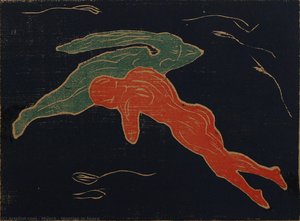
1894. Acrylic On Canvas.

§ 1Catalogue data


§ 2Abstract
コレクション詳細
 続きを読む
続きを読む
アーティストプロフィール
エドヴァルド・ムンク(1863-1944):不安や死をテーマにした表現主義の先駆者。代表作「叫び」は、現代人の心の葛藤を象徴する不朽の名画です。愛、喪失、精神的な苦悩を描いた作品を通して、20世紀美術に大きな影響を与えました。
§ 3Commentary
A Portrait of Unease: Exploring Edvard Munch’s “Separation”
Edvard Munch's "Separation," painted in 1894, transcends mere depiction; it embodies the very essence of Expressionism—a movement that sought to convey inner emotional states rather than objective reality. This monumental canvas housed within Oslo’s Munch Museum isn’t simply a visual record of two figures; it’s a visceral exploration of disconnection and unspoken longing, rendered with masterful technique and steeped in psychological depth. The painting immediately draws the eye to its central duo: a woman gazing outwards towards the sea, her posture conveying a palpable sense of detachment from the man beside her—a figure who stands close but seems unreachable.- Style & Technique: Munch’s signature style is characterized by bold brushstrokes and vibrant colors applied in swirling patterns that mirror the turbulent emotions depicted. The use of tempera on canvas contributes to a textured surface, emphasizing the artist's intention to capture not just what he saw but how he *felt*.
- Historical Context: Created during Munch’s formative years, “Separation” reflects the anxieties prevalent in European intellectual circles at the time—specifically, concerns about psychological instability and the impact of trauma on human experience. It aligns perfectly with the broader Expressionist preoccupation with portraying subjective emotion as opposed to objective observation.
- Symbolism & Composition: The woman’s averted gaze is laden with symbolism; she represents vulnerability and introspection, while her gaze directs our attention away from the man's presence. The sea itself serves as a powerful metaphor for isolation and uncertainty—a vast expanse mirroring the emotional distance between the subjects. Notably, the inclusion of a clock in the upper left corner underscores the relentless passage of time and the inevitability of loss.
- Emotional Impact: “Separation” achieves its profound effect through Munch’s masterful manipulation of color and form. The dominant hues—deep blues and reds—evoke feelings of melancholy and passion, respectively, creating a dramatic interplay that captures the core tension of the scene. It's a painting that lingers in the mind long after viewing, prompting contemplation on themes of intimacy, sorrow, and the complexities of human relationships.
* Google Arts & Culture: https://artsandculture.google.com/asset/-AFoDHxU1msdjw
* WikiArt: https://www.wikiart.org/en/edvard-munch/separation-1894
よくあるご質問
ムンク作「Separation munch museum」の手描き複製画を販売しているのはどこですか?
ムンク作「Separation munch museum」の手描き複製画は、当サイトの手描き油彩複製画ページよりリネンキャンバスに手描きされた油彩複製画にてご購入いただけます。
ムンク作「Separation munch museum」は、どの芸術運動、およびどの時代に位置づけられますか?
「Separation munch museum」はExpressionist Paintingの様式に属しており、その作者は19世紀の時代に活動していました。
ムンク作「Separation munch museum」は、どのような感情を伝えていますか?
ムンク作「Separation munch museum」は、全体的なDramaticなムードの中に、Melancholicな感情を伝えています。


 プリント版に切り替え


 いずれかの辺が105 cm(約41インチ)を超えるアートワークまたは複製画の場合、フレームは分解されたキットの状態でお届けいたします。この方法は、輸送中の破損を防ぎ、安全に配送するために採用しております。