

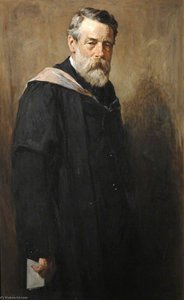
1891. , 180.0 x 90.0 cm.

§ 1カタログデータ

- 180.0 x 90.0 cm

§ 2抽象
アーティストの略歴
Discover Edwin Arthur Ward's portraits of British figures – nobility, military & civic leaders (1859-1933). Explore his detailed realism and historical commissions.
1891. , 180.0 x 90.0 cm.
Discover Edwin Arthur Ward's portraits of British figures – nobility, military & civic leaders (1859-1933). Explore his detailed realism and historical commissions.

1859 - 1933
In the golden twilight of the Victorian and Edwardian eras, a period defined by rigid social hierarchies and an unwavering respect for institutional dignity, few artists captured the essence of British prestige as masterfully as Edwin Arthur Ward. Born in 1859 in the quiet town of Basford, Nottinghamshire, Ward’s journey from the Midlands to the heart of London’s vibrant art scene is a testament to a life dedicated to the pursuit of technical perfection and the subtle nuances of human character. His early years were steeped in the influence of his father, a man involved in the decorative arts, which planted the seeds of a lifelong fascination with design, texture, and the meticulous rendering of form.
Upon arriving in London at the age of nineteen, Ward sought to refine his burgeoning talents within the prestigious halls of the Slade School of Fine Art. It was here that he encountered the legendary Frederic Leighton, a pivotal moment that would forever shape his artistic philosophy. Under Leighton’s tutelage, Ward embraced the classical ideals of anatomical precision and compositional balance, learning that a truly great portrait does more than merely replicate a face; it must evoke the very soul and social standing of the sitter. This rigorous training in drawing and etching provided him with the foundational tools to navigate the competitive London art world, eventually leading to his election as a member of the Royal Society of Portrait Painters in 1891.
Ward’s career was defined by a remarkable period of consistent excellence, particularly between 1884 and 1903, when his works became staples of the Royal Academy exhibitions. He possessed a rare ability to navigate the complexities of society portraiture, moving seamlessly between the depiction of high-ranking military officers, members of the aristocracy, and influential civic leaders. His style was never one of flashy bravado; instead, he favored a sophisticated, muted tonal palette that allowed the subject's inherent gravitas to take center stage. Through a profound understanding of drapery and light, Ward could render the heavy velvet of a formal robe or the crisp linen of a uniform with such tactile realism that the viewer could almost feel the weight of the fabric.
The brilliance of his technique lay in his ability to balance physical accuracy with psychological depth. While his hands were skilled in the meticulous rendering of anatomy, his eyes were attuned to the subtle shifts in expression that reveal a subject's inner life. Whether he was capturing the solemnity of The Reverend Canon E. N. Gowing or the youthful energy of a young Winston Churchill, Ward’s brushwork served to elevate his subjects, imbuing them with a sense of timelessness and historical importance. His work did not merely document a person; it constructed a legacy.
The true measure of an artist often lies in the permanence of their impact on the cultural landscape. Ward’s reputation was cemented through prestigious commissions that saw his portraits gracing the halls of town halls, museums, and private estates across Britain. His depictions of figures such as Thomas Bescoby for Retford Town Hall stand as enduring monuments to a bygone era of British civic pride. Even as the world moved toward the more fragmented styles of modernism, Ward remained a steadfast guardian of the classical tradition, ensuring that the dignity of his subjects was preserved through the medium of oil on canvas.
Though he passed away in 1933 in Dorset, leaving behind a legacy that includes notable works held within the Nottingham Castle Museum, Ward’s influence continues to resonate. He remains a vital figure for historians and art enthusiasts alike, representing a bridge between the meticulous craftsmanship of the nineteenth century and the evolving portraiture of the twentieth. His life's work serves as a window into the social fabric of his time, offering a gaze into the faces of those who shaped the British identity during one of its most transformative epochs.

AllPaintingsStore.com, “Edwin Arthur Ward, Thomas Bescoby, Mayor (1890) (1891)”, https://allpaintingsstore.com/ja/art/edwin-arthur-ward-thomas-bescoby-mayor-1890-AS7SKK-en/ (参照日 9 10月 2026).
当社のアーティストが、ご希望のサイズと額縁に合わせてキャンバスに手描きで制作する、オーダーメイドの油彩画です。 ( プリント版に切り替え デジタル画像販売へ切り替え)
注文書余白に詳細が記載されており、現在の内容は以下の通りです。
Thomas Bescoby, Mayor (1890)
複製画サイズ一覧
より細部までこだわった表現、洗練された技術、そして十分な制作時間
-
いずれかの辺が105 cm(約41インチ)を超えるアートワークまたは複製画の場合、フレームは分解されたキットの状態でお届けいたします。この方法は、輸送中の破損を防ぎ、安全に配送するために採用しております。
組み立てには専門知識が必要です(DIY用製品ではありません)。
本キットは、経験豊富なプロの額装師が、木工用ボンド(別売)、キャンバス用プライヤー、およびボンドの乾燥時に桟を直角に保持するためのクランプを使用して、組み立ておよびキャンバスの張り作業を行う必要があります。不適切な組み立てやキャンバスの張りの不均一は、作品に永久的な損傷を与える恐れがあり、弊社の保証対象外となります。
すべての無垢材のパーツが含まれており、組み立てに最適なサイズに正確にカットされています。
付属のネジを使用し、角の接合部には別途木工用ボンドをご用意ください(ボンドは付属しておりません)。ボンドは額装業者様にてご手配をお願いいたします。
プロ仕様の道具が必要ですが、キットには含まれていません:キャンバス用ストレッチングプライヤー(テンショナー)、および接着剤が乾燥するまで木枠を直角に固定するためのクランプ。
重要:
コーナーの接合部には木工用ボンドが必要です。また、ボンドが完全に乾くまでクランプでバーを固定しておく必要があり、組み立てたフレームにキャンバスを張るにはキャンバス用ストレッチングプライヤーが必要となります。これらの道具はキットに含まれておりません。このサイズをご注文される前に、経験豊富なプロの額装師(フライマー)の手配をお願いいたします。
-
光沢ワニス(色彩を鮮やかに引き立て、光や湿気から保護します)
カスタマイズの例:顔をお客様の写真に差し替える、ペットを追加する(例:猫を犬に変更)、背景に隠しメッセージを入れる、背景の風景や要素を変更する。
世界中への配送()は、通常の5週間ではなく、3〜4週間でお届けいたします。(6 11月)。品質には一切の妥協を許しません。
世界中への配送()は、5週間ほどでお届けします。(13 11月)。
すべての注文に同梱
 詳細を表示
詳細を表示




 いずれかの辺が105 cm(約41インチ)を超えるアートワークまたは複製画の場合、フレームは分解されたキットの状態でお届けいたします。この方法は、輸送中の破損を防ぎ、安全に配送するために採用しております。


