

Painting.

§ 1Catalogue data


§ 2Abstract
コレクション詳細
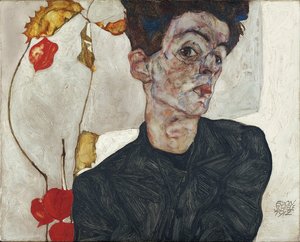
A haunting black and white exploration of human connection and existential dread, this Expressionist masterpiece by Egon Schiele captures raw vulnerability and invites you to experience his profound artistic vision.
 続きを読む
続きを読む
アーティストプロフィール
エゴン・シーレ(1890-1918):大胆な肖像画、心理的テーマ、そして独特の線が生み出す、感情に訴えかける表現主義の世界。死と生、人間の内面を深く掘り下げた傑作たちを発見してください!
§ 3Commentary
A Haunting Encounter with Expressionist Rawness
To stand before Egon Schiele’s untitled (6645) is to enter a realm where the boundaries between the physical body and the psychological soul dissolve into a singular, breathless moment. This striking black and white composition serves as a profound testament to the anxieties of the early 20th century, capturing a scene that feels less like a captured moment and more like an unearthed memory. At its heart, the painting presents two figures seated upon the earth, locked in an embrace that is simultaneously intimate and fraught with an unspoken tension. Schiele, a master of the Austrian Expressionist movement, eschews the comfort of traditional beauty to instead offer a visual distillation of existential dread and human vulnerability.
The composition is masterfully orchestrated to direct the viewer’s gaze through a landscape of stark contrasts. While the central figures command our attention with their raw, naked presence, Schiele subtly anchors the scene with a solitary chair positioned in the upper left corner. This element introduces a sense of domesticity that feels strangely displaced, heightening the feeling of isolation within a minimal, almost void-like environment. The presence of other figures, partially obscured or receding into the background, adds layers of complexity to the narrative, suggesting a world that is watching, yet remains fundamentally disconnected from the central intimacy.
The Language of Line and Distorted Form
Schiele’s technique is nothing short of revolutionary, characterized by an expressive line that seems to vibrate with nervous energy. Eschewing the soft, blended transitions of his contemporaries, he utilizes bold, jagged contours to define the anatomy of his subjects. The bodies are often rendered with a deliberate distortion—elongated limbs and exaggerated musculature that amplify the emotional weight of the piece. This is not mere anatomical inaccuracy; it is a purposeful use of form to convey internal psychological states. The skin tones, even when interpreted through the monochrome lens, suggest a sickly pallor, hinting at the fragility of life and the pervasive presence of mortality that haunted Schoup’s personal history.
For the discerning collector or interior designer, this piece offers a sophisticated interplay of light and shadow. The absence of color forces the eye to focus on the structural integrity of the drawing and the dramatic tension created by the heavy blacks against the stark whites. This monochromatic palette lends the work a timeless, archival quality, making it an ideal centerpiece for spaces that value intellectual depth and avant-garde elegance. It is a work that does not merely decorate a wall; it commands the atmosphere of a room, inviting contemplation and deep emotional resonance.
Symbolism in an Age of Uncertainty
Created during the turbulent years surrounding 1916-1918, this work is deeply embedded in the historical zeitgeist of World War I. The pervasive sense of instability and the looming shadow of death are woven into the very fabric of the painting. Schiele’s obsession with the intersection of Eros and Thanatos—sexuality and death—finds its most potent expression here. The nakedness of the figures represents a total lack of defense, a stripping away of societal pretenses to reveal the primal truth of human existence. In an era defined by the collapse of old empires and the rise of psychoanalysis, Schiele’s work mirrors the collective psyche of a generation grappling with loss and the fragmentation of identity.
Investing in a high-quality reproduction of this masterpiece allows one to bring this profound dialogue between beauty and anguish into a modern setting. Whether placed in a curated gallery-style living room or a quiet study, untitled (6645) serves as a window into the turbulent heart of Modernism. It remains an enduring icon for those who find inspiration in the raw, unvarnished truth of the human condition and seek art that challenges, moves, and lingers in the mind long after the first encounter.
よくあるご質問
エゴン・シエレ作「untitled (6645)」のX線画像を見ることはできますか?
「untitled (6645)」は、作品のX線解析ページにて、層ごとに詳しく観察することができます。このビューアは修復家のライトベンチに着想を得ており、画像の11層にわたる光学的な読み取りを可能にしています。
学生向けのエゴン・シエレ作「untitled (6645)」に関するファクトシートはありますか?
「untitled (6645)」のガイドは、作品のガイドページです。このページは印刷可能なファクトシートとなっており、作品のキャプション、クレジット、および詳細情報(作家名、制作年、技法、原寸大、所蔵)をまとめてご確認いただけます。
エゴン・シエレ作「untitled (6645)」では、どのような配色が使われていますか?
「untitled (6645)」の色調は、Darkなパレットを構成しています。この分類は、主要な色相のグループを表しています。


 プリント版に切り替え


 いずれかの辺が105 cm(約41インチ)を超えるアートワークまたは複製画の場合、フレームは分解されたキットの状態でお届けいたします。この方法は、輸送中の破損を防ぎ、安全に配送するために採用しております。


