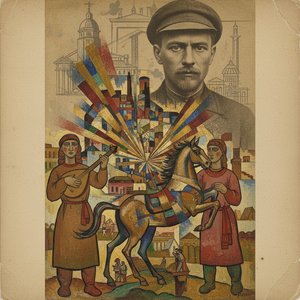
1928. Painting.

§ 1カタログデータ


§ 2抽象
作品解説
Experience the dynamic red letters of El Lissitzky's 1928 Constructivist masterpiece, Basic Calculus, a vibrant journey into Russian avant-garde art you can own.
 詳細を表示
詳細を表示
§ 3解説
The Geometry of Thought: Exploring El Lissitzky's "Basic Calculus"
To stand before El Lissitzky’s Basic Calculus is not merely to observe paint on canvas; it is to step into the very engine room of modern thought. Created in 1928, this work pulses with the intellectual fervor and revolutionary energy of the Russian avant-garde. The composition eschews traditional pictorial space for a dynamic interplay of pure form—bold, arresting red letters that seem suspended, falling, or perhaps ascending according to an unseen mathematical principle. Lissitzky, ever the visionary architect of ideas, uses these typographic elements not just as decoration, but as structural components in a visual equation, inviting the viewer into a dialogue between art and intellect.
Constructivism and the Language of Red
The style is unmistakably Constructivist, a movement that believed art must serve a practical, social function. Here, the letters—the very building blocks of language—are elevated to monumental status. The choice of vibrant red against what we can imagine as a stark background is nothing by accident; it is a declaration. Red, in this historical context, was the color of revolution, of urgent action, and of vital energy. Lissitzky masterfully manipulates scale and arrangement, creating an illusion of depth that pulls the eye across the canvas, suggesting movement through pure graphic force. It speaks to a time when art felt inseparable from societal upheaval, demanding clarity and structure.
Symbolism in Form and Letter
What does "Basic Calculus" truly represent? Beyond its literal title, the piece functions as a profound meditation on knowledge itself. The letters are abstract symbols, stripped of their narrative context to reveal their pure formal potential. They suggest systems—the underlying rules that govern physics, mathematics, or even human behavior. For the collector or designer, this translates into an object of potent symbolism: it is a conversation starter for those who appreciate intellectual rigor and modernist purity. It suggests that beauty can be found not in representation, but in relationship.
Bringing Avant-Garde Energy Home
For those looking to infuse a space with the electrifying spirit of the early 20th century, this reproduction offers an unparalleled opportunity. The bold graphic impact of Basic Calculus transcends mere decoration; it acts as an anchor point for sophisticated interior design schemes that favor clean lines and intellectual depth. Whether placed above a minimalist console or serving as a dramatic focal piece in a modern gallery setting, its inherent dynamism ensures that the artwork remains perpetually engaging. It is a wearable piece of history, allowing the viewer to connect with the revolutionary spirit of Lissitzky’s genius.
Q&A
エル・リシツキー作「Basic Calculus」は、どのような感情を伝えていますか?
「Basic Calculus」は、ModernなムードにReflectiveな感情が添えられた作品です。
エル・リシツキー作「Basic Calculus」を特徴づける技法やスタイルは何ですか?
エル・リシツキー作「Basic Calculus」は、Paintingの技法とConstructivismの様式を融合させた作品です。技法(テクニック)は制作手法を、様式(ムーブメント)はその作品のスタイルを表しています。
「Basic Calculus」(1928)は、エル・リシツキーのキャリアにおけるどの時期の作品にあたりますか?
1928年という制作年代から、「Basic Calculus」はエル・リシツキーのConstructivist Periodに属します。



 プリント版に切り替え


 いずれかの辺が105 cm(約41インチ)を超えるアートワークまたは複製画の場合、フレームは分解されたキットの状態でお届けいたします。この方法は、輸送中の破損を防ぎ、安全に配送するために採用しております。