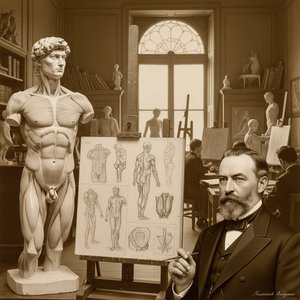
The Legacy of Precision: The Life and Art of Émile Deyrolle
In the heart of nineteenth-century Paris, where the pursuit of scientific discovery met the elegance of fine art, the name Émile Deyrolle resonated as a symbol of unparalleled natural accuracy. Born in Lille in 1838, Deyrolle was not merely an artist in the traditional sense, but a custodian of the natural world. He inherited a profound legacy, stepping into the footsteps of his grandfather, Jean-Baptiste Deyrolle, and his father, Achille, to manage a family institution that would become a global landmark for natural history. His life was defined by a seamless marriage between the rigorous demands of zoology and the delicate touch of an illustrator, creating a body of work that served as both a scientific record and a profound aesthetic tribute to the complexity of life.
The foundation of Deyrolle’s artistry was laid in the quiet, observant atmosphere of his family’s establishment. Under the tutelage of Achille, he developed an eye for the minute details that define biological existence. This education went beyond mere sketching; it involved a deep immersion into the physical reality of specimens. To capture the essence of a creature, Deyrolle understood that one had to look beneath the skin. His process was one of meticulous reconstruction, where he would study the skeletal frameworks and muscular structures of animals to ensure that every line drawn on paper or canvas possessed anatomical truth. This dedication transformed his work from simple illustration into a vital tool for the scientific community, bridging the gap between the collector's cabinet and the researcher's laboratory.
A Mastery of Anatomical Realism
Deyrolle’s artistic technique was characterized by an almost haunting level of realism. While many of his contemporaries focused on the romanticized or stylized depictions of nature, Émile sought the truth found in dissection and observation. His canvases and illustrations were celebrated for their ability to convey the internal architecture of the animal kingdom. Whether rendering the delicate bones of a marine specimen or the robust musculature of a terrestrial predator, his work possessed a clarity that was both intellectually stimulating and visually arresting. This precision allowed him to capture the élan vital—the vital force—of his subjects, making even a skeletal structure feel imbued with the memory of life.
The significance of his work extended far beyond the walls of his Parisian shop at Rue du Bac. As a dealer in natural history specimens, fossils, and taxidermy, he curated an environment where science and beauty were indistinguishable. His contributions to the field of anatomical illustration provided invaluable insights for biologists and medical professionals of the era. Notable examples of his focus on the structural wonders of nature include:
- The Dolphin Skeleton: A masterpiece of marine anatomy that showcases his ability to translate complex biological forms into a clear, educational, and artistic composition.
- Fossilized Fish Casts: Works that demonstrate his skill in capturing the ancient, petrified textures of prehistoric life, blending paleontology with fine art.
- Anatomical Reconstructions: Detailed renderings of musculature and bone that served as essential references for the scientific advancement of the late 19th century.
Historical Significance and Eternal Influence
The era of Émile Deyrolle was a golden age for natural history, a time when the collection of specimens was seen as a noble pursuit of knowledge. Through his stewardship of the Deyrolle establishment, he helped maintain Paris as a central hub for entomology, taxidermy, and mineralogy. His work stood at the intersection of several disciplines, influencing not only the scientific illustrators who followed him but also the collectors of "cabinets of curiosities" who sought to find beauty in the strange and the anatomical. Even as the methods of scientific study evolved, the standard of accuracy set by Deyrolle remained a benchmark for excellence.
Today, the legacy of Émile Deyrolle lives on through the enduring fascination with his anatomical precision. His work continues to appeal to modern collectors of natural history art and enthusiasts of marine biology, offering a window into a period when the act of looking closely at nature was an act of profound discovery. He remains a pivotal figure whose name is forever linked to the delicate balance between the scientific eye and the artist's hand, reminding us that true beauty is often found in the most intricate details of the natural world.


 続きを読む
続きを読む


 プリント版に切り替え


 いずれかの辺が105 cm(約41インチ)を超えるアートワークまたは複製画の場合、フレームは分解されたキットの状態でお届けいたします。この方法は、輸送中の破損を防ぎ、安全に配送するために採用しております。