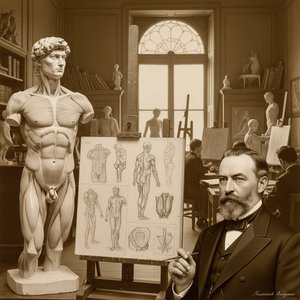
1902. Acrylic On Canvas, 42.0 x 23.0 cm. ボスニア・ヘルツェゴビナ国立美術館.

§ 1カタログデータ

- 42.0 x 23.0 cm


§ 2抽象
作品解説
Ferdinand Hodler’s ‘Figure Study’ (1901) captures a woman's grace with Symbolist lines and muted tones, reflecting his exploration of form and mortality. Discover the artist’s intimate creative process.
 詳細を表示
詳細を表示
アーティストの略歴
フンガード・ホドラーは、シンボル主義と独自の「パラレルリズム」スタイルで知られるスイスの画家です。彼の傑作『セルフ ポートレイト』や壮大な歴史画『ベルテ・ホドラー』など、印象的な風景描写と人間の内面を表現した作品が特徴です。彼は美術界に大きな影響を与え、特に表現主義への道を拓きました。彼の芸術は、社会の変化や科学の進歩といった複雑な問題に取り組むための視覚言語を提供し、時代遅れを感じさせる人々にも感動と洞察を与えました。
§ 3解説
Ferdinand Hodler’s ‘Figure Study’: A Window into Symbolist Soul
Ferdinand Hodler's “Figure Study,” created in 1901, isn’t merely a portrait; it’s an invitation to delve into the heart of Symbolism – a movement that sought to express inner emotions and spiritual truths rather than simply depicting external reality. This particular work, housed within the Musée Jenisch in Vevey, Switzerland, offers a remarkably intimate glimpse into Hodler's artistic process and his profound engagement with the human condition. The drawing itself is deceptively simple: a woman stands before a muted wall, her hands gently folded at her chest, conveying an aura of quiet contemplation. Yet, within this apparent stillness lies a wealth of symbolic resonance.
Hodler’s style during this period—often referred to as “parallelism”—is characterized by elongated figures, flowing lines, and a deliberate blurring of form. He eschewed sharp outlines in favor of soft transitions and overlapping planes, creating an effect that is both dreamlike and profoundly evocative. The muted palette – predominantly browns, grays, and subtle blues – further contributes to the work’s melancholic yet serene atmosphere. Notice how the light seems to emanate from within the figure itself, rather than being reflected off a surface; this technique was central to Hodler's approach, aiming to capture not just appearance but also the essence of his subjects.
The Language of Symbolism and its Roots
To understand “Figure Study,” it’s crucial to appreciate the context of Symbolism. Emerging in France and Germany during the late 19th century, this movement reacted against the materialism and scientific rationalism of the preceding era. Artists like Hodler sought to tap into a deeper realm of experience—the subconscious, dreams, myths, and spirituality—using evocative imagery and ambiguous forms to convey complex emotions and ideas. Hodler’s personal life, marked by early loss and a deep sensitivity to mortality, undoubtedly informed his artistic vision. The recurring motif of death and the ephemeral nature of existence is palpable throughout his oeuvre.
Influences on Hodler's style can be traced back to Japanese woodblock prints (Ukiyo-e), which he admired for their flattened perspective, decorative patterns, and emphasis on mood and atmosphere. He also drew inspiration from the works of Gustave Moreau, a key figure in the Symbolist movement, whose paintings often featured mythological subjects rendered with opulent detail and symbolic richness. Hodler’s work represents a synthesis of these diverse influences, resulting in a uniquely personal and expressive style.
Decoding the Figure: Gesture, Emotion, and Intention
The woman depicted is not presented as a static subject; rather, she embodies a state of being—a moment of quiet reflection. Her posture, with hands gently folded at her chest, suggests both vulnerability and inner strength. The slight tilt of her head and the subtle curve of her lips hint at an unspoken emotion – perhaps sadness, longing, or simply a deep awareness of herself. Hodler’s masterful use of gesture—the way the lines flow across the paper to capture the movement of the body—is particularly noteworthy.
It's important to note that Hodler frequently employed himself as a model, and this particular study likely served as a preliminary sketch for a larger composition, possibly “The Emotion.” The unfinished quality of the drawing – the visible pencil strokes and the lack of meticulous detail – emphasizes the artist’s process and his focus on capturing the essence of the subject rather than creating a photographic likeness. The work invites us to contemplate not just what we see but also what lies beneath the surface, mirroring the core tenets of Symbolist art.
Bringing Hodler's Vision Home: Reproductions and Artistic Legacy
Reproductions of “Figure Study” offer a remarkable opportunity to experience the beauty and emotional depth of this iconic work. AllPaintingsStore provides meticulously crafted hand-painted reproductions that faithfully capture Hodler’s distinctive style and evocative atmosphere. Whether adorning your living room, bedroom, or study, this artwork will serve as a constant reminder of the power of art to transcend time and connect us with the deepest aspects of human experience.
Beyond its aesthetic appeal, “Figure Study” stands as a testament to Hodler’s artistic genius—a profound exploration of emotion, symbolism, and the enduring mysteries of the human soul. It's a piece that rewards repeated viewing, revealing new layers of meaning with each encounter.
Q&A
フェルディナン・ホドラー作「Figure study」の制作年はいつですか?
フェルディナン・ホドラー作「Figure study」は1902年に制作されました。
Symbolismにおいて、「Figure study」はどの程度人気がありますか?
フェルディナン・ホドラー作「Figure study」は、Recognizedに分類され、Symbolismの様式に属しています。
フェルディナン・ホドラー作「Figure study」は、強いコントラストを用いた構成でしょうか、それとも柔らかな調和を重んじた構成でしょうか?
フェルディナン・ホドラー作「Figure study」 の色彩分析は、Serene なコントラストと Unified Palette な調和を捉えています。


 プリント版に切り替え


 いずれかの辺が105 cm(約41インチ)を超えるアートワークまたは複製画の場合、フレームは分解されたキットの状態でお届けいたします。この方法は、輸送中の破損を防ぎ、安全に配送するために採用しております。