

1908. .

§ 1カタログデータ

§ 2抽象
アーティストの略歴
A German illustrator known for his elegant book plates. Discover the timeless beauty of Paul Thumann's art today.
1908. .
A German illustrator known for his elegant book plates. Discover the timeless beauty of Paul Thumann's art today.

1834 - 1908, Germany
Born on 5 October 1834 in Groß Schacksdorf-Simmersdorf, Paul Thumann was raised in the household of a teacher. His early inclinations did not immediately point toward the canvas. He initially sought a path in the technical sciences, enrolling at the engineering school in Glogau to pursue a career in that field. This practical direction, however, proved to be a temporary detour in a life that would eventually be defined by the visual arts.
The pull toward art eventually superseded his scientific interests. Between 1854 and 1856, Thumann sought formal instruction at the Prussian Academy of Arts in Berlin. This period of study provided the foundational discipline required for his future work as a painter and illustrator. He moved from the structured world of engineering toward the more fluid demands of graphic art and portraiture, setting the stage for a career that would span many decades and various mediums.
After honing his skills in the studios of Julius Hübner in Dresden, Thumann moved toward the academic rigor of the Weimar Saxon-Grand Ducal Art School. Under the guidance of Ferdinand Pauwels, his technical proficiency deepened, leading to his appointment as a professor in 1866. His career, however, was not confined to the quietude of the classroom. During the Franco-Prussian War, he stepped away from his academic duties to serve as a draftsman at the Prussian Third Army's headquarters, applying his precision to the demands of military documentation.
His reputation within the German academic circuit grew steadily. In 1875, he reached a significant professional milestone when he was appointed Professor at the Academy of Arts in Berlin. He held this prestigious position for over a decade, until 1887, shaping the next generation of artists through his instruction. His tenure in Berlin solidified his standing as a central figure in the institutional art world of the era.
Thumann’s life was marked by a restless movement across the European continent. His interests frequently drew him away from the academic circles of Berlin and Weimar toward the varied landscapes of Hungary and Transylvania. These excursions were often paired with more structured art-related tours through Italy and France, where he sought to refine his visual understanding. He also spent a period of time studying in England, a move that expanded his perspective beyond the Prussian tradition.
The pull of the Mediterranean proved particularly strong in his later years. Between 1887 and 1891, he made Italy his home, living there for several years. This period of residence allowed for a deeper immersion in the light and classical forms of the region. His reputation eventually crossed the Atlantic, reaching an audience far beyond the European sphere. In 1893, he exhibited his work Psyche at Nature's Mirror at the World's Columbian Exposition in Chicago. The piece caught the attention of the management of the White Rock Mineral Water, who subsequently purchased the reproduction rights to use the image as part of their logo.
Thumann’s output was defined by a versatility that bridged the gap between fine art and commercial illustration. He was a prolific illustrator, crafting plates for the literary works of Goethe, Tennyson, Chamisso, and Heine. His ability to translate text into visual form made him a frequent collaborator for publishers seeking elegance in their editions. This skill extended to his depictions of social and domestic life, seen in his various iterations of Die Gartenlaube produced in 1877, 1878, 1880, and 1882.
His reach extended beyond the printed page and into the realm of decorative arts. He produced several porcelain plaques, including a notable depiction of The Three Fates. In the realm of oil painting, his hand was seen in works such as The young suitor, which he signed and dated in 1871. His compositions often possessed a certain grace that appealed to both private collectors and commercial interests.
One of his most unexpected successes occurred through the medium of branding. His work Psyche at Nature's Mirror gained significant attention at the World's Columbian Exposition in Chicago in 1893. The image was so striking that the management of White Rock Mineral Water purchased the reproduction rights, adopting the work as a central element of their logo.
The final decade of Thumann's career was marked by a transition into significant institutional responsibilities. In 1892, he assumed the leadership of the Master Studio of Professor Julius Schrader, a position that solidified his influence within the academic circles of Berlin. His personal life during these years reflected a connection to the upper echelons of European society; he was married to a woman of the English nobility. This social standing was further extended through his family, as one of his daughters married the brother of the poet Algernon Swinburne.
As his career progressed, the elegance of his illustrative style began to face criticism for becoming increasingly facile. Despite this shift in critical reception, his presence in the German art scene remained steady until his passing. He died in Berlin on 19 February 1908.

AllPaintingsStore.com, “Paul Thumann, In the Bath (1908)”, https://allpaintingsstore.com/ja/art/in-the-bath-by-paul-thumann/ArtistReproduction/ (参照日 23 10月 2026).
当社のアーティストが、ご希望のサイズと額縁に合わせてキャンバスに手描きで制作する、オーダーメイドの油彩画です。 ( プリント版に切り替え デジタル画像販売へ切り替え)
注文書余白に詳細が記載されており、現在の内容は以下の通りです。
In the Bath
複製画サイズ一覧
より細部までこだわった表現、洗練された技術、そして十分な制作時間
-
いずれかの辺が105 cm(約41インチ)を超えるアートワークまたは複製画の場合、フレームは分解されたキットの状態でお届けいたします。この方法は、輸送中の破損を防ぎ、安全に配送するために採用しております。
組み立てには専門知識が必要です(DIY用製品ではありません)。
本キットは、経験豊富なプロの額装師が、木工用ボンド(別売)、キャンバス用プライヤー、およびボンドの乾燥時に桟を直角に保持するためのクランプを使用して、組み立ておよびキャンバスの張り作業を行う必要があります。不適切な組み立てやキャンバスの張りの不均一は、作品に永久的な損傷を与える恐れがあり、弊社の保証対象外となります。
すべての無垢材のパーツが含まれており、組み立てに最適なサイズに正確にカットされています。
付属のネジを使用し、角の接合部には別途木工用ボンドをご用意ください(ボンドは付属しておりません)。ボンドは額装業者様にてご手配をお願いいたします。
プロ仕様の道具が必要ですが、キットには含まれていません:キャンバス用ストレッチングプライヤー(テンショナー)、および接着剤が乾燥するまで木枠を直角に固定するためのクランプ。
重要:
コーナーの接合部には木工用ボンドが必要です。また、ボンドが完全に乾くまでクランプでバーを固定しておく必要があり、組み立てたフレームにキャンバスを張るにはキャンバス用ストレッチングプライヤーが必要となります。これらの道具はキットに含まれておりません。このサイズをご注文される前に、経験豊富なプロの額装師(フライマー)の手配をお願いいたします。
-
光沢ワニス(色彩を鮮やかに引き立て、光や湿気から保護します)
カスタマイズの例:顔をお客様の写真に差し替える、ペットを追加する(例:猫を犬に変更)、背景に隠しメッセージを入れる、背景の風景や要素を変更する。
世界中への配送()は、通常の5週間ではなく、3〜4週間でお届けいたします。(20 11月)。品質には一切の妥協を許しません。
世界中への配送()は、5週間ほどでお届けします。(27 11月)。
すべての注文に同梱

Elevate your bathroom with icons from Van Eyck to Warhol. Find curated museum-quality art on AllPaintingsStore.com. Explore the full collection online.
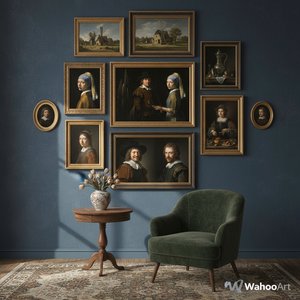
Journey through the Golden Age with our guide to the Top 10 Dutch Baroque masterpieces! Explore iconic paintings by Rembrandt, Vermeer & Frans Hals. Find museum-quality art reproductions and elevate your home decor at AllPaintingsStore.com.

Transform your bathroom with icons from Warhol to Renoir. Explore museum-quality masterpieces on AllPaintingsStore.com.

Explore a curated journey through iconic bathing scenes from myth to Impressionism. Discover the history of art's most sacred waters now.
 詳細を表示


 いずれかの辺が105 cm(約41インチ)を超えるアートワークまたは複製画の場合、フレームは分解されたキットの状態でお届けいたします。この方法は、輸送中の破損を防ぎ、安全に配送するために採用しております。


