

1912. .

§ 1Catalogue data

§ 2Abstract
アーティストプロフィール
Explore the serene landscapes & portraits of Johan Krouthén, a Swedish artist who broke from tradition to capture realism & idealism in his paintings.
1912. .
Explore the serene landscapes & portraits of Johan Krouthén, a Swedish artist who broke from tradition to capture realism & idealism in his paintings.
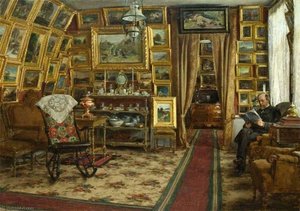
1858 - 1932
In the annals of Swedish art history, few names evoke the delicate balance between meticulous realism and poetic idealism quite like Johan Krouthén. Born on November 2, 1858, in Linköping, Krouthén emerged from a lineage deeply rooted in the tactile world of craftsmanship; his family, the Krouthéns of Norrköping, had practiced the intricate trade of pewter smithing for generations. This ancestral connection to fine detail and material precision likely laid the groundwork for an artistic eye that could find profound beauty in the smallest textures of the natural world. His journey began not in a grand studio, but through a formative apprenticeship under Svante Leonard Rydholm, where he honed the dual disciplines of painting and photography—a combination that would later grant his canvases a unique sense of light and structural truth.
Krouthén’s artistic evolution was marked by a courageous departure from the rigid, often stifling formalism of the Swedish Academy. While his early education at the Royal Swedish Academy of Arts provided him with essential technical foundations, it was the influence of mentors like Edvard Perseus that encouraged him to look beyond established academic doctrines. Krouthén sought a more visceral connection to the environment, a pursuit that led him on a transformative journey through the art capitals of Europe. A brief but impactful sojourn in Paris expanded his aesthetic horizons, exposing him to the shifting currents of modernism, while his time in Denmark allowed him to find kinship with the legendary Skagen Painters. These encounters with artists such as Oscar Björck and Anders Zorn helped refine a style that was both deeply Swedish in its subject matter and cosmopolitan in its technical execution.
Upon returning to Sweden, Krouthén turned his gaze toward the lush landscapes of Scania and Bohuslän, finding endless inspiration in the interplay of light and seasonal change. His work became a celebrated tapestry of rural life, where gardens, meadows, and portraits of local people were rendered with an uncompromising honesty. He possessed a rare ability to capture the soul of a place—not merely its topography, but its atmosphere. In his evocative oil landscapes, such as the 1912 depiction of 'Heather clad cliffs with sheep,' one can feel the rugged, windswept majesty of the Scottish moorlands, brought to life through masterful atmospheric depth and meticulous detail.
His technical prowess extended into the portrayal of movement and nostalgia. In works like 'Horsedrawn Carriage' (1918), Krouthén transports the viewer to a vanishing era, using textural realism to evoke the crispness of autumnal air and the rhythmic pace of country life. Even when tackling more complex or historical themes, his touch remained masterful. His 1921 painting 'Malmen' stands as a testament to his versatility, portraying cavalry maneuvers with a muted color palette that lends a sense of historical gravity and emotional resonance to the scene. Whether capturing the tranquil stillness of a garden or the dynamic energy of a rural landscape, Krouthén’s brushwork remained anchored in a profound respect for the natural world.
The significance of Johan Krouthén lies far beyond his individual masterpieces; he was a catalyst for a new aesthetic sensibility within the Nordic art landscape. By rejecting the strict constraints of academic tradition in favor of a more emotive, observational approach, he helped pave the way for a modern Swedish identity in painting. His ability to fuse the precision of realism with the dreamlike qualities of idealism allowed him to create works that felt both grounded in reality and elevated by spirit.
Today, Krouthén’s legacy is preserved in esteemed institutions such as the Östergötlands Länsmuseum, where his serene landscapes and intimate portraits continue to captivate audiences. His contribution to art remains a vital chapter in the story of Swedish Romanticism, reminding us that true artistic progress often requires the courage to look away from the academy and toward the enduring beauty of the earth itself.

AllPaintingsStore.com, “Johan Krouthén, Jack Roussel (1912)”, https://allpaintingsstore.com/ja/art/johan-krouthen-jack-roussel-AQR9P4-en/ArtistReproduction/ (accessed 1 10月 2026).
当社のアーティストが、お客様のご希望のサイズと額縁に合わせて、キャンバスに手描きで制作する油彩画です。 ( プリント版に切り替え デジタル画像販売へ切り替え)
It is specified on the order sheet in the margin; the present state of that sheet reads as follows.
Jack Roussel
複製画サイズ一覧
より細部までこだわった表現、洗練された技術、そして十分な制作時間
-
いずれかの辺が105 cm(約41インチ)を超えるアートワークまたは複製画の場合、フレームは分解されたキットの状態でお届けいたします。この方法は、輸送中の破損を防ぎ、安全に配送するために採用しております。
組み立てには専門知識が必要です(DIY用製品ではありません)。
本キットは、経験豊富なプロの額装師が、木工用ボンド(別売)、キャンバス用プライヤー、およびボンドの乾燥時に桟を直角に保持するためのクランプを使用して、組み立ておよびキャンバスの張り作業を行う必要があります。不適切な組み立てやキャンバスの張りの不均一は、作品に永久的な損傷を与える恐れがあり、弊社の保証対象外となります。
すべての無垢材のパーツが含まれており、組み立てに最適なサイズに正確にカットされています。
付属のネジを使用し、角の接合部には別途木工用ボンドをご用意ください(ボンドは付属しておりません)。ボンドは額装業者様にてご手配をお願いいたします。
プロ仕様の道具が必要ですが、キットには含まれていません:キャンバス用ストレッチングプライヤー(テンショナー)、および接着剤が乾燥するまで木枠を直角に固定するためのクランプ。
重要:
コーナーの接合部には木工用ボンドが必要です。また、ボンドが完全に乾くまでクランプでバーを固定しておく必要があり、組み立てたフレームにキャンバスを張るにはキャンバス用ストレッチングプライヤーが必要となります。これらの道具はキットに含まれておりません。このサイズをご注文される前に、経験豊富なプロの額装師(フライマー)の手配をお願いいたします。
-
光沢ワニス(色彩を鮮やかに引き立て、光や湿気から保護します)
カスタマイズの例:顔をお客様の写真に差し替える、ペットを追加する(例:猫を犬に変更)、背景に隠しメッセージを入れる、背景の風景や要素を変更する。
世界中への配送()は、通常の5週間ではなく、3〜4週間でお届けいたします。(29 10月)。品質には一切の妥協を許しません。
世界中への配送()は、5週間ほどでお届けします。(5 11月)。
Included with every order


 続きを読む
続きを読む


 いずれかの辺が105 cm(約41インチ)を超えるアートワークまたは複製画の場合、フレームは分解されたキットの状態でお届けいたします。この方法は、輸送中の破損を防ぎ、安全に配送するために採用しております。


