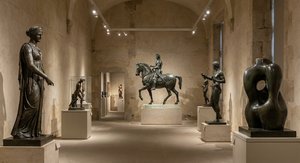
Assemblage. オスカー・ニエミエーゲル美術館.

§ 1Catalogue data


著作権保護について
このページに掲載されている作品は著作権法によって保護されており、当社の許可なく同一の複製物を制作または販売することは法律で禁じられています。この保護は、以下のような国際条約に基づき執行されます。 ベルヌ条約 および、以下の条項に定められたものを含む各国の法律により、 米国著作権法 第17編。
敬意を払った法的な代替手段として、私たちはオリジナルにインスピレーションを与えられた、カスタムの手描きアートワークを提供しています。私たちの熟練したプロのアーティストは、元の作品が持つスタイル、情緒、そして芸術的なエッセンスを注意深く研究し、独自の創作物でありながら、同じ感性を呼び起こすような、新しくユニークな作品を作り上げます。
この手法は、著作権で保護された作品の複製や複写を伴わないため、著作権法に完全に準拠しています。これは単なる模倣ではなく、創造的な再解釈です。元の作品からインスピレーションを受けつつも、それとは異なる、全く新しい絵画を生み出すものです。
 詳細を見る
詳細を見る§ 2Abstract
コレクション詳細
Explore Man Ray's 'Non-Euclidean Object,' a striking silver sculpture blending geometry and surrealism – a unique piece from the Dada/Surrealist era.
§ 3Commentary
The Geometry of Dreams: Man Ray’s “Non-Euclidian Object”
Man Ray's "Non-Euclidian Object," crafted in 1932 and meticulously realized in 1973, isn’t merely a sculpture; it’s an invitation to contemplate the very nature of perception and reality. Born Emmanuel Radnitzky, Man Ray—a name he adopted with deliberate artistry—was a pivotal figure in the Dada and Surrealist movements, a restless innovator who consistently challenged conventional artistic boundaries. This particular piece embodies his fascination with geometric abstraction, combined with a subtle, almost unsettling, sense of spatial distortion. It’s a work that rewards prolonged observation, revealing layers of meaning within its deceptively simple form.
The sculpture itself is constructed from a striking array of materials: polished silver, sturdy steel tubing, and flexible rubber, all anchored to a subtly textured wooden base. The central element—a polyhedron with a precisely drilled hole—appears to defy the laws of Euclidean geometry, hinting at alternate dimensions and suggesting that our familiar understanding of space may be fundamentally flawed. This deliberate disruption of established rules aligns perfectly with the core tenets of Surrealism, which sought to unlock the subconscious through unexpected juxtapositions and illogical arrangements. Ray’s choice of materials – the cold gleam of silver representing precision and intellect, contrasted against the yielding softness of rubber – creates a compelling tension, mirroring the interplay between logic and intuition within the human psyche.
A Legacy Forged in Paris
Ray's artistic journey began in Philadelphia, where he honed his skills as a commercial artist before being drawn to the vibrant avant-garde scene of New York City. It was through his connections with Marcel Duchamp and the burgeoning Dada movement that Ray’s work began to shift towards abstraction and experimentation. Paris became his adopted home, and it's here, amidst the intellectual ferment of the 1920s and 30s, that he truly blossomed as a photographer and sculptor. The “Non-Euclidian Object” reflects this Parisian influence – a synthesis of American pragmatism with European artistic sophistication.
The sculpture’s creation coincided with Ray's exploration of photograms, or "rayographs," techniques he pioneered to capture ethereal images without the use of traditional cameras. This interest in manipulating light and shadow—in creating illusions of depth and form—clearly informed his approach to sculptural design. The piece can be seen as a continuation of this photographic experimentation, translating the principles of image-making into three dimensions.
Symbolism and the Unconscious
Beyond its purely geometric qualities, “Non-Euclidian Object” is rich in symbolic potential. The hole within the polyhedron could represent an opening to another realm—a portal to the subconscious mind, as explored by Surrealists like Freud. The deliberate distortion of space suggests a questioning of established norms and a desire to break free from conventional thinking. Some art historians have interpreted the piece as a meditation on time itself, with the hole acting as a visual representation of an infinite void.
Furthermore, the use of silver—a material often associated with spirituality and reflection—adds another layer of meaning. It invites contemplation and encourages viewers to engage with their own perceptions and beliefs. The sculpture’s inherent ambiguity allows for multiple interpretations, making it a truly engaging and thought-provoking work of art.
A Timeless Masterpiece
“Non-Euclidian Object” stands as a testament to Man Ray's innovative spirit and his profound understanding of the relationship between form, space, and perception. It’s a sculpture that transcends its materials—wood, metal, and rubber—to become a powerful symbol of artistic exploration and intellectual curiosity. Reproductions capture the essence of this work, offering a glimpse into the mind of one of the 20th century's most influential artists. Its unique geometry continues to challenge our assumptions about reality, inviting us to embrace the beauty of the unexpected and the power of the unconscious.
よくあるご質問
マン・レイ作「Non-Euclidian Object」 の技法(画材)は何ですか?
「Non-Euclidian Object」の技法はAssemblageです。
マン・レイ作「Non-Euclidian Object」は、明るい印象の作品ですか、それとも暗い印象の作品ですか?
全体として、「Non-Euclidian Object」の明るさはbrilliantと記録されています。知覚的な明るさとは、作品がどの程度明るく、あるいは暗く感じられるかを表すものです。
マン・レイ作「Non-Euclidian Object」は、どのような色彩の調和を見せていますか?
マン・レイ作「Non-Euclidian Object」の色使いは、Softly Mixed Paletteな調和を見せています。ここでの「調和」とは、色彩同士が互いにどのように響き合っているかを表しています。


 プリント版に切り替え


 いずれかの辺が105 cm(約41インチ)を超えるアートワークまたは複製画の場合、フレームは分解されたキットの状態でお届けいたします。この方法は、輸送中の破損を防ぎ、安全に配送するために採用しております。