

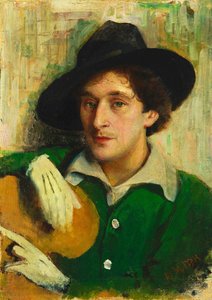
1914. Oil On Canvas.

§ 1Catalogue data


著作権保護について
このページに掲載されている作品は著作権法によって保護されており、当社の許可なく同一の複製物を制作または販売することは法律で禁じられています。この保護は、以下のような国際条約に基づき執行されます。 ベルヌ条約 および、以下の条項に定められたものを含む各国の法律により、 米国著作権法 第17編。
敬意を払った法的な代替手段として、私たちはオリジナルにインスピレーションを与えられた、カスタムの手描きアートワークを提供しています。私たちの熟練したプロのアーティストは、元の作品が持つスタイル、情緒、そして芸術的なエッセンスを注意深く研究し、独自の創作物でありながら、同じ感性を呼び起こすような、新しくユニークな作品を作り上げます。
この手法は、著作権で保護された作品の複製や複写を伴わないため、著作権法に完全に準拠しています。これは単なる模倣ではなく、創造的な再解釈です。元の作品からインスピレーションを受けつつも、それとは異なる、全く新しい絵画を生み出すものです。
 詳細を見る
詳細を見る§ 2Abstract
コレクション詳細
Experience Marc Chagall's 'The Fiddler,' a vibrant Cubist masterpiece depicting a musician and his audience. Explore its surreal imagery, folklore-inspired style, and artistic significance.
アーティストプロフィール
シャガールは、夢幻的な色彩とユダヤの民話が織りなす独特の世界観で知られる20世紀を代表する芸術家。絵画、ステンドグラスなど多彩な作品が生み出し、モダニズム美術に大きな影響を与えました。
§ 3Commentary
A Portrait of Rural Reverie: Marc Chagall’s “The Fiddler”
Marc Chagall's "The Fiddler," painted in 1914 during his formative years in Paris, isn’t merely a depiction of a man playing an instrument; it’s a shimmering portal into a world steeped in folklore, memory, and the quiet beauty of rural life. This oil on canvas, currently residing within the Kunstsammlung Nordrhein-Westfalen in Düsseldorf, embodies the artist's unique synthesis of influences – a potent blend of Cubism’s fractured perspectives, the vibrant hues of Fauvism, and the deeply personal symbolism rooted in his Jewish heritage.
The scene unfolds with an immediate sense of dreamlike tranquility. A solitary fiddler, rendered with bold, almost childlike strokes, stands before a modest dwelling, its snow-dusted roof hinting at a harsh winter landscape. His face, etched with a gentle melancholy and framed by a flowing red coat, is instantly recognizable – a figure both familiar and profoundly enigmatic. Around him, the composition isn’t concerned with strict realism; instead, Chagall employs Cubist principles to deconstruct forms into geometric shapes, layering planes and creating an intriguing sense of spatial ambiguity. The figures observing from afar are rendered in muted tones, almost dissolving into the background, suggesting a community witnessing this solitary moment.
The Language of Cubism and Jewish Folklore
Chagall’s embrace of Cubism is evident not as a rigid adherence to its tenets but rather as a means to express his inner vision. The fragmented forms, tilted perspectives, and overlapping planes aren't simply stylistic choices; they mirror the artist’s desire to capture fleeting memories and emotional states. Crucially, however, “The Fiddler” transcends mere Cubist experimentation. It’s deeply intertwined with Chagall’s personal iconography – a vocabulary of symbols drawn from his childhood in Vitebsk, Belarus, a region where Jewish culture thrived alongside Orthodox Christianity.
The fiddle itself is a potent symbol, representing not just music but also storytelling, tradition, and the preservation of cultural memory. The red coat, a recurring motif in Chagall’s work, often signifies passion, vitality, or even sacrifice. The presence of the boy – presumably the fiddler's son – adds another layer of meaning, evoking themes of lineage, continuity, and the passing down of heritage. Furthermore, the snow-covered house suggests both hardship and resilience—a testament to the enduring spirit of a rural community.
A Window into Chagall’s Artistic Evolution
Painted in the wake of World War I, “The Fiddler” reflects a period of profound artistic upheaval. Chagall was grappling with new ideas and experimenting with different styles, seeking to forge his own distinct voice amidst the revolutionary currents sweeping through the art world. This work demonstrates his early exploration of abstraction while retaining a strong connection to representational imagery and deeply personal symbolism. It’s a pivotal piece in understanding his artistic trajectory – a bridge between his formative years in Vitebsk and his later, more overtly expressive works.
The influence of artists like Pablo Picasso and Henri Matisse is undeniable, yet Chagall skillfully integrates these influences into his own unique style. His use of bold colors—particularly the vibrant red against the muted blues and whites—creates a dynamic visual impact, drawing the viewer’s eye through the composition. The painting's emotional resonance stems from its ability to evoke a sense of nostalgia, solitude, and the quiet dignity of everyday life. It is a testament to Chagall’s extraordinary talent for transforming personal memories into universal symbols.
Reproductions and Experiencing Chagall’s Vision
Art enthusiasts now have the opportunity to bring the magic of “The Fiddler” into their homes through meticulously crafted oil painting reproductions offered by AllPaintingsStore.com and similar platforms. These reproductions strive to capture not only the visual details of the original but also its emotional essence – the dreamlike quality, the vibrant colors, and the profound sense of human connection. By owning a reproduction of “The Fiddler,” one gains access to a timeless masterpiece that continues to resonate with viewers across generations.
For further exploration into Marc Chagall’s life and work, we encourage you to visit AllPaintingsStore.com or the Stedel museum for a deeper understanding of this extraordinary artist.
よくあるご質問
マルク・シャガール作「The Fiddler」のプリントサイズと向きは、どのような設定がおすすめですか?
マルク・シャガール作「The Fiddler」のプリントは、Portraitの向きでMediumのサイズに印刷することをお勧めします。
マルク・シャガール作「The Fiddler」のコントラストはどの程度強いですか?
「The Fiddler」の明暗のコントラストはStatementと記録されています。コントラストとは、明るい部分と暗い部分がどの程度強く異なっているかを表す指標です。
マルク・シャガール作「The Fiddler」は、強いコントラストを用いた構成でしょうか、それとも柔らかな調和を重んじた構成でしょうか?
マルク・シャガール作「The Fiddler」の色彩構成は、StatementなコントラストとDiscordant Paletteな調和を併せ持っています。


 プリント版に切り替え


 いずれかの辺が105 cm(約41インチ)を超えるアートワークまたは複製画の場合、フレームは分解されたキットの状態でお届けいたします。この方法は、輸送中の破損を防ぎ、安全に配送するために採用しております。


