

1649. 油彩 キャンバス, 78.0 x 65.0 cm.

§ 1Catalogue data

- 78.0 x 65.0 cm


§ 2Abstract
コレクション詳細
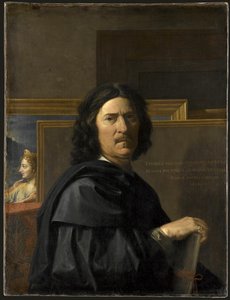
Explore Nicolas Poussin's captivating 'Self Portrait' (1649), a masterpiece of classicism showcasing his workshop and artistic dedication. Admire its realism, symmetry, and influence on Ingres.
 続きを読む
続きを読む
アーティストプロフィール
ピュッソンは、古典的な美しさを追求したフランスバロック絵画の巨匠であり、特に伝説や風景画で知られています。彼の作品群は、永遠の調和と秩序を表現する芸術家としての遺産です。
§ 3Commentary
The Introspective Eye: Unveiling Nicolas Poussin’s Self-Portrait
Nicolas Poussin, a name synonymous with the serene beauty of 17th-century French art, gifted us not only breathtaking landscapes and mythological scenes but also an intimate glimpse into his own creative soul – captured in his remarkably direct self-portrait. Completed around 1649 and now residing within the hallowed halls of the Musée du Louvre in Paris, this oil on canvas work transcends a simple likeness; it’s a profound meditation on art, mortality, and the artist's unwavering dedication to classical ideals. More than just a portrait, it’s a window into Poussin’s mind, revealing a man deeply engaged with his craft and profoundly aware of its significance.
The painting immediately draws the viewer in with its understated elegance. Poussin presents himself not as a grand figure, but as a thoughtful scholar seated at his workbench. Dressed in a rich, enveloping black robe – a deliberate choice echoing the formality and seriousness associated with classical antiquity – he’s bathed in soft light that illuminates his face and hands. His expression is one of quiet concentration, a subtle hint of melancholy mingling with an undeniable sense of purpose. He holds a quill pen poised above a sheet of paper, suggesting the ongoing process of creation, while an open book lies nearby, hinting at the vast reservoir of knowledge and inspiration fueling his artistic vision. The inclusion of these tools – the pen, the paper, the book – isn’t merely decorative; it's a deliberate statement about Poussin’s identity as a dedicated artist, deeply rooted in the traditions of learning and observation.
The Language of Classicism
Poussin’s self-portrait is a quintessential example of his mastery of classicism, a style that dominated European art during the 17th century. Rooted in the artistic principles of ancient Greece and Rome, classicism emphasized clarity, order, and harmony – qualities Poussin sought to embody in every brushstroke. Notice the meticulous attention to detail, the carefully rendered folds of his robe, the precise lines of his features, and the balanced composition of the scene. Unlike the dramatic, emotionally charged Baroque style prevalent at the time, Poussin’s work is characterized by a sense of restraint and intellectual rigor. The use of a limited color palette – primarily blacks, browns, and subtle shades of grey – further contributes to this atmosphere of calm contemplation.
The composition itself is carefully constructed, adhering to classical principles of symmetry and proportion. The arrangement of objects within the workshop—the pen, paper, book, and even Poussin’s own posture—creates a harmonious balance that reflects his artistic philosophy. This deliberate control over form and space speaks volumes about Poussin's commitment to achieving visual perfection, mirroring the ideals he admired in ancient Greek sculpture and architecture.
A Reflection on Mortality
Beyond its formal qualities, the self-portrait carries a poignant undercurrent of reflection on mortality. The presence of the sepulchral monument – a subtle “memento mori” or reminder of death – immediately draws attention to the fragility of human existence. Poussin’s expression, though seemingly serene, hints at an awareness of his own inevitable fate. The putti (cherubs) flanking the monument represent both innocence and the passage of time, adding another layer of complexity to the image. It's a quiet acknowledgment that even in the midst of creative endeavor, the artist is not immune to the universal human experience of loss and decay.
Poussin’s Legacy: A Bridge to Ingres
Nicolas Poussin’s self-portrait holds a significant place in art history, serving as a crucial bridge between the classical traditions of the past and the Neoclassical movement that emerged in the late 18th century. His work profoundly influenced Jean-Auguste-Dominique Ingres, a prominent Neoclassical painter who sought to revive the ideals of ancient Greek art. Ingres deeply admired Poussin’s meticulous technique, his emphasis on line, and his ability to evoke a sense of timeless beauty. Studying Poussin's self-portrait, one can readily see echoes of Ingres' own style—a similar restraint, a comparable focus on form, and a shared reverence for classical principles. The influence is undeniable, demonstrating the enduring power of Poussin’s artistic vision.
Today, AllPaintingsStore offers exquisite, hand-painted reproductions of Nicolas Poussin’s self-portrait, allowing you to bring this masterpiece into your own home or office. These meticulously crafted reproductions capture the essence of the original painting—its subtle nuances, its profound emotional depth, and its timeless beauty. Explore this iconic work alongside other stunning Poussin reproductions on our website: https://AllPaintingsStore.com.
よくあるご質問
ニコラ・プーサン作「Self Portrait」は、どの芸術運動に属していますか?
ニコラ・プーサン作「Self Portrait」に関連する芸術運動はNeoclassicismです。この分類により、本作は関連する他の芸術家や作品群の中に位置づけられます。
ニコラ・プーサン作「Self Portrait」は、お部屋にどのような雰囲気をもたらしてくれるでしょうか?
ニコラ・プーサン作「Self Portrait」が醸し出す古典的な雰囲気は、おすすめの空間であるリビングルームにぴったりです。
「Self Portrait」は、ニコラ・プーサンのキャリアにおけるどの時期の作品でしょうか?
「Self Portrait」は、ニコラ・プーサンのキャリアにおけるMature Periodに属します。この分類は、作品をアーティストの画業の変遷に関連付けるものです。


 プリント版に切り替え


 いずれかの辺が105 cm(約41インチ)を超えるアートワークまたは複製画の場合、フレームは分解されたキットの状態でお届けいたします。この方法は、輸送中の破損を防ぎ、安全に配送するために採用しております。


