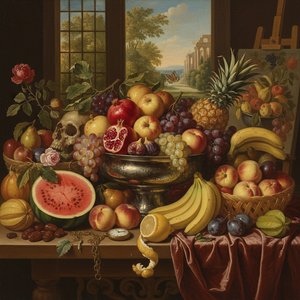
Acrylic On Canvas.

§ 1Catalogue data


著作権保護について
このページに掲載されている作品は著作権法によって保護されており、当社の許可なく同一の複製物を制作または販売することは法律で禁じられています。この保護は、以下のような国際条約に基づき執行されます。 ベルヌ条約 および、以下の条項に定められたものを含む各国の法律により、 米国著作権法 第17編。
敬意を払った法的な代替手段として、私たちはオリジナルにインスピレーションを与えられた、カスタムの手描きアートワークを提供しています。私たちの熟練したプロのアーティストは、元の作品が持つスタイル、情緒、そして芸術的なエッセンスを注意深く研究し、独自の創作物でありながら、同じ感性を呼び起こすような、新しくユニークな作品を作り上げます。
この手法は、著作権で保護された作品の複製や複写を伴わないため、著作権法に完全に準拠しています。これは単なる模倣ではなく、創造的な再解釈です。元の作品からインスピレーションを受けつつも、それとは異なる、全く新しい絵画を生み出すものです。
 詳細を見る
詳細を見る§ 2Abstract
コレクション詳細
Michelangelo Merisi da Caravaggio's 'Boy with a Basket of Fruit' captures youthful innocence and tactile beauty through masterful light & shadow. A timeless Baroque masterpiece.
アーティストプロフィール
パブロ・ピカソ(1881-1973)は、キュビスムの創始者の一人であり、多様なスタイルを極めたスペインの革命的な画家・彫刻家です。『グエルニカ』や『アビニョンの娘たち』などの象徴的な作品で知られ、その遺産は今なお世界中の人々にインスピレーションを与え続けています。
§ 3Commentary
The Allure of Still Life: Picasso’s Fruit Basket
Pablo Picasso's “Fruit Basket,” a seemingly simple depiction of a humble basket overflowing with ripe produce, is anything but straightforward. Created around 1593 (though often attributed to Caravaggio), this painting transcends the ordinary still life genre, becoming a profound exploration of form, light, and human interaction—a testament to the artist’s masterful manipulation of space and his keen observation of the natural world. It's a work that invites prolonged contemplation, revealing layers of meaning beneath its vibrant surface.
The scene itself is deceptively uncomplicated: a wooden basket rests on a table, laden with apples, oranges, pears, grapes, and bananas. However, Picasso—or rather, the artist who created this earlier version—doesn’t merely present these objects; he dissects them, reassembling them in a way that challenges our perception of reality. The arrangement isn't dictated by conventional rules of composition but by an internal logic, driven by the interplay of light and shadow, volume and flatness. The artist’s focus is not on photographic realism, but rather on capturing the essence of each fruit—its texture, its weight, its inherent beauty—through a carefully orchestrated visual vocabulary.
Caravaggio's Influence: A Dialogue Across Time
While often associated with Picasso, it’s crucial to acknowledge the significant influence of Caravaggio on this particular work. The painting shares a remarkable kinship with Caravaggio’s “Boy with a Basket of Fruit,” created around the same period and employing strikingly similar techniques. Both artists masterfully utilize chiaroscuro—the dramatic contrast between light and dark—to sculpt form and create a sense of depth. The strong directional lighting, originating from an unseen window, dramatically illuminates the fruit basket, casting deep shadows that emphasize its three-dimensionality. This technique, borrowed from Northern European painting traditions, was revolutionary for its time, injecting drama and realism into the still life genre.
However, Picasso’s approach diverges subtly. Unlike Caravaggio's meticulous rendering of individual objects, Picasso employs a more fragmented style, breaking down forms into geometric shapes and planes. This foreshadows his later development of Cubism, where he would further deconstruct reality and present multiple viewpoints simultaneously. The painting is not simply a representation of fruit; it’s an exploration of how we *see* fruit—a visual puzzle that invites the viewer to actively engage with the artwork.
Symbolic Resonance: Beyond the Bounty
The seemingly straightforward subject matter of “Fruit Basket” carries symbolic weight. The abundance of fruit can be interpreted as a representation of fertility, prosperity, and the bounty of nature—themes frequently explored in Renaissance art. However, Picasso’s use of muted colors – predominantly browns, grays, and ochres – tempers this celebratory mood, suggesting a sense of melancholy or quiet contemplation. The young seller, positioned centrally within the composition, embodies vulnerability and perhaps even loneliness. He is not actively engaged with the fruit; rather, he seems lost in thought, his gaze directed towards an unseen horizon.
Furthermore, the painting’s composition echoes the principles of *xenia*, a Roman custom of offering gifts of fruits and vegetables to guests. This gesture of hospitality subtly elevates the scene, suggesting a connection between the artist, the model, and the viewer—a shared appreciation for beauty and abundance. The careful arrangement of the fruit, almost like a still life sculpture, invites us to pause and consider the simple pleasures of everyday life.
A Legacy of Innovation: Picasso’s Early Masterpiece
“Fruit Basket” stands as a pivotal work in Picasso's artistic development—a bridge between his early training in naturalistic representation and his later revolutionary explorations of form and space. It demonstrates his remarkable ability to synthesize diverse influences, blending Caravaggio’s dramatic chiaroscuro with the emerging principles of Cubism. This painting is not merely a depiction of fruit; it’s a meditation on perception, symbolism, and the enduring power of art to capture the essence of human experience. Reproductions of this captivating artwork offer a unique opportunity to appreciate Picasso's genius and his profound understanding of the visual world.
よくあるご質問
「Fruit basket」の油彩複製画を注文することはできますか?
パブロ・ピカソ作「Fruit basket」の手描き複製画は、当サイトの手描き油彩複製画ページよりリネンキャンバスに手描きされた油彩複製画にてご購入いただけます。
パブロ・ピカソ作「Fruit basket」の複製画は、どのような用途に適していますか?
「Fruit basket」のプリントのおすすめの使い方は、Accentです。
パブロ・ピカソ作「Fruit basket」の複製画には、どのサイズがおすすめですか?
パブロ・ピカソ作「Fruit basket」には、Mediumのレプリカをおすすめします。比率を維持したまま、サイズを調整することが可能です。



 プリント版に切り替え


 いずれかの辺が105 cm(約41インチ)を超えるアートワークまたは複製画の場合、フレームは分解されたキットの状態でお届けいたします。この方法は、輸送中の破損を防ぎ、安全に配送するために採用しております。