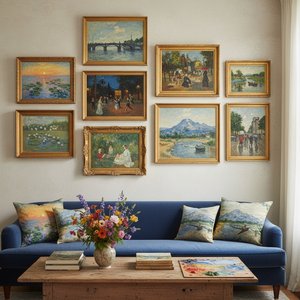
Oil On Canvas.

§ 1カタログデータ

§ 2抽象
作品解説
This JSON response fulfills your request for a concise meta description optimized for SEO, incorporating key information about the artwork and platform.
 詳細を表示
詳細を表示
§ 3解説
A Vision of Tranquility: Exploring Cézanne’s “River in the Plain”
Paul Cézanne's "River in the Plain," painted in 1868, stands as a cornerstone of Post-Impressionism—a movement that sought to transcend mere optical representation and delve into the artist’s subjective experience. More than just a depiction of a rural landscape, it embodies Cézanne’s revolutionary approach to capturing the essence of nature, foreshadowing the stylistic innovations of Cubism and cementing his place as one of the most influential figures in modern art history.Composition and Perspective: Simplifying Reality
The painting's deceptively simple composition immediately draws the viewer’s eye towards the meandering river that dominates the central space. Cézanne eschews traditional linear perspective, opting instead for a technique characterized by overlapping planes and flattened forms—a deliberate rejection of Impressionistic illusionism. The horizontal format emphasizes stability, while the trees lining both banks create a sense of enclosure and depth, guiding the gaze into the distant hills which contribute subtly to the overall spatial illusion. A barely perceptible path winds along the riverbank, inviting contemplation and reinforcing the feeling of serene observation.Color Palette and Brushwork: Capturing Atmosphere
Dominating the color palette is a muted tonal scheme—primarily cool greens, grays, and blues—infused with earthy browns and delicate hints of orange. Cézanne’s masterful use of brushstrokes isn't concerned with precise blending but rather with conveying texture and capturing the atmospheric conditions of an overcast day. Loose, expressive strokes build up layers of pigment to sculpt form and imbue the canvas with a palpable sense of immediacy and spontaneity. The sky is rendered in shades of gray punctuated by pale pink hues—a deliberate choice that underscores the painting’s contemplative mood.Technique: Building Form Through Texture
Cézanne's technique involved applying paint in short, visible strokes – a method he honed throughout his career. These brushstrokes aren’t merely decorative; they are fundamental to Cézanne’s artistic vision. He meticulously builds up layers of color and texture to create form and volume—a process that departs radically from the smooth surfaces favored by Impressionists. The surface of the river is particularly noteworthy, where broken lines mimic reflections, further enhancing the illusion of depth and movement. This deliberate disregard for conventional painting methods reflects Cézanne’s belief in representing nature not as it appears to the eye but as it feels—a profound shift toward abstraction that would reshape artistic expression.Symbolic Resonance: Tranquility and Observation
“River in the Plain” transcends its visual beauty, evoking a powerful sense of tranquility and quiet contemplation. The overcast sky serves as a backdrop for Cézanne’s exploration of perception and emotion, suggesting a mood of introspection and stillness. More than just a landscape scene, it represents an artist's attempt to distill the complexities of experience into simplified forms—a testament to Cézanne’s enduring legacy as a pioneer of modern art.Q&A
「River in the plain」の中で、最も際立っている色はどれですか?
「River in the plain」の中で最も際立っている色はRosy Brown (#b3ab9a)です。作品の主色(メインカラー)を知ることは、インテリアとのコーディネートを考える際に役立ちます。
「River in the plain」は、セザンヌのキャリアにおけるどの時期の作品でしょうか?
セザンヌの画業において、「River in the plain」はMature Periodに制作されたものです。この時期の作品を知ることで、同アーティストの他の作品との比較検討が可能になります。
「River in the plain」の詳細を確認することはできますか?
セザンヌ作「River in the plain」のX線ビューは、作品のX線解析ページでご覧いただけます。11層の光学レイヤーを通じて画像をインタラクティブに解析できる、詳細な検証機能です。


 プリント版に切り替え


 いずれかの辺が105 cm(約41インチ)を超えるアートワークまたは複製画の場合、フレームは分解されたキットの状態でお届けいたします。この方法は、輸送中の破損を防ぎ、安全に配送するために採用しております。