油彩絵具.

§ 1カタログデータ


§ 2抽象
作品解説
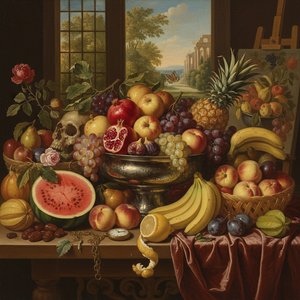
Paul Cézanne's 'Still Life with Commode' (1887-88) showcases his revolutionary approach to perspective & form, bridging Impressionism and Cubism. Explore depth, color, and a pivotal moment in art history.
 詳細を表示
詳細を表示
§ 3解説
Paul Cézanne’s Still Life with Commode: A Window into Modern Perception
Paul Cézanne's Still Life with Commode, painted around 1887-1888, isn’t merely a depiction of objects arranged on a table; it’s a profound exploration of how we *see*. This pivotal work, housed within the esteemed collection of the Harvard Art Museums, represents a crucial bridge between the Impressionist movement and the burgeoning world of Cubism, marking a radical shift in artistic perspective. Cézanne wasn't interested in simply replicating reality as seen through fleeting light; instead, he sought to capture the underlying structure and essence of his subject – a deliberate act that profoundly influenced generations of artists to come.
The painting itself is deceptively simple at first glance. A modestly sized table, draped with a subtly textured fabric, anchors the composition. Upon it rests a commode—a piece of furniture typically associated with domesticity and order—alongside an assortment of carefully chosen objects: a bowl overflowing with fruit – apples and oranges dominate, their colors rendered in rich, earthy tones – a vase holding flowers, and several books. Yet, Cézanne’s genius lies not in the realistic portrayal of these items, but in his masterful manipulation of space and form. He abandons traditional perspective, creating an illusion of depth through a complex interplay of lines, planes, and color. The table itself seems to tilt slightly, the objects are rendered with varying degrees of detail, and the background is deliberately ambiguous, drawing the viewer’s eye directly into the heart of the scene.
Post-Impressionist InnovationCézanne's approach firmly places him within the Post-Impressionist movement. Characterized by a rejection of Impressionism’s emphasis on capturing momentary impressions and a greater focus on subjective experience, Post-Impressionists like Cézanne sought to express their inner vision through color, form, and composition. Cézanne's use of short, broken brushstrokes—a technique he developed throughout his career—creates a sense of dynamism and movement within the static arrangement of objects. These strokes aren’t meant to blend seamlessly; rather, they retain their individual character, contributing to the painting’s overall texture and visual complexity. The work embodies the spirit of this era – an exploration beyond mere representation, delving into the very nature of perception itself.
Beyond its formal innovations, Still Life with Commode carries a subtle emotional resonance. The arrangement feels both familiar and slightly unsettling—a quiet tableau of everyday life imbued with a sense of contemplative stillness. The carefully chosen objects – fruit, books, a vase – evoke associations with domesticity, knowledge, and beauty. However, Cézanne’s deliberate distortions and unconventional perspective subtly disrupt this comfortable familiarity, prompting the viewer to question their own assumptions about how things *should* look. The painting invites us to engage in a process of active interpretation, recognizing that reality is not simply observed but constructed through our own perceptual filters.
If you’re captivated by Cézanne's revolutionary approach and wish to experience this masterpiece firsthand, consider commissioning a handmade oil painting reproduction from AllPaintingsStore.com. Our skilled artists meticulously recreate the nuances of Cézanne’s technique, capturing the subtle color variations, broken brushstrokes, and unique spatial relationships that define this iconic work. A reproduction offers an accessible way to bring this profound exploration of perception into your own home or office – a testament to Cézanne's enduring legacy as one of art history’s most influential figures. For further insight into Cézanne’s life and artistic journey, explore his artist page on AllPaintingsStore.com, or delve deeper into the broader context of Post-Impressionism and its key practitioners like Piet Mondrian and Wassily Kandinsky on our Cubist Art Movement page.
- Key Techniques: Short, broken brushstrokes; manipulation of perspective; emphasis on form and structure.
- Symbolic Elements: The commode represents domesticity and order; the fruit symbolizes abundance and beauty; the books suggest knowledge and contemplation.
- Historical Significance: A pivotal work bridging Impressionism and Cubism, profoundly influencing modern art.
Q&A
セザンヌ作「Still Life with Commode」の来場者の属性(統計データ)はどこで確認できますか?
セザンヌ作「Still Life with Commode」に関する統計情報は、作品の閲覧統計ページでご確認いただけます。こちらでは、作品の月間訪問数、アーティストの作品への訪問数、および最近の訪問者の国別・言語別の内訳をご覧いただけます。
美術史におけるセザンヌ作「Still Life with Commode」の立ち位置とはどのようなものでしょうか。
セザンヌ作「Still Life with Commode」の美術史的な分類は、19世紀期におけるPost-Impressionismです。
「Still Life with Commode」の油彩複製画を注文することはできますか?
セザンヌ作「Still Life with Commode」の手描き複製画は、こちらの手描き油彩複製画ページから直接ご注文いただけます:リネンキャンバスに手描きされた油彩複製画(受注制作)


 プリント版に切り替え


 いずれかの辺が105 cm(約41インチ)を超えるアートワークまたは複製画の場合、フレームは分解されたキットの状態でお届けいたします。この方法は、輸送中の破損を防ぎ、安全に配送するために採用しております。