


 設置イメージを表示
 シェアする
シェアする シェアする
シェアする
 詳細を見る
詳細を見る ガイドを表示

 ダウンロード
 似ている作品
 X線調査
X線調査 スライドショーを表示
 Q&A
Q&A 統計情報
統計情報St. Michael

 詳細を表示
詳細を表示
ジークレー/アートプリント
スピーディーな制作と多彩な仕上げオプションが魅力の、ミュージアムクオリティなジークレー・キャンバスプリント。 ( 手描き複製画を注文する デジタル画像販売へ切り替え)




P118B ¥10

P118H ¥10

P118W ¥10

P438Z ¥10

P508JH ¥12

P508YH ¥12

P805H ¥10

P805Z ¥10

P919BZ ¥10

P919G ¥10

P919XJ ¥10

P959ZH ¥10

P968JZ ¥12

W106C ¥8

W218G ¥10

W218JH ¥8

W218Y ¥10

W307PJ ¥10

W316G ¥10

W316PJ ¥8

W316Y ¥10

W398PJ ¥8

W4111J ¥10

W500HY ¥15

W500JH ¥15

W692G ¥12

W849H ¥8

W940BG ¥15

W953PJ ¥8




作品のオリジナル比率に合わせた、当店の規定サイズからお選びください。

額縁や壁のスペースに合わせて、ご希望の幅と高さを入力してください。プリントはカットすることは可能ですが、元の画像より大きくすることはできないため、異なる比率のサイズを選択された場合は、画像の一部が欠けることになります。印刷を開始する前に、内容を確認していただくためのデジタルモックアップをお送りいたします。このページに表示されている画像は、実際のカット後の状態を示すものではありません。実際の仕上がりはモックアップにてご確認ください。


 ガラスオプションは、110cm未満のサイズでのみご利用いただけます。

St. Michael
ジークレー/アートプリント
複製画サイズ一覧
-


合計金額
¥ 10279
A Portrait of Faith and Geometry – Piero della Francesca’s St. Michael
Piero della Francesca (c. 1415-1492), born in Sansepolcro, Umbria, stands as a singular figure within the Early Renaissance landscape. Unlike many artists of his era consumed by humanist ideals and eager to embrace Florentine innovation, Piero pursued an intellectual path that prioritized mathematical precision alongside artistic expression—a distinction that profoundly shaped his oeuvre.
“St. Michael,” housed in the Gemäldegalerie Alte Meister Dresden, exemplifies this remarkable blend. Painted around 1450-52, it’s not merely a depiction of Saint Michael vanquishing Lucifer; it's an elaborate exercise in visual reasoning—a testament to Piero’s conviction that art could illuminate fundamental truths about existence.
Style and Technique: The Tuscan Ideal
The painting adheres to the Tuscan style, characterized by its serene composure and monumental scale. Unlike Masaccio’s groundbreaking frescoes at Santa Maria Novella in Florence, which ushered in a new era of realism through perspective, Piero eschewed dramatic chiaroscuro—the stark contrast between light and dark—favoring instead a subtle gradated tonal palette that imbues the scene with an ethereal glow.
- Linear Perspective: Piero meticulously employs linear perspective to create an illusionistic space, anchoring the figures within a geometrically precise framework. The vanishing point is positioned subtly off-center, contributing to the painting’s contemplative mood.
- Color Harmony: Della Francesca utilizes a harmonious color scheme dominated by blues and ochres—colors associated with piety and stability—creating a visual experience that transcends mere representation.
- Smooth Surfaces: The artist achieves remarkable smoothness on the canvas surface, resulting in an almost polished appearance that enhances the painting’s luminosity.
Historical Context and Symbolism
Painted during a period of intense religious fervor—the High Middle Ages transitioned into the Renaissance—“St. Michael” reflects the prevailing preoccupation with theological concepts such as divine justice and spiritual warfare. Saint Michael, depicted in regal attire, embodies courage and righteousness, confronting Lucifer—represented as a shadowy figure—who attempts to undermine God’s authority.
The inclusion of two angels flanking St. Michael reinforces this symbolic narrative. Their positioning underscores the hierarchical order of heaven, emphasizing God's dominion over creation. Furthermore, the geometric precision of the composition serves as an allegory for divine rationality—suggesting that God governs the universe according to immutable laws.
Emotional Impact and Legacy
"St. Michael" transcends its formal conventions to evoke a profound sense of serenity and contemplation. The painting’s stillness invites viewers to engage in introspection, prompting reflection on themes of faith, morality, and the eternal struggle between good and evil.
Della Francesca's masterpiece continues to inspire artists and scholars alike—a beacon of intellectual rigor and artistic beauty that secures its place among the most enduring achievements of Renaissance art. Its meticulous technique and symbolic depth offer a timeless meditation on humanity’s relationship with divinity, ensuring St. Michael’s legacy persists for generations to come.
Q&A
ピエロ・デッラ・フランチェスカ作「St. Michael」の配色はどのように表現されていますか?
ピエロ・デッラ・フランチェスカ作「St. Michael」は、Neutralsなカラーパレットを使用しています。この配色は、作品全体の色彩的特徴を象徴しています。
「St. Michael」全体の明るさはどの程度ですか?
視覚的な明るさの観点から見ると、ピエロ・デッラ・フランチェスカ作「St. Michael」 は brilliant です。
ピエロ・デッラ・フランチェスカには他にどのような名で知られているものがありますか?
「St. Michael」の作者であるピエロ・デッラ・フランチェスカには、他にピエロ・ディ・ベネデット・デ・フランチェスキといった名称でも記録されています。
関連作品


作家プロフィール
ピエロ・デッラ・フランチェスカ:静謐と秩序の探求者
15世紀初期ルネサンスを代表する画家、ピエロ・デッラ・フランチェスカ。彼の名は、単なる芸術家という枠を超え、数学者、幾何学者としても知られています。ウンブリア地方の小さな町サンセポルクロで生まれ、その生涯は謎に包まれている部分も多いものの、残された作品群は、静謐な美と秩序への飽くなき探求を物語っています。フランチェスカの芸術は、単なる写実性を超え、知性と精神性が融合した独自の表現へと昇華されており、後世の芸術家たちに多大な影響を与えました。
生い立ちと初期の試み:フィレンツェとの出会い
ピエロ・デッラ・フランチェスカは、1415年頃、サンセポルクロで生まれました。父は革細工師であり、裕福な家庭環境で育ったピエロは、幼少期から教育を受け、読み書き能力も身につけました。1430年代には、地元の画家アントニオ・ダンギアリのもとで修行を積み、その後、芸術の中心地であるフィレンツェへと旅立ちます。そこで彼は、マサッチョの革新的な壁画や、フィリッポ・ブルネレスキの建築的才能に触発され、遠近法という新たな表現手法に魅せられます。ドメニコ・ヴェネツィアーノとの共同制作を通じて、フランチェスカはフィレンツェの芸術様式を深く理解し、自身の芸術性を磨き上げていったのです。
真実の十字架:傑作が生み出す静謐な世界
ピエロ・デッラ・フランチェスカの名声を決定づけたのは、アレーッツォのサン・フランチェスコ教会に描かれた『真実の十字架物語』の壁画です。この作品群は、十字架の木材が発見されるまでの伝説を壮大なスケールで描き出しており、その構成と色彩、そして何よりも人物の表情には、深い精神性と静謐さが漂っています。遠近法を駆使した緻密な空間描写は、見る者を圧倒し、まるで現実世界に入り込んだかのような錯覚を与えます。フランチェスカは、単なる物語を描くのではなく、人間の内面にある信仰心や希望といった普遍的なテーマを表現しようとしたのです。
数学と芸術の融合:遠近法への探求
ピエロ・デッラ・フランチェスカの芸術の特徴として、数学的知識との融合が挙げられます。彼は、レオナルド・ダ・ヴィンチやミケランジェロに先駆けて、遠近法の理論を深く研究し、それを自身の作品に応用しました。『遠近法に関する画法』という著書にも残されているように、彼は幾何学的な計算に基づいた正確な空間表現を追求しました。その結果、フランチェスカの作品は、単なる写実性を超え、秩序と調和がもたらす美しさを体現したものとなっています。彼の絵画は、まるで精密機械のように完璧に計算され、配置された要素が、見る者の心を静かに魅了するのです。
後世への影響:ルネサンスを越えた普遍性
ピエロ・デッラ・フランチェスカの芸術は、生前の評価とは異なり、20世紀になってようやくその真価が再認識されました。レオナルド・ダ・ヴィンチやラファエロといった巨匠たちも、彼の作品から影響を受けたと伝えられており、ルネサンス美術における重要な位置を占めています。フランチェスカの静謐で秩序立った世界観は、現代においても多くの人々に感動を与え続けています。彼の芸術は、単なる過去の遺産ではなく、普遍的な美と知性の探求という形で、未来へと受け継がれていくでしょう。
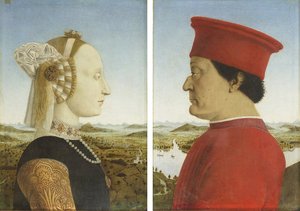
ピエロ・デッラ・フランチェスカ
1415 - 1492 , イタリア
プロフィール概要
- フルネーム: ピエロ・デッラ・フランチェスカ
- 主な作品:
- 受胎告知
- 真の十字架の伝説
- モンテフェルトロ祭壇画
- 出生地: サンセポルクロ(イタリア)
- 国籍: イタリア
- 影響を与えたアーティスト:
- レオナルド・ダ・ヴィンチ
- ラファエロ
- 影響を受けたアーティスト:
- マサッチョ
- ドメニコ・ヴェネツィアーノ
- 死亡年月日: 1492年10月12日
- 生年月日: 1415年頃
- 芸術運動またはスタイル: 初期ルネサンス
関連記事

Slate Blue Masterpieces: 10 Iconic Paintings & Timeless Home Decor Ideas
Immerse yourself in the captivating world of slate blue! Explore 10 iconic paintings by Monet, Van Gogh & Renoir. Discover their stories, techniques & find museum-quality art reproductions for your home at .

Azure Visions: Exploring Representations of the Blue Dress in Western Art History
Explore the rich history of the blue dress in Western art! Discover its symbolism, from Renaissance masterpieces to modern interpretations by artists like Martin & Schiele. Uncover cultural meanings and artistic techniques.

Piero della Francesca: Renaissance Perspective, Divine Proportion & the Pursuit of Ideal Form
Explore the revolutionary art of Piero della Francesca – master of perspective, divine proportion & Renaissance humanism. Discover his iconic paintings & lasting influence on art history.

The Allure of Azure: Exploring the Symbolic & Aesthetic Depths of Blue in Art History
Explore the rich history of blue in art! Discover its symbolism, from ancient pigments to modern masterpieces by Kandinsky & Seurat. Uncover the psychological impact and cultural meanings behind this captivating hue.

Crimson Threads of Narrative: Exploring Symbolism & Representation in Artworks Featuring the Red Dress
Explore the rich symbolism of the red dress in art history! From ancient power displays to iconic portraits like Cézanne’s 'Madame Cezanne', discover the cultural and artistic significance behind this captivating color. Expert analysis & insights.


