

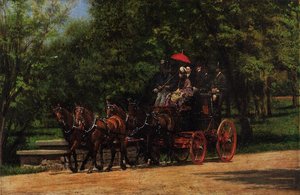
1873. Watercolor. イェール芸術美術館.

§ 1カタログデータ


§ 2抽象
作品解説
Inspired by the sport of rowing, Eakins combined scientific observation with artistic skill to create this iconic piece.
 詳細を表示
詳細を表示
アーティストの略歴
トーマス・エイキンズ(1844-1916)は、写実主義を代表するアメリカ人画家。容赦ない人物描写と力強いボート漕ぎの風景で知られ、解剖学的な正確さも特徴です。19世紀美術史における彼の遺産を探求してください!
§ 3解説
The Poetics of Precision: Eakins’s Vision of Motion
In the quiet, rhythmic pulse of the Schuylkill River, there exists a moment of profound stillness captured forever in Thomas Eakins’s 1873 watercolor, John Biglin in a Single Scull. This masterpiece is far more than a mere sporting illustration; it is a breathtaking meditation on the intersection of human willpower and the natural world. As the viewer gazes upon the scene, they are not just observing a rower at work, but are instead invited into a sanctuary of intense concentration. The subject, John Biglin—a champion oarsman of his era—is rendered with a sculptural vitality that belies the delicate medium of watercolor. Eakins, a titan of American Realism, possessed an almost scientific obsession with the mechanics of life, and here, he translates the physical strain of rowing into a visual symphony of muscle, water, and light.
The composition draws the eye toward the center of the frame, where Biglin sits poised within his vessel. Clad in a crisp white shirt that catches the soft light, and accented by a striking red bandana, he serves as a focal point of human energy against the serene, sprawling backdrop of the river. The artist’s mastery lies in his ability to balance the heavy physicality of the man with the ethereal, translucent qualities of the water. One can almost feel the tension in the oars and hear the gentle ripple of the surface as the boat cuts through the blue expanse. It is a study in controlled power, where every stroke of the brush serves to document the precise physics of movement.
A Masterclass in American Realism
To understand this work is to understand the soul of 19th-century American art. During a period when many artists were drifting toward the fleeting, light-drenched abstractions of Impressionism, Eakins remained anchored in an unflinching devotion to reality. His technique in John Biglin in a Single Scull reflects this rigorous approach; while there is a certain atmospheric softness reminiscent of Impressionist light, the underlying structure is built upon anatomical accuracy and structural integrity. He does not merely suggest the weight of the boat or the tension of the oarsman's limbs—he proves them through meticulous observation.
The use of watercolor in this piece provides a unique emotional texture. The medium allows for subtle gradations of tone that mimic the way sunlight filters through a humid afternoon, creating an atmosphere that feels both nostalgic and immediate. For the collector or the interior designer, this painting offers a rare versatility. Its palette—dominated by tranquil blues, earthy greens, and the sharp, energetic punctuation of red—possesses a calming yet commanding presence. It is a piece that breathes life into a room, providing a window into a bygone era of athletic grace and quiet determination.
Timeless Inspiration for the Modern Space
Beyond its historical significance, John Biglin in a Single Scull resonates deeply with the contemporary desire for authenticity and connection to nature. In an age of digital abstraction, Eakins’s commitment to the tangible, the physical, and the real offers a grounding influence. The painting symbolizes the beauty of focus—the ability to find one's flow within the vastness of the world. It is a tribute to the solitary pursuit of excellence, making it an evocative choice for spaces dedicated to reflection, study, or sophisticated relaxation.
Whether displayed in a sunlit gallery, a stately library, or a modern living space, a high-quality reproduction of this work serves as a conversation piece that transcends time. It invites onlookers to pause, to breathe, and to appreciate the quiet strength found in a single, perfectly executed moment of human endeavor. To own such a piece is to possess a fragment of American art history, rendered with a passion for truth that remains as potent today as it was in 1873.
Q&A
「John Biglin in a Single Scull」の作者と制作年はいつですか?
「John Biglin in a Single Scull」は、1873年にトーマス・エイキンズによって制作されました。
トーマス・エイキンズ作「John Biglin in a Single Scull」を特徴づける技法やスタイルは何ですか?
トーマス・エイキンズ作「John Biglin in a Single Scull」は、Watercolorの技法とContemporary Realismの様式を融合させた作品です。技法(テクニック)は制作手法を、様式(ムーブメント)はその作品のスタイルを表しています。
トーマス・エイキンズ作「John Biglin in a Single Scull」 の色彩に調和する空間はどこでしょうか?
Darkの色彩を纏ったトーマス・エイキンズ作「John Biglin in a Single Scull」は、Living Roomに飾るのがおすすめです。その色使いこそが、この提案の理由のひとつです。




 プリント版に切り替え


 いずれかの辺が105 cm(約41インチ)を超えるアートワークまたは複製画の場合、フレームは分解されたキットの状態でお届けいたします。この方法は、輸送中の破損を防ぎ、安全に配送するために採用しております。


