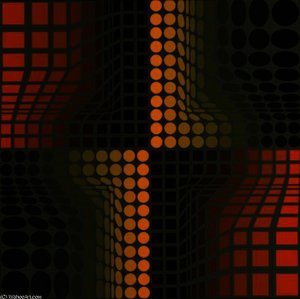
Acrylic On Canvas.

§ 1Catalogue data


著作権保護について
このページに掲載されている作品は著作権法によって保護されており、当社の許可なく同一の複製物を制作または販売することは法律で禁じられています。この保護は、以下のような国際条約に基づき執行されます。 ベルヌ条約 および、以下の条項に定められたものを含む各国の法律により、 米国著作権法 第17編。
敬意を払った法的な代替手段として、私たちはオリジナルにインスピレーションを与えられた、カスタムの手描きアートワークを提供しています。私たちの熟練したプロのアーティストは、元の作品が持つスタイル、情緒、そして芸術的なエッセンスを注意深く研究し、独自の創作物でありながら、同じ感性を呼び起こすような、新しくユニークな作品を作り上げます。
この手法は、著作権で保護された作品の複製や複写を伴わないため、著作権法に完全に準拠しています。これは単なる模倣ではなく、創造的な再解釈です。元の作品からインスピレーションを受けつつも、それとは異なる、全く新しい絵画を生み出すものです。
 詳細を見る
詳細を見る§ 2Abstract
コレクション詳細
Vibrant abstract composition by Victor Vasarely, a key figure in Op Art, showcases dynamic geometric shapes and bold colors – yellow, orange, blue, and purple. Explore this captivating kinetic artwork and bring its visual energy into your space.
§ 3Commentary
A Symphony of Geometric Perception: Exploring Victor Vasarely’s ‘Abstract Composition 6’
Victor Vasarely's “Abstract Composition 6” is more than just a colorful painting; it’s an invitation to reconsider the very nature of visual perception. Created by one of the foremost figures in Op Art, this vibrant work embodies the artist’s lifelong fascination with geometry and its impact on how we experience the world. Painted primarily in a dynamic palette of yellows, oranges, blues, and purples, the composition immediately draws the eye into a mesmerizing dance of shapes and patterns – triangles, squares, circles, and more – meticulously arranged to create an illusion of movement and depth. This isn't simply decorative art; it’s a rigorously constructed exploration of optical illusions, reflecting Vasarely’s deep engagement with scientific principles and his desire to translate mathematical concepts into tangible artistic forms.
The Genesis of Op Art: Bauhaus Roots and Kinetic Vision
Born in 1906 in Pécs, Croatia (then part of Austria-Hungary), Vasarely’s artistic trajectory began unexpectedly. Initially pursuing a medical degree, he abandoned this path in 1927 to embrace painting, ultimately finding his true calling within the burgeoning movement of Op Art – Optical Art. This pivotal shift was profoundly influenced by his studies at Sándor Bortnyik’s “Műhely” workshop, a school deeply rooted in the principles of functional design and geometric abstraction championed by the Bauhaus. The Bauhaus, with its emphasis on reducing form to its essential elements and exploring the relationship between art and industry, provided Vasarely with the theoretical framework for his groundbreaking work. He wasn't merely creating abstract images; he was attempting to capture the *effect* of visual perception – the way our eyes and brains interpret shapes and colors – a concept that would become central to Op Art’s success.
Technique and Illusion: A Masterclass in Visual Deception
Vasarely's technique was remarkably precise, relying on meticulous layering and the careful manipulation of color and scale. He employed a method he termed “static illusion,” creating the impression of movement through precisely controlled geometric forms. The seemingly random arrangement of shapes is, in fact, a carefully calculated system designed to trick the eye. Each element is rendered with exceptional clarity, contributing to the overall sense of depth and dynamism. The use of contrasting colors further enhances this effect, guiding the viewer’s gaze across the canvas and reinforcing the illusion of movement. This technique demanded not just artistic skill but also a deep understanding of optics and visual psychology – qualities that Vasarely possessed in abundance.
Symbolism and Emotional Resonance: Beyond Pure Geometry
While rooted in geometric abstraction, “Abstract Composition 6” possesses an undeniable emotional resonance. The vibrant colors evoke feelings of energy, excitement, and perhaps even a sense of wonder. Vasarely’s work isn't about representing the external world; it’s about exploring the internal landscape of perception itself. The dynamic composition can be interpreted as a reflection of the constant flux and change inherent in our experience – a visual representation of the ever-shifting patterns of thought and emotion. The piece invites contemplation on how we actively construct our reality through our sensory perceptions, making it a powerful statement about the subjective nature of vision.
よくあるご質問
ヴィクトル・ヴァザレリ作「Abstract composition 6」は、強いコントラストを用いた構成でしょうか、それとも柔らかな調和を重んじた構成でしょうか?
ヴィクトル・ヴァザレリ作「Abstract composition 6」の色彩構成は、StatementなコントラストとDiscordant Paletteな調和を併せ持っています。
ヴィクトル・ヴァザレリ作「Abstract composition 6」は、どのような主題と情緒を融合させているのでしょうか?
ヴィクトル・ヴァザレリ作「Abstract composition 6」は、abstract art, geometric shapes, color field, op art, victor vasarely, visual perception, dynamic designを描き出し、Calmな情緒を湛えています。主題と雰囲気が相まって、作品の物語を形作っています。
ヴィクトル・ヴァザレリ作「Abstract composition 6」 の推奨プリントサイズを教えてください。
ヴィクトル・ヴァザレリ作「Abstract composition 6」 の推奨プリントサイズは Large です。


 プリント版に切り替え


 いずれかの辺が105 cm(約41インチ)を超えるアートワークまたは複製画の場合、フレームは分解されたキットの状態でお届けいたします。この方法は、輸送中の破損を防ぎ、安全に配送するために採用しております。