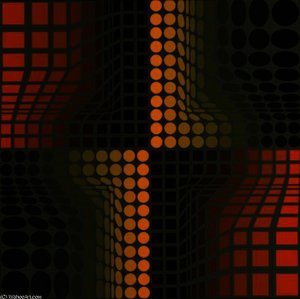
1956. Acrylic On Canvas.

§ 1Catalogue data


著作権保護について
このページに掲載されている作品は著作権法によって保護されており、当社の許可なく同一の複製物を制作または販売することは法律で禁じられています。この保護は、以下のような国際条約に基づき執行されます。 ベルヌ条約 および、以下の条項に定められたものを含む各国の法律により、 米国著作権法 第17編。
敬意を払った法的な代替手段として、私たちはオリジナルにインスピレーションを与えられた、カスタムの手描きアートワークを提供しています。私たちの熟練したプロのアーティストは、元の作品が持つスタイル、情緒、そして芸術的なエッセンスを注意深く研究し、独自の創作物でありながら、同じ感性を呼び起こすような、新しくユニークな作品を作り上げます。
この手法は、著作権で保護された作品の複製や複写を伴わないため、著作権法に完全に準拠しています。これは単なる模倣ではなく、創造的な再解釈です。元の作品からインスピレーションを受けつつも、それとは異なる、全く新しい絵画を生み出すものです。
 詳細を見る
詳細を見る§ 2Abstract
コレクション詳細
Experience Victor Vasarely's 'Our': A mesmerizing Op Art masterpiece of interlocking geometric shapes and vibrant colors, creating an illusion of movement and dynamic depth. Explore the captivating world of optical illusions.
§ 3Commentary
Victor Vasarely’s “Our”: A Dive into the Psyche of Op Art
Victor Vasarely's "Our," created in 1956, isn't merely a painting; it’s an invitation to a perceptual dance. This seminal work from the heart of the Op Art movement embodies a fascination with how our eyes and brains interpret visual information – a captivating exploration of illusion, rhythm, and the very nature of seeing. Born in Pécs, Croatia (then part of Austria-Hungary), Vasarely’s journey into abstraction began unexpectedly, initially pursuing medicine before finding his true calling in the world of art. His relocation to Paris marked a turning point, immersing him within the vibrant circles of post-war European artistic innovation and ultimately leading him to develop his signature style – one deeply rooted in geometric precision and optical stimulation.
"Our" immediately commands attention with its densely packed composition. Interlocking rectangles and trapezoids, rendered in shades of rich red, orange, and punctuated by grounding browns and blacks, create a complex tapestry that seems to shift and shimmer before the viewer’s eyes. The absence of a clear focal point is deliberate; Vasarely wasn't aiming for a singular point of interest but rather to orchestrate an experience of continuous movement across the entire canvas. The subtle gradient effects within each hue add depth, suggesting variations in tone and creating a sense of spatial ambiguity – it’s as if the forms are subtly receding or advancing, playing with our perception of distance.
Decoding the Language of Op Art
At its core, “Our” is a quintessential example of Op Art. This movement, pioneered by artists like Bridget Riley and Vasarely himself, sought to evoke an illusion of three-dimensionality through purely two-dimensional means. The crisp, precise lines that define each shape are crucial to this effect; they create a sense of order and control within the seemingly chaotic arrangement. The deliberate irregularities – slight asymmetries and variations in scale – prevent the composition from feeling overly rigid, mirroring the way our visual system actually processes information—not as perfectly ordered but with subtle distortions and shifts.
Vasarely’s meticulous technique is evident in the careful planning and execution of each geometric element. He employed acrylic paint on canvas, a medium that allowed for both vibrant color saturation and a degree of textural subtlety. The grainy texture observed in photographs suggests either an inherent quality of the original surface or the effects of the printing process – a deliberate choice to avoid a sterile, overly smooth appearance. This grain subtly enhances the visual dynamism, preventing the image from feeling static.
Symbolism and Emotional Resonance
While “Our” eschews representational imagery, it’s far from devoid of symbolic meaning. As an Op Art piece, it aims to trigger a visceral response – a sense of energy, rhythm, and perhaps even a touch of disorientation. The repetitive patterns can be interpreted as mirroring the rhythms of our own perception, highlighting how we actively construct reality through our visual processing. The color palette itself contributes to this emotional impact; the warm reds and oranges evoke feelings of excitement and vitality, while the darker browns provide grounding and contrast.
Considering Vasarely’s broader artistic philosophy, “Our” can be seen as an exploration of the relationship between perception and reality. It's a reminder that what we *see* is not necessarily what *is*, but rather a carefully constructed interpretation shaped by our individual visual systems. The work invites contemplation on how art can manipulate our senses and challenge our assumptions about the world around us. Reproductions, meticulously crafted to capture the original’s nuances, offer a remarkable opportunity to experience this captivating illusion firsthand.
よくあるご質問
「Our」のガイドはどこにありますか?
「Our」のガイドは、作品のガイドページです。このページは印刷可能なファクトシートとなっており、作品のキャプション、クレジット、および詳細情報(作家名、制作年、技法、原寸大、所蔵)をまとめてご確認いただけます。
ヴィクトル・ヴァザレリ作「Our」の複製画をプレビューするにはどうすればよいですか?
ヴィクトル・ヴァザレリ作「Our」のプレビューは、作品のプレビューページでご確認いただけます。
ヴィクトル・ヴァザレリ作「Our」は、よく知られた作品ですか?
ヴィクトル・ヴァザレリ作「Our」の記録されている人気度はRecognizedです。


 プリント版に切り替え


 いずれかの辺が105 cm(約41インチ)を超えるアートワークまたは複製画の場合、フレームは分解されたキットの状態でお届けいたします。この方法は、輸送中の破損を防ぎ、安全に配送するために採用しております。