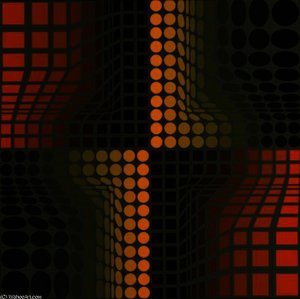
1950. Acrylic On Canvas, 20.0 x 36.0 cm.

§ 1Catalogue data

- 20.0 x 36.0 cm


著作権保護について
このページに掲載されている作品は著作権法によって保護されており、当社の許可なく同一の複製物を制作または販売することは法律で禁じられています。この保護は、以下のような国際条約に基づき執行されます。 ベルヌ条約 および、以下の条項に定められたものを含む各国の法律により、 米国著作権法 第17編。
敬意を払った法的な代替手段として、私たちはオリジナルにインスピレーションを与えられた、カスタムの手描きアートワークを提供しています。私たちの熟練したプロのアーティストは、元の作品が持つスタイル、情緒、そして芸術的なエッセンスを注意深く研究し、独自の創作物でありながら、同じ感性を呼び起こすような、新しくユニークな作品を作り上げます。
この手法は、著作権で保護された作品の複製や複写を伴わないため、著作権法に完全に準拠しています。これは単なる模倣ではなく、創造的な再解釈です。元の作品からインスピレーションを受けつつも、それとは異なる、全く新しい絵画を生み出すものです。
 詳細を見る
詳細を見る§ 2Abstract
コレクション詳細
Experience Victor Vasarely’s iconic Op Art ‘Zebra,’ a dynamic black and white optical illusion that challenges perception. This 1950 masterpiece explores movement and form through precise geometric patterns, perfect for art lovers.
§ 3Commentary
A Dance of Perception: Exploring Victor Vasarely’s ‘Zebra’
Victor Vasarely's 'Zebra' is more than just a black and white stripe; it’s an invitation to question the very nature of visual reality. Painted in 1950, this seminal work exemplifies the revolutionary impact of Op Art – Optical Art – a movement that sought to manipulate perception through precise geometric arrangements. Created by Hungarian artist Victor Vasarely, born in Pécs, Croatia in 1906, ‘Zebra’ showcases his mastery of creating illusions and challenging the viewer's assumptions about space and form. Initially drawn to medicine, Vasarely’s passion for visual expression led him to a transformative journey into abstraction, profoundly influenced by the Bauhaus movement and its emphasis on functional design and geometric principles. This artwork represents a pivotal moment in his career, solidifying his place as a pioneer of kinetic art and a key figure in 20th-century modernism.
The Illusion of Movement
At first glance, ‘Zebra’ presents itself as a simple depiction of black and white stripes. However, a closer examination reveals a dynamic complexity that belies its apparent simplicity. The artwork's composition is dominated by parallel lines that curve and bend, creating an illusion of movement and depth. These undulating stripes don't adhere to traditional perspective; instead, they converge and diverge strategically, drawing the eye across the canvas in a continuous flow. This deliberate manipulation of visual cues generates a powerful sense of disorientation – a hallmark of Op Art’s goal: to stimulate the viewer’s senses and challenge their perception of reality. The stark contrast between black and white amplifies this effect, intensifying the optical illusion and creating a visually arresting experience.
Technique and Materials
Vasarely's meticulous technique is central to ‘Zebra’s’ impact. He employed acrylic or oil paints on canvas, carefully calculating the placement of each line and shape to maximize its effect on the viewer’s visual system. The precision with which he executed this work speaks to his deep understanding of optics and perception. While the exact materials used remain somewhat open to interpretation, the resulting surface demonstrates a remarkable control over texture – an impression of depth created not through traditional modeling but through the strategic arrangement of lines that seem to bulge or recede depending on the viewer’s perspective. This technique is characteristic of Op Art's exploration of how our eyes and brains interpret visual information.
Symbolism and Emotional Resonance
The title ‘Zebra,’ referencing the animal’s distinctive stripes, serves as a clever metaphor for the artwork’s core theme: the illusion of order within apparent chaos. The composition evokes feelings of movement, energy, and disorientation – emotions deliberately sought by Vasarely to disrupt conventional modes of seeing. Beyond its aesthetic qualities, 'Zebra' represents a broader exploration of perception itself, questioning our ability to accurately represent the world around us. It’s a visual puzzle that invites contemplation and rewards repeated viewing with new discoveries.
A Statement Piece for Your Space
This 20 x 36 cm reproduction captures the essence of Vasarely's groundbreaking work, offering a stunning addition to any collection or interior design scheme. Its bold geometric forms and dynamic visual impact make it a captivating focal point, perfect for modern spaces seeking a touch of artistic intrigue. A testament to Victor Vasarely’s vision, ‘Zebra’ remains a powerful reminder of the beauty and complexity hidden within the simplest of patterns – a true icon of Op Art.
よくあるご質問
「Zebra」の閲覧数はどのくらいですか?
「Zebra」には、専用の統計情報ページがあります。このページでは、その作品およびアーティストの他の作品の月間訪問者数を、国別・言語別の内訳とともにグラフで表示しています。
ヴィクトル・ヴァザレリ作「Zebra」は、どのような感情を伝えていますか?
ヴィクトル・ヴァザレリ作「Zebra」に描かれた情緒はModernであり、その感情的なトーンはEnergeticです。
ヴィクトル・ヴァザレリ作「Zebra」において、芸術運動と時代はどのように交差しているのでしょうか?
ヴィクトル・ヴァザレリ作「Zebra」は、作者の近代美術という時代における、Op Artのムーブメントに位置づけられます。


 プリント版に切り替え


 いずれかの辺が105 cm(約41インチ)を超えるアートワークまたは複製画の場合、フレームは分解されたキットの状態でお届けいたします。この方法は、輸送中の破損を防ぎ、安全に配送するために採用しております。