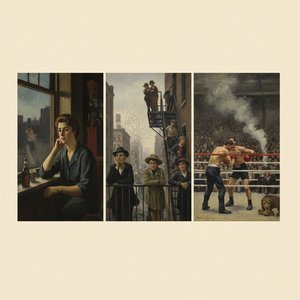
The Soul of American Modernism: The Life and Legacy of Arnold Blanch
In the vibrant tapestry of twentieth-century American art, few threads are as intricately woven as those left by Arnold Blanch. Born in the quiet landscape of Mantorville, Minnesota, in 1896, Blanch’s journey from the American Midwest to the heart of the New York avant-garde is a testament to a life defined by movement, discovery, and an unyielding commitment to the evolving language of modernism. His early years were steeped in a burgeoning creative curiosity, nurtured at the Minneapolis School of Art, where he first encountered his lifelong partner in art, Lucile Blanch. This foundational period provided the technical bedrock upon which he would later build a career characterized by profound versatility and emotional depth.
The Great War served as a transformative interruption to his studies, thrusting him into the broader world of Europe. It was during this time that the young artist stood before the masterpieces of the Louvre, absorbing the weight of art history while simultaneously witnessing the seismic shifts occurring in the Parisian ateliers. Upon returning to the United States, Blanch sought the pulse of the new age at the Art Students League of New and York. Under the mentorship of titans such as John Sloan, Robert Henri, Kenneth Hayes Miller, and Boardman Robinson, he began to synthesize traditional mastery with the radical energy of the burgeoning Social Realist movement. These mentors did more than teach him technique; they instilled in him a sense of social responsibility and a way of seeing that connected the canvas to the lived experience of the American people.
A Journey Through Color and Community
By 1923, Blanch had found his spiritual home in the legendary art colony of Woodstock, New York. This period was marked by an exquisite exploration of form and light, as he specialized in evocative landscapes and intimate still lifes that captured the very essence of rural American life. His work during these years reflected a sophisticated command of tonal gradations and a burgeoning interest in the fractured perspectives of Cubism and Futurism. As his reputation grew, so did his reach; a journey to the West Coast led him to teach at the California School of Fine Arts, where he forged unexpected connections with masters like Diego Rivera, further enriching his understanding of muralism and large-scale composition.
Blanch’s artistic output was never confined to a single medium. He was a true polymath of the printmaking world, moving seamlessly between the delicate precision of etching, the rich textures of lithography, and the bold expansiveness of mural painting. His involvement with the Works Progress Administration (WPA) allowed him to contribute to the monumental cultural projects of the era, most notably his mural “The Harvest” in Fredonia, New York. Through these works, he bridged the gap between high modernism and the public consciousness, using art as a tool for social cohesion during one of America's most turbulent decades.
Enduring Influence and Artistic Mastery
Beyond the canvas, Blanch’s legacy is etched into the very fabric of art education. As a dedicated teacher at the Art Students League for decades, he passed his rigorous standards and passion for experimentation to generations of emerging artists. His life was also defined by profound personal connections that mirrored his professional triumphs; his later years were shared with the artist Doris Lee, creating a partnership of immense creative synergy. Whether capturing the quietude of a still life or the sweeping drama of a landscape, Blanch’s work remains a vital touchstone for understanding the evolution of American Modernism.
Today, his contributions are preserved in the hallowed halls of the world's most prestigious institutions, ensuring that his vision continues to inspire:
- The Museum of Modern Art (MoMA), where his modernist sensibilities are celebrated.
- The Metropolitan Museum of Art, housing works that reflect his technical brilliance.
- The Smithsonian American Art Museum, preserving his role in the American narrative.
Arnold Blanch remains a symbol of an era when art was not merely an aesthetic pursuit, but a profound dialogue with history, society, and the human spirit.
Q&A
Arnold Blanchの出生地と誕生年はいつですか?
Arnold Blanchは1896年にMankatoで生まれました。
Arnold Blanchの作品をムード別に探すことはできますか?
アーティストのムード別ルームページでは、Arnold Blanchの作品をその雰囲気に合わせてご紹介しています。
Arnold Blanchの作品をカラーパレット別に閲覧することはできますか?
特定のカラーパレットでArnold Blanchの作品を探すには、アーティストのカラーパレット別ページをご利用ください。