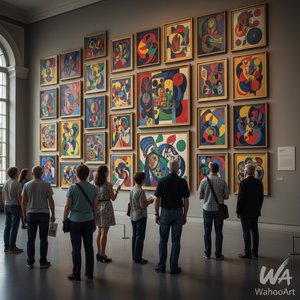
Arthur Goodwin: A Painter of Emotion and Texture
Arthur Goodwin (1922 – 1998) was a British artist whose distinctive style—characterized by vibrant still lifes, bold abstract compositions, and monumental mosaics—earned him recognition within the international art world. Born in London, his artistic journey began modestly but blossomed into a prolific career marked by experimentation and unwavering dedication to capturing the essence of visual experience.- Early Influences: Goodwin’s formative years were shaped by exposure to Impressionism and Post-Impressionism, particularly the works of Cézanne and Matisse. These artists instilled in him a profound appreciation for tonal variation and expressive brushwork—principles that would become central to his artistic vision.
- Formal Training: He pursued formal training at Chelsea School of Art and Slade School of Fine Art, honing his technical skills while simultaneously cultivating an intellectual understanding of art history and theory.
The Still Life Tradition Revisited
Goodwin’s early paintings predominantly focused on still lifes—fruit bowls overflowing with luscious colors, meticulously rendered draperies draped against textured backgrounds. However, he swiftly moved beyond mere imitation, injecting his canvases with palpable emotion and conveying a sense of immediacy that defied conventional stylistic conventions. His masterful handling of pigment—particularly oil paints—allowed him to achieve remarkable textural effects, simulating the appearance of skin, fabric, and stone with astonishing accuracy.- Notable Still Lifes: Among his most celebrated works are ‘Lemon’, ‘Apple’, and ‘Pear,’ each demonstrating Goodwin’s ability to transform commonplace objects into vehicles for artistic expression. Critics lauded his compositions for their dynamic balance and his skillful use of color—a palette that ranged from muted earth tones to dazzling hues reminiscent of Matisse.
Abstraction and Bold Color
As Goodwin matured as an artist, he increasingly embraced abstraction—rejecting representational imagery altogether in favor of purely visual elements. He experimented with geometric forms—squares, rectangles, circles—and explored the expressive potential of bold color combinations—often juxtaposing complementary hues to create striking visual contrasts.- Geometric Explorations: His abstract canvases—such as ‘Red Square’ and ‘Blue Rectangle’—were conceived as investigations into fundamental principles of visual perception. Goodwin sought to distill the complexities of artistic experience into simplified shapes and colors, demonstrating that profound meaning could be conveyed even in the absence of recognizable subjects.
Mosaic Art: Monumental Visions
Goodwin’s final artistic endeavors culminated in monumental mosaics—large-scale artworks crafted from tesserae—fragments of colored stone or glass—that adorned public spaces throughout Britain and beyond. These mosaics represented a culmination of his lifelong fascination with texture and color—a desire to transform surfaces into immersive environments that captivated the senses.- Public Commissions: He undertook numerous prestigious commissions, including mosaics for St Mary’s Cathedral in Edinburgh and the National Portrait Gallery in London. His mosaics were admired for their grandeur, their technical virtuosity, and their ability to evoke powerful emotional responses—testaments to Goodwin's enduring legacy as a visionary artist.
Legacy and Historical Significance
Arthur Goodwin’s artistic output stands apart from many of his contemporaries due to its unwavering commitment to conveying emotion through texture and color. He championed the expressive potential of abstraction—demonstrating that visual art could transcend representational conventions—and established himself as a pioneer in mosaic art—a medium that continues to inspire artists today. His work remains an important contribution to British modernism, reflecting the artistic sensibilities of a generation grappling with the challenges and opportunities presented by the postwar era.Q&A
Arthur Goodwinの全作品を通じた色彩の使い方を詳しく知ることはできますか?
Arthur Goodwinの作品のカラープロファイルは、アーティストのパレット・ゲノムページでご確認いただけます。
Arthur Goodwinの作品を3Dギャラリーで鑑賞できる場所はどこですか?
Arthur Goodwinの3Dミュージアムは、アーティストの作品をバーチャルな3Dギャラリーで鑑賞できるページです。
Arthur Goodwinの作品を、ムード別に探すにはどこへ行けばよいですか?
Arthur Goodwinのムード別ルームは、アーティストの作品をムード別にまとめたページです。