The Artistic Journey of Franz Ludwig Catel
Born in Berlin, Franz Ludwig Catel embarked on a creative odyssey that would eventually lead him to the heart of the Italian art scene. His early artistic endeavors were remarkably diverse, beginning not with a brush, but with the tactile precision of wood carving. This foundational skill in shaping form likely informed his later mastery of composition and structure. As his talents evolved, he transitioned into the delicate realm of book illustration, notably contributing ten plates for Goethe's Heredia and Dorothea in 1799. His progression through various media—from Indian ink to the fluid grace of watercolours—culminated in a significant achievement in 1806, when his large-scale watercolour piece, The Death of Nicholas of Bernau, earned him prestigious admission into the Berlin Academy.
The trajectory of Catel's life was profoundly shaped by his movements through Europe's great cultural capitals. Following his success in Berlin, he traveled to Paris in 1807 to immerse himself in the study of oil painting at the École des Beaux-Arts. This period of formal training provided him with the technical vocabulary necessary to navigate the complexities of light and shadow. However, it was his arrival in Rome in 1812 that would define his career. In the vibrant atmosphere of Italy, Catel became part of a distinguished circle of artists, drawing inspiration and advanced instruction from figures such as Koch, Overbeck, Schadow, and Cornelius. This connection to the new classic school of landscape painting allowed him to refine a style that blended architectural precision with atmospheric depth.
Mastery of Landscape and Genre
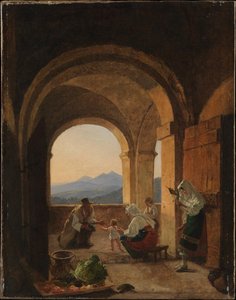
Catel’s artistic vision was characterized by an exquisite ability to marry the grandeur of nature with the intimacy of human experience. He found his true calling in landscapes that featured prominent architectural details or figures positioned in the foreground, a technique that often drifted into the realm of genre painting. His works are celebrated for their masterful use of perspective and a profound command over light and shade, creating immersive environments that invite the viewer to step into the scene. Whether capturing the sun-drenched courtyards of rural Italy in First Steps or the sweeping vistas of the Italian countryside, his paintings evoke a sense of harmony and classical balance.
His explorations were not limited to the Roman landscape; a visit to Sicily in 1818 significantly broadened the scope and breadth of his artistic ideas. This exposure to new terrains and light conditions enriched his palette and composition. His ability to capture the essence of a place—be it the nostalgic charm of a Sicilian life in Walk in Palermo or the dramatic, historical allure of Virgil's Tomb, Naples—demonstrates a versatility that resonated with the Romantic spirit of his era. Through his meticulous attention to detail and his ability to evoke emotion through scenery, Catel established himself as a significant voice in the nineteenth-century landscape tradition.
アーティストへのQ&A
Franz Ludwig Catelの作品を3Dギャラリーで鑑賞できる場所はどこですか?
バーチャルでの鑑賞も可能です:Franz Ludwig Catelの3Dギャラリーページでは、アーティストの作品を3Dギャラリーでご覧いただけます。
Franz Ludwig Catelの作品はどのくらい人気がありますか?
本サイトでは、Franz Ludwig Catelの作品に関する統計情報を掲載した閲覧統計ページをご覧いただけます。
Franz Ludwig Catelの出生地と誕生年はいつですか?
Franz Ludwig Catelは1778年、Berlinに生まれました。