Isaac Cooke: A Victorian Visionary of Landscape and Portraiture
Isaac Cooke (1846-1922) emerges from the canvas of late 19th-century England as a quietly significant artist, a master of capturing both the grandeur of the British landscape and the intimate details of human character. Born in Wahoo, Nebraska, to English immigrants, Cooke’s early life instilled within him a deep appreciation for the natural world – an influence that would profoundly shape his artistic trajectory. While he spent much of his adult life in England, particularly in Middlesbrough, North Yorkshire, his American roots subtly informed a unique perspective on light, color, and composition.
Cooke’s artistic journey began with studies in Chicago, where he honed his skills under the tutelage of George H. Reed. However, it was his relocation to England around 1870 that truly ignited his career. He quickly established himself as a portrait painter, initially focusing on capturing the likenesses of local notables and members of the landed gentry. His early portraits are characterized by a meticulous attention to detail, a subtle understanding of expression, and a restrained elegance – hallmarks of the Victorian aesthetic. Yet, it was his growing fascination with landscape painting that would ultimately define his legacy.
The Influence of Old Man Coniston
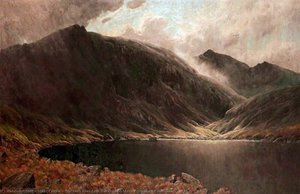
Cooke’s most celebrated works undoubtedly stem from his extended period spent documenting the dramatic scenery surrounding Lake Coniston in Cumbria. This imposing body of work, often referred to as “Old Man Coniston,” represents a pivotal moment in his artistic development. The rugged beauty of the fells, the moody skies, and the ever-changing light of the lake became central themes in his oeuvre. Unlike many landscape painters of the time who sought to romanticize nature, Cooke presented a more austere and realistic depiction – one that acknowledged the power and sometimes unforgiving nature of the environment.
The technique employed in these paintings is particularly noteworthy. Cooke utilized a layered approach, building up color gradually through numerous thin glazes, creating a remarkable sense of depth and atmospheric perspective. He was adept at capturing the subtle shifts in light and shadow, conveying the feeling of cold wind and dampness that permeated the Coniston region. His brushwork is often loose and expressive, yet always controlled, reflecting his deep understanding of color theory and composition.
Beyond Landscape: Portraits with a Quiet Intensity
While landscape dominated much of Cooke’s output, he never abandoned his portraiture skills. His portraits, particularly those painted later in life, possess a remarkable intimacy and psychological depth. He eschewed the overly flattering poses and theatrical lighting favored by some contemporary artists, instead opting for more naturalistic settings and capturing subjects with a quiet intensity. Subjects like Alfred Victor Smith, the Victoria Cross recipient, are rendered not as heroic figures but as men grappling with the realities of war and loss – a testament to Cooke’s ability to convey complex emotions through subtle gestures and expressions.
Cooke's portraits often feature elements of the landscape in the background, subtly connecting his subjects to their environment. This technique reflects his broader artistic philosophy: a belief that human experience is inextricably linked to the natural world. His portraits are not simply representations of individuals; they are windows into their souls.
A Legacy of Quiet Observation
Isaac Cooke’s work, though perhaps never achieving widespread fame during his lifetime, holds considerable historical significance. He represents a quieter, more understated voice within the vibrant artistic landscape of Victorian England. His meticulous observation, coupled with a deep understanding of light and color, produced paintings that are both visually stunning and emotionally resonant. His dedication to capturing the essence of both the British countryside and the human spirit ensures his place as a significant, if somewhat overlooked, figure in 19th-century art.
Today, Cooke’s works can be found in public collections across England, offering viewers a glimpse into the world of a talented artist who quietly observed and beautifully rendered the beauty and complexity of Victorian life. His legacy lies not in grand pronouncements or revolutionary techniques, but in the quiet power of his paintings – paintings that invite contemplation and evoke a profound sense of connection to both nature and humanity.
アーティストへのQ&A
カタログ内で閲覧可能なIsaac Cookeの作品数はいくつですか?
全作品一覧ページでは、Isaac Cookeによる作品数 8点点のアートワークをご覧いただけます。
Isaac Cookeが描いたすべての主題を一覧で確認することはできますか?
主題別アーカイブページでは、Isaac Cookeの作品を主題別に探すことができます。
Isaac Cookeの作品を特定のカラーパレットから探すには、どうすればよいですか?
Isaac Cookeの作品は、アーティストページのカラーパレットから探すからカラーパレット別に閲覧いただけます。