The Ethereal Landscapes of John Brandon Smith
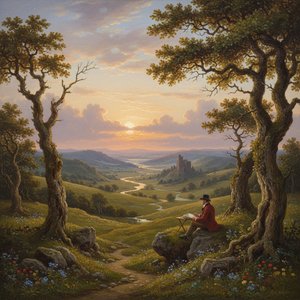
In the annals of Victorian landscape painting, few artists captured the raw, untamed spirit of the British wilderness with as much emotive power as John Brandon Smith. Born in London in 1848, Smith emerged during a period when the Romantic movement was deeply entwining itself with the natural world, seeking to find the sublime within the rugged corners of the United Kingdom. While his life was tragically brief, spanning only thirty-six years, his contribution to the depiction of the Welsh landscape remains a testament to a profound connection between the artist and the earth. His work does not merely document scenery; it seeks to translate the very pulse of falling water and the heavy, mist-laden atmosphere of the mountains into a visual language of texture and light.
Smith’s artistic journey began with a rigorous formal education at Somerset House, an institution that provided him with the technical discipline required to master the complexities of light and shadow. This foundational training instilled in him a meticulous attention to tonal harmony, yet his heart was never truly captured by the urbanity of London. Instead, he found his true muse in the dramatic topography of Wales. It was here, amidst the thunderous cascades of Gwynedd Falls and the secluded pools of the South Welsh valleys, that Smith developed his signature style. He became a chronicler of the ephemeral, obsessed with the way light fractures through spray and how the verdant mosses of the riverbanks absorb the dampness of the mountain air.
Technique and the Romantic Vision
To observe a Smith canvas is to witness a deliberate struggle between form and fluidity. Heavily influenced by the atmospheric legacies of Turner and Constable, Smith moved beyond mere topographical accuracy to embrace a more subjective, emotional realism. He was a master of impasto, applying thick, sculptural layers of paint to his canvases to mimic the physical ruggedness of the terrain he depicted. This technique allowed him to create surfaces that felt tactile, where the white of a waterfall was not just a color, but a raised, energetic movement of pigment that seemed to catch the light even in a darkened gallery.
His approach to composition often centered on the tension between the monumental and the intimate. In many of his most celebrated works, such as his depictions of the Lower Falls of Afon Hepste, he utilized a sophisticated blending of tonal gradations to guide the viewer's eye through the swirling mists. His brushwork was rarely static; it possessed a rhythmic quality that mirrored the constant motion of the rivers and streams that were his primary subjects. Through this expressive method, Smith achieved a sense of sublime beauty—a feeling of awe mixed with a touch of melancholy that is so characteristic of the late Romantic era.
Legacy and Historical Significance
Though John Brandon Smith passed away in 1884, leaving behind an unfinished body of work, his impact on the perception of the Welsh landscape continues to resonate. He belonged to a generation of British painters who helped define the national identity through the lens of its natural splendor. His ability to imbue a landscape with a sense of living, breathing energy ensured that his paintings were more than mere decorations; they were emotional experiences.
Today, collectors and art historians look to Smith as a vital link in the evolution of 19th-century landscape art. His work serves as a window into a vanished era of British Romanticism, reminding us of a time when the wildness of nature was viewed with both reverence and wonder. The enduring appeal of his paintings lies in their ability to transport the viewer to the edge of a misty precipice, feeling the cool spray of a waterfall and hearing the silent roar of the Welsh countryside through the masterful application of oil on canvas.
Q&A
カタログ内で閲覧可能なJohn Brandon Smithの作品数はいくつですか?
すべての作品一覧ページでは、John Brandon Smithによる作品数 11点点のアートワークをご覧いただけます。
John Brandon Smithの作品を、芸術運動(ムーブメント)別に閲覧することはできますか?
John Brandon Smithが活動した各ムーブメント(芸術運動)は、作品をムーブメント別に分類しているアーティストのすべてのムーブメントページでご覧いただけます。
John Brandon Smithの作品をカラーパレットごとにまとめて見られる場所はどこですか?
特定のカラーパレットでJohn Brandon Smithの作品を探すには、アーティストのカラーパレット別ページをご利用ください。