The Luminous Shadows of Orazio Samacchini
In the vibrant, intellectually charged atmosphere of late 16th-century Italy, few artists captured the tension between classical grace and Mannerist drama as effectively as Orazio Samacchino. Born in Bologna in 1532, Samacchini emerged from a city steeped in humanist tradition, a background that would later inform the profound allegorical depth of his compositions. His early years were defined by a rigorous apprenticeship under the celebrated Pellegrino Tibaldi, a master whose expressive use of color and emotional intensity provided the foundational blueprint for Samacchini’s burgeoning style. Through Tibaldi, the young artist learned to move beyond mere representation, seeking instead to infuse the human form with a palpable, often restless, vitality.
The trajectory of Samacchini’s career took a transformative turn in 1563 when he journeyed to Rome. This relocation placed him at the very epicenter of the artistic world during the transformative reign of Pope Pius IV. In the hallowed halls of the Vatican, Samacchini engaged in monumental collaborations that would cement his reputation among the elite. Working alongside the Zuccari brothers—Taddeo and Giovanni Battista—he contributed to the breathtaking decoration of the Vatican Belvedere and the Sala Regia. It was during this Roman period that his work began to absorb the sophisticated nuances of Venetian Mannerism, integrating a more luminous palette and a sense of compositional dynamism that echoed the influence of Titian.
A Mastery of Myth and Emotion
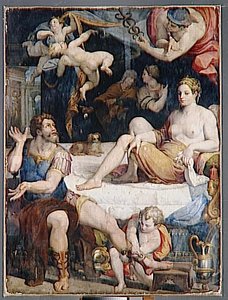
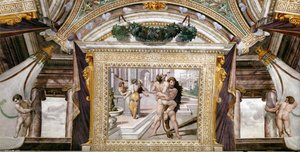
As Samacchini’s style matured, it became a captivating study in contrasts. He possessed a singular ability to manipulate light and shadow, creating chiaroscuro effects that lent his figures a sculptural presence and an almost theatrical weight. His subject matter frequently drifted between the sacred and the profane, navigating the complex narratives of classical mythology and profound religious devotion with equal fervor. In works such as Hercules and Antaeus, one can witness the raw power and muscular tension characteristic of the late Renaissance, while his mythological dramas, like the poignant Mercure ordonne à Énée d’abandonner Didon, showcase a sophisticated command of psychological tension and fate.
The artist's technical repertoire was as diverse as his inspirations. Whether executing grand-scale frescoes or more intimate panel paintings, Samacchini utilized intricate ornamentation and deliberately distorted figures to evoke the "maniera"—the stylized elegance that defined the era. His later works in Bologna and Parma reflect a synthesis of his various influences:
- The expressive, emotive brushwork inherited from Tibaldi.
- The grand, narrative scale required by papal commissions in Rome.
- The rich, atmospheric color palettes inspired by the Venetian school.
Legacy within the Mannerist Tradition
Though history often remembers the titans of the era like Michelangelo or Raphael, Orazio Samacchini remains a vital figure for understanding the transition of Italian art. His life, though tragically short—ending in 1577 at the age of forty-five—was marked by an unrelenting pursuit of artistic innovation. By blending the intellectual rigor of Bolognese humanism with the visual splendor of Roman and Venetian traditions, he helped cultivate a stylistic language that celebrated complexity, movement, and drama. His contributions to the churches of Bologna and the great palaces of Italy serve as enduring testaments to a master who could turn paint into poetry, capturing the fleeting beauty and the eternal struggles of the human condition.
アーティストへのQ&A
Orazio Samacchiniの作品を鑑賞できる3Dバーチャルツアーはありますか?
Orazio Samacchiniの3Dギャラリーでは、アーティストの作品をバーチャルな3Dギャラリーで鑑賞いただけます。
Orazio Samacchiniの作品を年代順に鑑賞できる場所はどこですか?
アーティストの作品の年表ページでは、Orazio Samacchiniの作品を制作年順に並べてご覧いただけます。
特定の技法によるOrazio Samacchiniの全作品を探すには、どうすればよいですか?
技法別一覧では、Orazio Samacchiniの作品を技法別にまとめています。