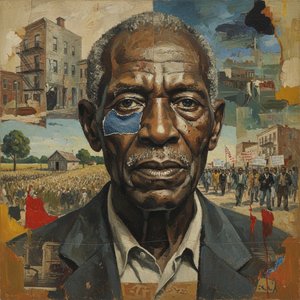
A Tapestry of Township Life: The Art of Sam Nhlengethwa
Sam Nhlengethwa, born in 1955 in Payneville township, Springs, Gauteng, South Africa, is more than just a collage artist; he’s a visual storyteller deeply rooted in the vibrant and often turbulent history of his nation. His work, characterized by layered magazine reproductions, intricate textures, and a palpable sense of rhythm, offers a poignant reflection on urban life, jazz music, and the enduring spirit of South Africa. Nhlengethwa's journey began not within formal art institutions, but in the everyday realities of township existence – a formative experience that profoundly shaped his artistic vision.
Growing up amidst the sounds of jazz and the rhythms of daily life in Springs, Nhlengethwa’s early years were marked by displacement. Following forced removals, his family relocated to Kwa-Themba, later settling in Ratanda, Heidelberg. This movement, coupled with a deep connection to his musical heritage – his brother was a renowned jazz musician – instilled within him a keen awareness of social change and the complexities of identity. He began collecting jazz records at 17, an activity that would become inextricably linked to his artistic practice, informing both the subject matter and the aesthetic sensibility of his work.
The Foundations: Early Training and Artistic Beginnings
Nhlengethwa’s formal art education commenced at the Evangelical Lutheran Church Art and Craft Centre in Rorke's Drift and later at the Johannesburg Art Foundation. These early experiences provided him with foundational skills while simultaneously exposing him to a burgeoning artistic community. Crucially, he established his own practice of exchanging artwork for others, fostering a collaborative spirit that would become a hallmark of his career. This informal apprenticeship, fueled by shared passion and mutual exchange, laid the groundwork for his later work with the Bag Factory Artists’ Studio.
The Bag Factory, co-founded in 1991, represented a pivotal moment in South African art history. It provided a vital space for black artists to develop their careers, fostering dialogue and collaboration within a context often marginalized by the dominant art establishment. Nhlengethwa’s involvement with the studio solidified his commitment to representing the experiences of ordinary people, particularly those residing in townships – a theme that would dominate much of his oeuvre.
Collage as Commentary: Style and Technique
Nhlengethwa's distinctive collage style is immediately recognizable. He meticulously cuts and arranges fragments from magazines—advertisements, fashion spreads, news clippings—creating layered compositions that evoke the chaotic energy of urban environments. The use of hard-edge cuts juxtaposed with soft textures generates a dynamic tension, mirroring the complexities of South African society. His work isn’t simply decorative; it's a deliberate act of commentary, transforming ephemeral images into enduring statements about culture, identity, and social change.
Beyond collage, Nhlengethwa has also explored photogravure and lithography, techniques that further enhance the textural richness and layered narratives within his work. These processes allow him to create subtle tonal variations and intricate patterns, adding depth and nuance to his compositions. He often incorporates elements of jazz—patterns reminiscent of musical scores or rhythmic arrangements—into his collages, reflecting his lifelong fascination with this influential genre.
Recognition and Legacy
Nhlengethwa’s artistic achievements have been widely recognized both within South Africa and internationally. In 1994, he was awarded the prestigious Standard Bank Young Artist of the Year award, a testament to his emerging talent and commitment to representing the experiences of marginalized communities. His work has been exhibited in major galleries and museums across the globe, including Carnegie Hall in New York City and the Venice Biennale.
Throughout his career, Nhlengethwa has remained dedicated to fostering artistic community and supporting emerging artists. His co-founding of the Bag Factory Artists’ Studio stands as a lasting legacy—a testament to his belief in the power of collaboration and the importance of providing opportunities for black artists to thrive. Sam Nhlengethwa's art is not merely a reflection of South Africa’s past; it’s an ongoing exploration of its present, offering a powerful and enduring commentary on identity, memory, and the resilience of the human spirit.
アーティストへのQ&A
Samson Mgudlandlu Nhlengethwaの出身地はどこですか?
Samson Mgudlandlu Nhlengethwaの出身国はSouth Africaです。
Samson Mgudlandlu Nhlengethwaの作品を特定のカラーパレットから探すには、どうすればよいですか?
Samson Mgudlandlu Nhlengethwaの作品は、アーティストページのカラーパレットから探すからカラーパレット別に閲覧いただけます。
Samson Mgudlandlu Nhlengethwaの作品一覧はすべて確認できますか?
本サイトにおけるSamson Mgudlandlu Nhlengethwaのすべての作品は、アーティストの全作品一覧ページからご覧いただけます。