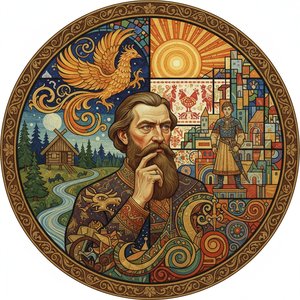
Stanislav Zhukovsky: Pioneer of Russian Abstract Expressionism
Stanislav Yulianovich Zhukovsky (1873–1944) stands as a singular figure in the annals of Russian art, recognized primarily for his contribution to Suprematism and Cubism – movements that fundamentally reshaped the visual landscape of the early 20th century. Born in Saint Petersburg, Zhukovsky’s artistic journey began amidst the intellectual ferment of the era, absorbing influences from Impressionism and Symbolism before decisively embracing radical abstraction. His work transcends mere representation; it delves into a realm of pure geometric forms and tonal harmonies, reflecting a profound engagement with philosophical concepts rooted in Russian Orthodox spirituality and Nietzschean thought.- Early Influences: Zhukovsky’s formative years coincided with the blossoming Impressionist movement in France, exposing him to artists like Monet and Sisley who championed capturing fleeting moments of light and color. Simultaneously, Symbolism captivated him with its exploration of inner psychological states and mythological narratives – a fascination evident in his initial canvases.
- The Embrace of Cubism: Around 1910 Zhukovsky transitioned to Cubism, aligning himself with the avant-garde fervor sweeping across Europe. He adopted Picasso’s analytical approach, dissecting objects into fragmented planes and presenting multiple perspectives simultaneously. This stylistic shift signaled a rejection of traditional illusionistic techniques in favor of intellectual rigor and conceptual innovation.
- Suprematism: Zhukovsky's most enduring legacy resides in his pioneering role as one of the founders of Suprematism, alongside Kazimir Malevich. Rejecting any reference to external reality, Suprematists sought to express pure spiritual concepts through geometric shapes – primarily squares and circles – arranged on a white background. Zhukovsky’s Suprematist compositions embody an uncompromising commitment to reducing art to its elemental essence.
Notable Works & Artistic Style
Zhukovsky's oeuvre comprises approximately 300 paintings, predominantly landscapes and interiors rendered in meticulous detail. However, his artistic brilliance truly shone through in his Suprematist masterpieces – “Black Square” (1915) and “White on White” (1918), which are considered seminal works of the movement. His technique involved layering thin washes of color onto primed canvas, achieving remarkable tonal gradations that conveyed depth and luminosity despite the absence of recognizable imagery. Zhukovsky’s meticulous observation of nature combined with his conceptual daring established him as a pivotal voice in Russian artistic discourse.- Key Paintings: Among his celebrated canvases are “Evening Interior,” depicting a tranquil domestic scene bathed in soft light; “May,” capturing the vibrant hues of springtime blossoms; and “The Fresh Snow,” portraying a serene winter landscape imbued with symbolic resonance. These works exemplify Zhukovsky’s masterful command of color and composition.
- Theoretical Contributions: Zhukovsky actively participated in discussions surrounding artistic theory, advocating for the liberation of art from representational constraints. He championed Malevich's radical ideas about reducing painting to its fundamental geometric forms – a stance that profoundly impacted the trajectory of Suprematism.
Legacy & Historical Significance
Stanislav Zhukovsky’s influence extends far beyond his immediate artistic output. His unwavering belief in the transformative power of abstraction paved the way for subsequent generations of Russian artists to explore uncharted territories of visual expression. He remains a revered figure within Suprematist circles and is recognized as an indispensable contributor to the broader context of Russian Modernism. Zhukovsky’s uncompromising vision continues to inspire contemplation on the relationship between art, spirituality, and the human condition—a testament to his enduring artistic significance.アーティストへのQ&A
Stanislav Zhukovskyの作品一覧はすべて確認できますか?
本サイトにおけるStanislav Zhukovskyのすべての作品は、アーティストの全作品一覧ページからご覧いただけます。
Stanislav Zhukovskyの作品を技法別にまとめて閲覧できる場所はどこですか?
Stanislav Zhukovskyの作品は、技法別一覧にて技法別に閲覧いただけます。
Stanislav Zhukovskyは、どの時代に活動していましたか?
Stanislav ZhukovskyはModernに活動していました。この時代背景は、その画家の足跡を歴史の中に位置づけるものです。