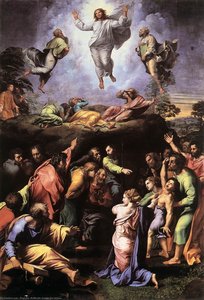
캔버스에 유채.

§ 1카탈로그 정보


§ 2추상
수집품 상세 설명
Discover Raphael’s ‘St John the Baptist,’ a masterpiece of the High Renaissance! Explore its tempera on canvas beauty, classical style & profound symbolism at the Hermitage.
 더 보기
더 보기
작가 프로필
라파엘로(1483-1520): 르네상스 시대의 거장으로, '아테네 학당'과 아름다운 마돈나 그림으로 유명합니다. 우르비노 출신으로 고전적 이상미를 담은 작품들은 서양 미술사에 큰 영향을 미쳤습니다.
§ 3해설
A Vision of Contemplation: Raphael’s St John the Baptist
Raphael’s *St John the Baptist*, painted in 1506, is a captivating early work that showcases the artist's burgeoning talent for portraying human beauty and psychological depth. This painting isn’t merely a depiction of a biblical figure; it’s an intimate study of youth, faith, and nascent spirituality. The artwork currently resides in the Hermitage Museum, St. Petersburg, offering viewers a glimpse into Raphael’s mastery even before his High Renaissance peak.Subject & Composition
The painting presents a young St John, nude save for a crimson cloak draped artfully over his shoulder, seated amidst a dark and somewhat ambiguous landscape. He holds a reed cross in his left hand – a subtle yet potent symbol of his future destiny as the herald of Christ – while his right hand is raised in a gesture that can be interpreted as both pointing towards heaven and acknowledging divine inspiration. The composition is remarkably balanced; St John’s relaxed pose, combined with the gentle curve of his body, creates a sense of serene contemplation. He isn't presented as an austere prophet but rather as a beautiful youth on the cusp of fulfilling his sacred role.Style & Technique
*St John the Baptist* exemplifies Raphael’s early style, blending influences from Umbrian masters like Perugino with emerging Renaissance ideals. The use of tempera on canvas – a technique common during this period – allows for delicate layering and luminous color application. Raphael's skill in rendering anatomy is evident, though softened by a characteristic gracefulness that distinguishes his work from the more muscular figures favored by Michelangelo. The sfumato technique, borrowed from Leonardo da Vinci, subtly blurs outlines, creating an ethereal quality and enhancing the figure’s three-dimensionality. The dark background serves to accentuate St John's form, drawing the viewer’s eye directly to his face and expressive gesture.Historical Context & Symbolism
Created during a period of intense religious fervor and artistic innovation, *St John the Baptist* reflects the Renaissance fascination with classical antiquity and humanism. The depiction of St John as an idealized nude figure draws upon ancient Greek and Roman sculptural traditions. However, Raphael imbues this classical form with Christian symbolism. The reed cross signifies St John’s role as a precursor to Christ, while his gaze directed upwards suggests a connection to the divine realm. The landscape itself, though dark, hints at the wilderness where St John preached repentance. The crimson cloak is often interpreted as foreshadowing the blood he will shed for his faith.Emotional Impact & Interpretation
This painting evokes a sense of quiet reverence and introspective beauty. It’s not a dramatic or overtly emotional work; instead, it invites viewers to contemplate the inner life of St John – his vulnerability, his devotion, and his acceptance of his divine calling. The artwork's enduring appeal lies in its ability to connect with universal themes of faith, self-discovery, and spiritual awakening. The painting’s subtle sensuality, combined with its religious subject matter, creates a compelling tension that continues to captivate audiences centuries later.For Collectors & Designers
- A high-quality reproduction of *St John the Baptist* would serve as a stunning focal point in any interior space, adding a touch of Renaissance elegance and spiritual depth.
- The painting’s muted color palette – dominated by warm earth tones and subtle reds – complements a variety of décor styles, from traditional to contemporary.
- Its intimate scale makes it suitable for both smaller rooms and larger galleries.
- As a testament to Raphael's genius, this artwork represents not only an aesthetic investment but also a connection to one of the most influential artists in history.
질의응답
라파엘로의 "St John the Baptist"은 어느 시대의 작품인가요?
라파엘로의 "St John the Baptist"은(는) 르네상스 시대의 작품으로, 이 시기는 해당 작품의 역사적 배경을 잘 보여줍니다.
라파엘로의 "St John the Baptist"의 프린트 제품은 어디에서 구매할 수 있나요?
라파엘로의 "St John the Baptist"의 프린트는 해당 작품의 파인 아트 프린트 페이지에서 간편하게 주문하실 수 있습니다: 코튼 캔버스 또는 아카이브용 캔버스지에 인쇄된 파인 아트 프린트.
라파엘로의 다른 이름이나 별칭에는 무엇이 있나요?
라파엘로은(는) 레오나르도 산치오 다 우르비노, 라파엘로 산치오라는 이름으로도 활동하고 있습니다.



 프린트 판매로 전환


 가로 또는 세로 중 어느 한 면이라도 105cm(약 41인치)를 초과하는 작품이나 복제화의 경우, 프레임은 분해된 키트 형태로 배송됩니다. 이는 안전한 배송을 보장하고 운송 중 발생할 수 있는 손상을 방지하기 위함입니다.