Gwarancja zwrotu pieniędzy · 100 dni Darmowa dostawa na cały świat
449 587dzieła sztuki 30 613artyści 4 660muzea 32język
Catalogue entry

untitled (1185)

Acrylic On Canvas.

Fig. 1. Gustaw Moreau, untitled (1185). Shown as the reproduction you are specifying: , .

§ 1Catalogue data

§ 2Abstract

Opis obiektu

Explore Gustave Moreau’s "Untitled (1185)", a dramatic Symbolist painting of Arion's myth. Intense emotion, turbulent composition & earthy tones depict primal forces. Discover this unique artwork!

Biografia artysty

Poznaj Gustave Moreau – francuskiego mistrza Symbolizmu! Jego dzieła fascynują bogactwem kolorów i głęboką symboliką. Odkryj jego niezwykły świat sztuki XIX wieku!

§ 3Commentary

A Tempestuous Encounter: Decoding Gustave Moreau’s “Untitled (1185)”

This captivating painting by Gustave Moreau plunges viewers into a dramatic and emotionally charged scene drawn from classical mythology – most likely an interpretation of the legend of Arion, the Greek poet saved from drowning by a dolphin after being thrown overboard by treacherous sailors. The work exemplifies the height of Symbolist artistry, prioritizing evocative power and psychological depth over strict realism.

Style & Technique: A Masterclass in Romantic Symbolism

Moreau’s style is instantly recognizable for its blend of meticulous detail and a dreamlike atmosphere. “Untitled (1185)” showcases his signature approach: loose, expressive brushwork that builds texture and conveys a sense of turbulent energy. The painting leans heavily into the Romantic tradition with its emphasis on intense emotion, dramatic lighting, and a sublime – yet menacing – landscape. However, Moreau transcends simple Romanticism through his Symbolist lens, imbuing the scene with layers of allegorical meaning. Oil paints are expertly manipulated to create both velvety smoothness in areas like the woman’s skin and rugged impasto in the rocky terrain.

Subject & Composition: Chaos and Resilience

The composition is powerfully pyramidal, drawing the eye upwards towards the monstrous serpent – a multi-headed creature rising from the murky depths. This serpentine form dominates the scene, embodying primal forces and potential evil. Scattered around the base of this visual pyramid are nude male figures, suggesting sacrifice, defeat, or perhaps the remnants of those who succumbed to the sea’s dangers. At the heart of the chaos stands a beautiful woman in classical garb; her presence offers a focal point of resilience amidst the turmoil. The rugged landscape – towering cliffs and a restless body of water – further amplifies the sense of drama and isolation.

Color & Light: An Earthy Palette with Luminous Accents

Moreau employs a predominantly earthy color palette, dominated by browns, ochres, and greys that evoke a somber and foreboding mood. This subdued base is punctuated by lighter tones – beige and cream – used to illuminate the central female figure, drawing attention to her vulnerability and strength. Hints of green in the foliage provide fleeting moments of life within the desolate scene, while the serpent itself shimmers with shades of green, brown, and gold, emphasizing its otherworldly nature. Dramatic lighting creates stark contrasts between light and shadow, heightening the emotional impact and sense of mystery.

Symbolism & Interpretation: Unveiling Hidden Meanings

The painting is rich in symbolism. The serpent represents not only danger but also primal instincts and untamed forces. The woman embodies resilience, perhaps even a personification of beauty confronting adversity. The nude figures can be interpreted as symbols of mortality or the consequences of unchecked ambition. Moreau’s work often explores themes of good versus evil, the power of myth, and the complexities of the human psyche. This piece invites contemplation on the fragility of life, the enduring strength of the human spirit, and the eternal struggle between order and chaos.

Historical Context & Legacy

Gustave Moreau (1826-1898) was a pivotal figure in the Symbolist movement, rejecting the realism of earlier art movements in favor of subjective experience and imaginative expression. His work profoundly influenced later artists such as Henri Matisse and Georges Rouault. While initially falling out of favor after his death, Moreau’s artistry has experienced a significant reevaluation since the 1960s, solidifying his place as one of the most important Symbolist painters. Visiting the Musée Gustave Moreau in Paris offers an unparalleled opportunity to immerse oneself in his unique artistic world.

Emotional Impact & Interior Design

“Untitled (1185)” is a painting that demands attention and evokes strong emotions. Its dramatic composition, rich symbolism, and masterful technique create a captivating visual experience. For interior design, this artwork would serve as a striking focal point in a study, library, or living room, adding depth, sophistication, and a touch of mystique to any space. A high-quality reproduction allows art enthusiasts to bring the power and beauty of Moreau’s vision into their homes.

Pytania i odpowiedzi

Czy można pobrać obraz "untitled (1185)"?

Obraz „untitled (1185)” – Gustaw Moreau można pobrać na stronie Pobierz plik cyfrowy dzieła: wysokiej rozdzielczości cyfrowe zdjęcie do pobrania.

Z jakiego kraju pochodzi dzieło Symbolism pt. "untitled (1185)"?

Dzieło z nurtu Symbolism, zatytułowane "untitled (1185)", zostało stworzone przez artystę urodzonego w Francja.

W jakim pomieszczeniu najlepiej wyeksponować "untitled (1185)", biorąc pod uwagę jego paletę barw?

Dzięki swojej palecie barw Earthy, dzieło „untitled (1185)” – Gustaw Moreau idealnie sprawdzi się w Living Room. Kolorystyka jest jedną z przyczyn tej rekomendacji.
§ 4The artist

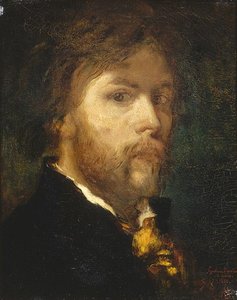
Gustaw Moreau

Gustaw Moreau

1826 - 1898, Francja

Quick facts about Gustaw Moreau

  • Artistic Movement Or Style: Symbolizm
  • Artists Or Movements Influenced By This Artist:
    • Matisse
    • Rouault
  • Artists Who Influenced This Artist:
    • Delacroix
    • Michelangelo
  • Date Of Birth: 6 kwietnia 1826
  • Date Of Death: 18 kwietnia 1898
  • Full Name: Gustave Moreau
  • Nationality: Francuz
  • Notable Artworks:
    • Salome tańcząca
    • Prometeusz
    • Święta Elżbieta
  • Place Of Birth: Paryż, Francja

Biografia artysty

A Dream Weaver of Symbolism: The Life and Art of Gustave Moreau

Gustave Moreau, a name inextricably linked to the ethereal beauty and profound mysteries of Symbolist painting, emerged from 19th-century Paris as an artist utterly distinct in his vision. Born in 1826 into a comfortable bourgeois family—his father an architect and archivist—Moreau’s early life was steeped in intellectual curiosity and a deep appreciation for aesthetics. From a remarkably young age, he displayed a prodigious talent for drawing, nurtured through the rigorous training of the École des Beaux-Arts under esteemed figures like François-Édouard Picot. However, Moreau's artistic trajectory swiftly diverged from the prevailing Realist and Impressionist currents dominating his time. He wasn’t driven by a desire to capture fleeting moments or represent objective reality; instead, he sought to unlock the hidden realms of myth, religion, and the intricate workings of the human psyche through a deeply personal and symbolic visual language. His artistic journey became an inward exploration, translating subjective emotions and spiritual yearnings onto canvas with meticulous detail and a palette often rich in vibrant, almost opulent hues.

The Forge of Imagination: Influences and Artistic Development

Moreau’s artistic development wasn't forged in isolation. While rejecting the dominant trends of his era, he drew inspiration from a remarkably diverse range of sources. The dramatic use of color and exotic subject matter found in the works of Eugène Delacroix ignited within him a passionate interest in narrative painting imbued with intense emotionality. He held Renaissance masters—Michelangelo and Leonardo da Vinci, in particular—in the highest esteem, deeply admiring their mastery of composition, anatomical precision, and their remarkable ability to penetrate the complexities of human psychology. Yet, Moreau wasn’t merely imitating these giants; he was synthesizing their influences into something entirely new, a distinctly personal style. His pivotal journey to Italy during the 1850s proved transformative, immersing him in the art of antiquity and the Renaissance. This experience provided an unparalleled wealth of motifs and stylistic cues that would subsequently populate his future works. He meticulously copied Old Master paintings—not as mere reproductions, but as a means of absorbing their techniques and unlocking their secrets—carefully studying brushstrokes, color palettes, and compositional strategies. This dedication to craft, combined with his burgeoning fascination with mythology and literature, formed the bedrock of his unique artistic vision.

A World of Symbols: Themes and Techniques

Moreau’s paintings are not simply illustrations of myths or biblical stories; they are complex allegories designed to provoke contemplation and interpretation. He didn't aim to retell these narratives literally but rather to explore their underlying psychological and spiritual truths. His canvases are populated with a rich tapestry of symbolic imagery—serpents representing temptation, jewels signifying earthly desires, and figures embodying abstract concepts such as grief, loss, or redemption. He masterfully created an atmosphere of dreaminess through intricate detail, shimmering textures, and often unsettling juxtapositions of light and shadow. Moreau’s technique was characterized by a painstaking layering of paint—a deliberate process that resulted in surfaces brimming with iridescent colors and evoking a sense of otherworldly beauty. His skillful use of gold leaf further enhanced this effect, lending his works a Byzantine quality that underscored their spiritual dimension. He prioritized the expressive power of color and form over strict adherence to realistic representation, focusing on conveying mood and meaning rather than photographic accuracy.

Notable Works and Legacy

Throughout his career, Moreau produced an astonishing body of work, including iconic paintings such as *Salomé tańcząca przed Herodem* (Salome Dancing before Herod), *Jupiter i Semele*, *Orfeusz*, *Widzenie*, and *Święta Elżbieta z Anglii lub Cud róż*. These works demonstrate his extraordinary skill in depicting mythological scenes, biblical narratives, and allegorical themes. Moreau’s influence extended far beyond the Symbolist movement itself. He mentored numerous artists at the École des Beaux-Arts, encouraging them to embrace imagination, symbolism, and individual expression—a radical departure from the prevailing academic norms of the time. Though initially met with mixed reactions, Moreau's work gained recognition in the late 19th and early 20th centuries, solidifying his place as a pivotal figure in modern art. Today, the Musée Gustave Moreau in Paris stands as a testament to his enduring legacy—a sanctuary where visitors can immerse themselves in the captivating world of this extraordinary artist, experiencing firsthand the power and beauty of his symbolic vision.

Key Characteristics

  • Symbolic Imagery: Moreau’s paintings are replete with symbols representing complex ideas and emotions.
  • Dreamlike Atmosphere: He skillfully created an ethereal and otherworldly atmosphere through meticulous detail and color manipulation.
  • Rich Palette: His use of vibrant, often opulent colors contributed to the overall sense of mystery and beauty.
  • Influence of Renaissance Masters: Moreau drew inspiration from the techniques and philosophies of Michelangelo and Leonardo da Vinci.

§ 5Comparanda

§ 6Questions

Najważniejsze informacje

  • artist: Gustave Moreau
  • style: Romantic
  • medium: oil on canvas
  • movement: Symbolism

Quiz o sztuce

Do każdego pytania dotyczy tylko jedna poprawna odpowiedź.

Pytanie 1:
To which artistic movement does Gustave Moreau's 'untitled (1185)' most strongly belong?
Pytanie 2:
The scene depicted in 'untitled (1185)' is likely referencing which mythological tale?
Pytanie 3:
What is a dominant characteristic of the brushwork in this painting, contributing to its overall effect?
Pytanie 4:
The color palette used by Moreau in 'untitled (1185)' is best described as:
Pytanie 5:
What symbolic role does the serpent likely play within the composition?

§ 7Cite this entry

AllPaintingsStore.com, “Gustaw Moreau, untitled (1185)”, https://allpaintingsstore.com/pl/art/gustave-moreau-untitled-1185-9GF2C3-en/ArtistReproduction/ (accessed 4 Październik 2026).

§ 8The reproduction

Ręcznie malowana reprodukcja olejowa

Ręcznie malowany obraz olejny na płótnie, wykonany na zamówienie przez naszych artystów w wybranym przez Ciebie wymiarze i oprawie. ( Przełącz na wydania drukowane Przejdź do wersji cyfrowej)

It is specified on the order sheet in the margin; the present state of that sheet reads as follows.

untitled (1185)

Technika reprodukcji

Wymiary reprodukcji

-

Wybitny mistrz artystyczny

Większa szczegółowość, finezja i dodatkowy czas na realizację

-

Opcje oprawy reprodukcji

-

-

W przypadku dzieł sztuki lub reprodukcji, których którykolwiek z boków przekracza 105 cm (około 41 cali), rama zostanie wysłana w formie zestawu do samodzielnego montażu. Metoda ta zapewnia bezpieczną dostawę i zapobiega uszkodzeniom podczas transportu.

Wymagany profesjonalny montaż – nie jest to produkt typu DIY.
Zestaw musi zostać złożony, a płótno naciągnięte przez doświadczonego profesjonalnego ramiarza, przy użyciu kleju do drewna (brak w zestawie), kleszczy do naciągania płótna oraz ścisków, które utrzymają krosna w równej pozycji podczas schnięcia kleju. Nieprawidłowy montaż lub nierównomierne napięcie płótna może trwale uszkodzić dzieło sztuki i nie podlega naszej gwarancji.

  • W zestawie znajdują się wszystkie listwy z litego drewna, precyzyjnie docięte do wymiarów.

  • Montaż odbywa się przy użyciu dołączonych wkrętów oraz kleju do drewna do łączenia narożników, którego zestaw nie zawiera i który musi zostać dostarczony przez ramiarza.

  • Wymagane są profesjonalne narzędzia, których nie ma w zestawie: kleszcze do naciągania płótna (napinacz) oraz zaciski, które pozwolą utrzymać listwy w równej pozycji podczas schnięcia kleju.

Ważne:
Do połączenia narożników niezbędny jest klej do drewna, listwy należy unieruchomić za pomocą ścisków do momentu całkowitego wyschnięcia kleju, a naciągnięcie płótna na złożoną ramę wymaga użycia kleszczy do naciągania płótna. Żaden z tych elementów nie jest dołączony do zestawu. Przed zamówieniem tego rozmiaru zalecamy konsultację z doświadczonym ramiarzem.

Etykieta obiektu

-

-

Lakier ochronny

Lakier z połyskiem (pogłębia kolory, chroni przed światłem i wilgocią)

-

Personalizacja dzieła

Przykłady możliwości personalizacji: zastąp twarz zdjęciem klienta; dodaj zwierzę domowe (np. zamień kota na psa); umieść ukrytą wiadomość w tle; zmień krajobraz lub elementy tła.

-

Ekspresowa

Dostawa na cały świat () w ciągu 3–4 tygodni zamiast standardowych 5 tygodni. (1 Listopad). Bez kompromisów w kwestii jakości.

-

Przesyłka ekspresowa

Dostawa na cały świat () w ciągu 5 tygodni. (8 Listopad).

W cenie

Cena całkowita

zł 1004

Included with every order

  • Bezpłatna ekspresowa wysyłka na cały świat
  • Wysokiej jakości płótno lniane
  • Pełne ubezpieczenie przesyłki
  • Gwarancja zwrotu należności celnych i podatków importowych
  • Gwarancja wiernego odwzorowania kolorów
  • 100-dniowa polityka zwrotów (tylko w przypadku wad)
  • Gwarancja 100% zwrotu pieniędzy
  • Zniżka przy zakupie wielu sztuk
Order sheet