Money-Back Guarantee · 100 days Free Worldwide Delivery
449,564artworks 30,613artists 4,658museums 32languages
Catalogue entry

Self-Portrait on the Bordeline Between Mexico and the United States

Oil On Canvas.

Fig. 1. Frida Kahlo, Self-Portrait on the Bordeline Between Mexico and the United States. Shown as the reproduction you are specifying: , .

§ 1Catalogue data

§ 2Abstract

Collectible Description

Explore Frida Kahlo's powerful 'Self-Portrait on the Borderline...' (1932). This iconic work blends Mexican heritage & surrealism, depicting cultural identity and displacement during her time in the US.

Artist Biography

Frida Kahlo's surrealist self-portraits like The Two Fridas define her legacy. Explore her iconic works and vibrant Mexican heritage today.

§ 3Commentary

Self-Portrait on the Borderline Between Mexico and the United States: A Divided Identity

Frida Kahlo's Self-Portrait on the Borderline between Mexico and the United States, painted in 1932, is a poignant exploration of identity, cultural displacement, and national allegiance. Created during a period when her husband, Diego Rivera, was undertaking mural projects in the United States, this painting encapsulates Kahlo's complex feelings about living abroad while deeply connected to her Mexican heritage. It stands as one of her most significant works, offering a powerful visual commentary on the clash between two cultures and the internal struggles of an artist navigating shifting landscapes.

Artistic Style and Technique: Surrealism Meets Folk Art

Kahlo's artistic style is characterized by its unique blend of Mexican folk art traditions and surrealist elements. This painting exemplifies this fusion, employing vibrant colors and bold brushstrokes typical of her aesthetic. The oil on canvas medium allows for rich textures and a palpable sense of emotion. While often associated with Surrealism, Kahlo herself resisted the label, stating that she painted her own reality rather than dreams. In Self-Portrait on the Borderline, this "own reality" is starkly divided – one half representing Mexico, the other, the United States. The composition itself is carefully constructed to emphasize this dichotomy, with a clear visual separation between the two sides of the border.

Symbolism and Historical Context: A Nation Divided

The painting's symbolism is layered and deeply personal. Kahlo depicts herself standing on a stone marker that signifies the boundary between Mexico and the United States. Her attire reflects this division; one side adorned in traditional Mexican clothing, representing her cultural roots and identity, while the other features more modern American garments, symbolizing her temporary residence and exposure to a different way of life. The barren landscape behind her underscores the sense of separation and alienation she felt. The industrial backdrop on the U.S. side—a Ford factory with smoking chimneys—contrasts sharply with the lush vegetation and pre-Columbian ruins representing Mexico. This juxtaposition critiques the perceived coldness and industrialization of American society compared to the vibrancy and historical richness of her homeland. The Mexican flag, held proudly by Kahlo, serves as a declaration of her unwavering loyalty to her country.

Emotional Impact: A Portrait of Longing and Resilience

Self-Portrait on the Borderline between Mexico and the United States evokes a profound sense of longing and internal conflict. The painting is not merely a depiction of two nations but an exploration of Kahlo's own fractured identity. Her expression, though stoic, hints at the emotional toll of being caught between worlds. Despite the evident division, there’s also a quiet strength in her posture—a resilience that speaks to her determination to maintain her cultural heritage amidst unfamiliar surroundings. The painting resonates with viewers because it taps into universal themes of belonging, displacement, and the search for identity, making it both deeply personal and universally relatable.

Questions & Answers

Can I use augmented reality to see "Self-Portrait on the Bordeline Between Mexico and the United States" by Frida Kahlo in my room?

"Self-Portrait on the Bordeline Between Mexico and the United States" by Frida Kahlo can be previewed on your own wall with the artwork's AR Preview page, using augmented reality on a compatible device.

How do medium and movement combine in "Self-Portrait on the Bordeline Between Mexico and the United States"?

"Self-Portrait on the Bordeline Between Mexico and the United States" by Frida Kahlo combines the oil on canvas technique with the Surrealism style. Technique and movement describe the making and the style of the work.

Which period of Frida Kahlo's career does "Self-Portrait on the Bordeline Between Mexico and the United States" belong to?

"Self-Portrait on the Bordeline Between Mexico and the United States" represents the Early-Mid Period of Frida Kahlo.
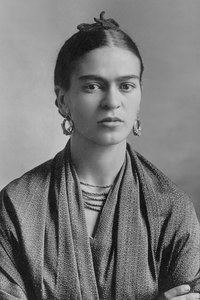
§ 4The artist

Frida Kahlo

Frida Kahlo

1907 - 1954, Mexico

Quick facts about Frida Kahlo

  • Artistic Movement Or Style: Surrealism, Mexican folk art, Realism
  • Artists Or Movements Influenced By This Artist:
    • Surrealism
    • Feminist art
  • Artists Who Influenced This Artist: ['Diego Rivera']
  • Full Name: Magdalena Carmen Frieda Kahlo y Calderón
  • Nationality: Mexican
  • Notable Artworks:
    • The Two Fridas
    • Self Portrait with Thorn Necklace
    • The Broken Column
    • Henry Ford Hospital
    • Viva la Vida
  • Place Of Birth: Coyoacán, Mexico
  • Date Of Birth: 1907
  • Date Of Death: 1954

Artist Biography

Early Life and Family Background

Coyoacán, Mexico City, provides the setting for the birth of Magdalena Carmen Frieda Kahlo y Calderón on July 6, 1907. Her household is a convergence of different lineages. Her father, Guillermo Kahlo, works as a German-Mexican photographer. Her mother, Matilde, carries both Amerindian and Spanish descent. This domestic landscape shapes the early years of Frida Kahlo, a child whose physical reality begins to shift under the weight of illness.

At six years old, polio strikes. The disease leaves her with a permanent limp, a physical marker that will persist through her adulthood. She navigates a childhood defined by this vulnerability, yet her environment remains intellectually active. By 1922, she enters the National Preparatory School in Mexico City, one of only thirty-five female students in the institution. She is outspoken and brave in a space dominated by men.

A Life Defined by Physical Pain

The trajectory of Frida Kahlo's life shifts violently in 1925. A horrific bus accident shatters her reality, leaving her with catastrophic injuries including fractures to her spine, pelvis, and leg. The impact is not merely a momentary shock but a permanent state of being. She faces a lifetime of medical intervention, eventually undergoing 35 operations in total. The physical toll is relentless, a constant companion that dictates the rhythm of her existence.

Recovery begins in the stillness of confinement. Bound by plaster casts and the limitations of a broken body, she turns to a specialized easel adapted for use while lying down. This tool transforms her bed into a workspace. She begins to paint, turning her gaze inward to confront the trauma etched into her bones. Self-portraiture becomes her primary method of navigation, a way to document the reality of her own suffering. She once said, "I paint myself because I am often alone and I am the subject I know best."

Her canvas becomes a site of confrontation. She does not merely depict her likeness; she uses the medium to process the visceral experience of her own fragility. The pain is not a background element but the very substance of her visual language.

Marriage and Artistic Development

In 1929, Frida Kahlo marries the Mexican muralist Diego Rivera. The union is a volatile force, a tempestuous affair defined by intense passion and frequent infidelity. Their lives move between the studios of Mexico and the urban landscapes of San Francisco, California, and New York City. Amidst this emotional turbulence, a personal transformation occurs; around 1935, she drops the "e" from her name, transitioning from Frieda to Frida.

Her brushwork begins to coalesce into a singular visual language. She rejects simple imitation, instead blending the flattened forms and bright colors of Mexican folk art with elements of realism and surrealism. This style becomes her primary tool for navigating a life marked by separation and reconciliation. She does not merely paint her surroundings; she constructs a symbolic reality to process her existence.

Symbolic Works and Key Paintings

The canvas becomes a site of visceral confrontation. In Henry Ford Hospital (1932), the scene is raw and clinical, depicting her miscarriage through a floating arrangement of a fetus, a flower, a pelvis, and a snail, all tethered by veins. This unflinching gaze extends to her physical anatomy. In The Broken Column (1944), her torso is split open to reveal a crumbling Ionic column in place of her spine, held together by straps and pierced with nails. The pain is not merely felt; it is externalized through these heavy, structural metaphors.

Identity undergoes a violent split in her portraiture. The Two Fridas (1939) captures the duality of her selfhood following her divorce from Rivera, presenting two versions of herself linked by a shared circulatory system. This preoccupation with the self is a constant; of her 143 paintings, at least 55 are self-portraits. She uses her own image to navigate the complexities of her existence, often layering it with symbolic weight. In Self-Portrait with Thorn Necklace and Hummingbird (1940), thorns wrap around her neck to represent her enduring pain, while a hummingbird hangs suspended, a symbol of hope and resilience.

  • The Two Fridas (1939)
  • Self-Portrait with Thorn Necklace and Hummingbird (1940)
  • The Broken Column (1944)
  • Henry Ford Hospital (1932)

Legacy and Cultural Impact

The scale of her influence shifted dramatically after her death. While she lived in the shadow of the muralist movement, her reputation soared posthumously. By the 1980s, a surge of books focused on her life and work brought her image into the global consciousness. She became a figure who challenged traditional gender roles and societal expectations, using her own likeness to confront the viewer. Her presence moved beyond the canvas to become a symbol of resilience and strength for many.

André Breton recognized her within the Surrealist movement, describing her art as a ribbon around a bomb. This comparison captures the tension between her delicate forms and the explosive nature of her subject matter. She did not merely paint; she constructed a visual language of identity that resonated far beyond the borders of Mexico. Her life and her struggle became part of a larger cultural dialogue regarding the female experience and the politics of identity.

§ 5Comparanda

§ 6Questions

Quick Facts

  • Title: Self-Portrait on the Borderline Between Mexico and the United States
  • Notable elements or techniques:
    • Dichotomy of cultures
    • Vibrant colors
  • Artistic style: Unique blend of Mexican folk art and surrealism
  • Dimensions: 76 x 60 cm
  • Movement:
    • Surrealism
    • Mexican folk art
  • Location: Detroit Institute of Arts

Art Quiz

There is only one correct answer for each question.

Question 1:
What is the primary theme explored in Frida Kahlo's "Self-Portrait on the Borderline between Mexico and the United States?"
Question 2:
Which artistic styles are most evident in this painting?
Question 3:
What does the division of Kahlo's body, with one side in traditional Mexican clothing and the other in American attire, symbolize?
Question 4:
What is depicted on the right side of the painting, representing the United States?
Question 5:
Where is "Self-Portrait on the Borderline between Mexico and the United States" currently housed?

§ 7Cite this entry

AllPaintingsStore.com, “Frida Kahlo, Self-Portrait on the Bordeline Between Mexico and the United States”, https://allpaintingsstore.com/en/art/frida-kahlo-self-portrait-on-the-bordeline-between-mexico-and-8CEFHJ-en/ (accessed 12 October 2026).

§ 8The reproduction

Hand Made Oil Reproduction

Hand-painted oil on canvas in your size and frame, made to order by our artists. ( Switch to Print Switch to Digital Image)

It is specified on the order sheet in the margin; the present state of that sheet reads as follows.

Self-Portrait on the Bordeline Between Mexico and the United States

Reproduction Medium

Reproduction Size

-

Elite Senior Artist

More detail, finesse, and extra production time

-

Reproduction Frame

-

-

For artworks or reproductions larger than 105 cm (approximately 41 inches) on any side, the frame will be shipped as a kit, disassembled. This method ensures safe delivery and prevents damage during transport.

Professional assembly required - this is not a DIY product.
The kit must be assembled and the canvas stretched by an experienced professional framer, using wood glue (not supplied), a canvas stretching plier and clamps to hold the bars square while the glue dries. Incorrect assembly or uneven canvas tension can permanently damage the artwork and is not covered by our warranty.

  • All solid wood bars are included, precisely cut to size.

  • Assembled with the screws provided, plus wood glue for the corner joints, which is not supplied and must be sourced by your framer.

  • Professional tools are required and not included: a canvas stretching plier (tensioner) and clamps to hold the bars square while the glue dries.

Important:
The corner joints require wood glue, the bars must be held with clamps until the glue is fully dry, and tightening the canvas on the assembled frame requires a canvas stretching plier. None of these are included in the kit. Please arrange an experienced professional framer before ordering this size.

Nameplate

-

-

Protective Varnish

Glossy Varnish (enhances colors, protects against light/moisture)

-

Customize My Artwork

Examples of what can be changed: Replace face with customer photo; Add pet (e.g., replace cat with dog); Include hidden message in background; Change background landscape or elements.

-

Urgent

Worldwide Delivery () in 3/4 weeks instead of standard 5 weeks. (9 November). No compromise on quality.

-

Express Shipping

Worldwide Delivery () in 5 weeks. (16 November).

Included

Total Price

$ 258

Included with every order

  • Free Worldwide Express Shipping
  • High-Quality Linen Canvas
  • Full Shipping Insurance
  • Customs Tax Refund Guarantee
  • True Color Matching Guarantee
  • 100-Day Return Policy (Defects Only)
  • 100% Money-Back Guarantee
  • Bulk Discount Offer
Order sheet