


1


Updated October 2026 · ranked by our popularity score (searches, visits and orders for each work) · 86 works by Henry Carr in our catalogue
Quick answer
The most famous Henry Carr painting is Incendiaries in a Suburb (1941). Margaret Mills, Mrs Hardman (1908 -1970) (1920) and A Bofors Gun, Algiers (1943) are numbers two and three. Out of the 86 works by Henry Carr in our catalogue, these are the 85 most famous, ranked, each with its year and museum, so you can choose the painting to order.


 Study of a Head1924
12
 Ballast Island, Porthmadog1932 · National Trust
13
 Carthage1943
14
 Henry Cox, CMG, BEM1943
15
 Searchlight on Infantry Landing Craft1943
16
 His Highness the Bey of Tunis1943
17
 The Bailey Bridge at Medjez el Bab1943
18
 Tirailleur Algérien1943
19
 A Member of the Pope's Swiss Guard1943
20
 Air Chief Marshal Sir Arthur Tedder (1890–1967), GCB1943
21
 Sir Arthur Street, KCB, KBE, CMG, CIE, MC1942
22
 Captain Atal Served at Keren, Eritrea1941
23
 Admiral of the Fleet, Sir Andrew Cunningham (1890–1967), Bt, GCB, DSO1943
24
 William E. Mundy, Daily Telegraph War Correspondent1943
25
 A Railway Terminus1941
26
 Waterfront, Algiers1943 · Government Art Collection
27
 Marcel Peyrouton (1887–1983), Governor General, Algeria, 19431943
28
 General Spaatz (1891–1974), Air Commodore in Chief, American Air Force1943
29
 General the Honourable Sir Harold Alexander (1891–1969), GCB, CSI, DSO1943
30
 Major General H. M. Gale, CB, CBE, MC1943
31
 General Dwight D. Eisenhower (1890–1969)1943
32
 Army Divers Sappers of a Port Reconstruction and Repair Group1943
33
 The Gulf of Carthage1943
34
 Charles C. Collingwood, War Correspondent, Columbia Broadcasting System of America1943
35
 Howard Marshall, War Correspondent, British Broadcasting Corporation1943
36
 Arthur E. Mann, War Correspondent, Mutual Broadcasting Company of America1943
37
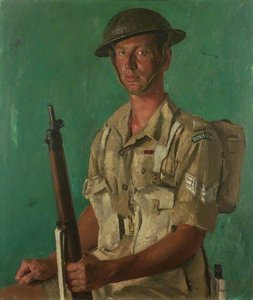 Sergeant J. P. Kenneally, VC, First Battalion, Irish Guards1943
38
 Infantry Landing Craft Disembarking Troops1943
39
 Sergeant B. Montague One of the Desert Rats (7th Armoured Division)1943
40
 Mosquito Nets1943
41
 In the Temple Garden1942 · Government Art Collection
42
 St Clement Dane's Church on Fire after Being Bombed1941
43
 Staff Sergeant Major E. A. Billett1943
44
 Village of Dinton, January 19411941 · Government Art Collection
45
 Medjez el Bab, Grenadier Hill in the Background1943 · Government Art Collection
46
 Sister Edna Morris, Queen Alexandra's Imperial Military Nursing Service1943 · Laing Art Gallery
47
 B. R. Hill, HH, First Battalion, KRRC, 6852209, RFN (Soldier Cleaning His Rifle)1943
48
 A Camouflaged 25 Pounder Gun in Action near Medjez el Bab with Djebel Djaffa, Tunis, in the Background1943
49
 Familiar Silhouettes1942
50
 The Griller Quartet Sidney Griller (1911–1993), CBE, FRAM (leader), Colin Hampton (1911–1996), FRAM (cello), Philip Burton (1907–1961), FRAM (viola), and Jack O'Brien (b.1909), FRAM (violin)1941 · Royal Academy of Music
51
 Lieutenant W. F. Smyth, Gunner Officer1944
52
 The Goumier1944
53
 Liberation1944
54
 View in Rome, Italy1945
55
 Edward Ardizzone (1900–1979), Official War Artist1944
56
 Air Marshal Sir Leslie Hollinghurst, KBE, CB, DFC1945
57
 Major Paul Triquet, VC, of Cabano, Province of Quebec1944
58
 A Cockney Soldier1944
59
 Paul Wyand, War Correspondent1944
60
 A 7.2 Gun Firing at Night1944
61
 Cassino1944
62
 Frederick Alexander Lindemann (1886–1957), PC, FRS, First Baron Cherwell of Oxford1946
63
 Major the Viscount Stopford, First Battalion, London Irish Rifles (Royal Ulster Rifles)1944
64
 Miss Mary Sternberg, American Red Cross1947
65
 Council of the College, 1946–19471947
66
 Entry into Tunis of the 1st Derbyshire Yeomanry, 2 May 19431946 · Buxton Museum - Art Gallery
67
 Sepoy Kamal Ram (1924–1982), VC, 8th Punjab Regiment1944
68
 Mrs Gertrude Kinnell1945 · Royal Free Hospital
69
 A 3.7 Anti Aircraft Gun of 393 72 Heavy Anti Aircraft Regiment, RA, CMF1944
70
 Nurse Giving an Injection of Penicilin to a Wounded Man, 15th Canadian General Hospital1944
71
 Micheline Dehais, French Ambulance Driver1944 · The Hepworth Wakefield
72
 An Ordinary Telegraphist, Maurice Alan Easton1944 · National Maritime Museum
73
 General Sir Harold Franklyn, KCB, DSO, MC, Colonel of the Regiment (1939–1949)1944 · The Green Howards Regimental Museum
74
 Bernard Mouat Jones (1882–1953), DSO, MA, DCL, LLD, Vice Chancellor of the University of Leeds (1938–1948)1948 · The Stanley - Audrey Burton Gallery
75
 Eglantyne Mary Jebb (1889–1978), MA, the Third Principal of Froebel College (1932–1955)1950 · Froebel College
76
 HRH Princess Margaret (1930–2002)1950
77
 Constantine1943 · Government Art Collection
78
 Vesuvius in Eruption, March 19441944
79
 Pat Millard1950 · Goldsmiths
80
 San Vittore1944 · Government Art Collection
81
 Brixham, DevonLeeds Art Gallery
82
 Henry Rushbury's Daughter
83
 Merchant Navy, the Bridge
84
 Parachute Drop1943
85
 Merchant Service Fireman1942 · National Maritime Museum
The four most frequent subjects in this ranking, with the top painting for each.
The 8 museums that hold the most of the paintings on this page.
| Museum | City | Works by Henry Carr | Paintings from this list |
|---|---|---|---|
 Government Art Collection |
London | 6 | Waterfront, Algiers, In the Temple Garden, Village of Dinton, January 1941 |
 National Trust |
Liverpool | 2 | Margaret Mills (1908–1970), Mrs Hardman, Ballast Island, Porthmadog |
 National Maritime Museum |
London | 2 | An Ordinary Telegraphist, Maurice Alan Easton, Merchant Service Fireman |
 City of Westminster Archives Centre |
London | 1 | Dismantling an Emergency Water Tank |
 Wakefield County Hall |
Wakefield | 1 | Sir William Cartwright, Chairman of the County Council of the West Riding of Yorkshire (1933–1946) |
 Laing Art Gallery |
Newcastle upon Tyne | 1 | Sister Edna Morris, Queen Alexandra's Imperial Military Nursing Service |
 Royal Academy of Music |
London | 1 | The Griller Quartet Sidney Griller (1911–1993), CBE, FRAM (leader), Colin Hampton (1911–1996), FRAM (cello), Philip Burton (1907–1961), FRAM (viola), and Jack O'Brien (b.1909), FRAM (violin) |
 Buxton Museum - Art Gallery |
Buxton | 1 | Entry into Tunis of the 1st Derbyshire Yeomanry, 2 May 1943 |
Select a decade to see its top painting.


Incendiaries in a Suburb (1941) ranks first, followed by Margaret Mills, Mrs Hardman (1908 -1970) (1920) and A Bofors Gun, Algiers (1943).
Henry Carr was 47: Incendiaries in a Suburb is dated 1941, and Henry Carr was born in 1894.
Incendiaries in a Suburb, Margaret Mills, Mrs Hardman (1908 -1970), A Bofors Gun, Algiers, The Merchant Navy The Chain Locker, Dismantling an Emergency Water Tank, Sir William Cartwright, Chairman of the County Council of the West Riding of Yorkshire (1933–1946), Self Portrait, The Mersey, Margaret Mills (1908–1970), Mrs Hardman and Miss H. Dearlove (Old Iron Portrait Collection). Year and museum for each are in the ranking above.
86 works by Henry Carr are in our catalogue, dated 1912 to 1950.
Mainly in Government Art Collection (London), National Trust (Liverpool) and National Maritime Museum (London). See the museum table above for the full list.
In 1940s: 72 of the 85 paintings ranked here date from that time, including Incendiaries in a Suburb.
Earliest on this page: The Mersey (1912). Latest: Eglantyne Mary Jebb (1889–1978), MA, the Third Principal of Froebel College (1932–1955) (1950).
Among the 85 paintings ranked here: Portraiture (2), Melancholy mood (2) and Early 20th century (2).
Contemporary realism, based on the paintings ranked on this page.
The Government Art Collection, London holds 6 of the paintings ranked here, including Waterfront, Algiers, In the Temple Garden and Village of Dinton, January 1941.
To encounter the work of Henry Marvell Carr is to step into a world where light and memory intertwine, creating a visual dialogue between the tangible landscape and the profound depths of human emotion. Born in 1894, Carr emerged as a vital figure within the tapestry of American Impressionism, though his artistic spirit was far too expansive to be confined by a single movement. His journey was one of constant synthesis, blending the rigorous technical training of the European tradition with an intimate, soulful dedication to capturing the essence of both the natural world and the African American cultural experience. Through his brush, the fleeting atmospheric shifts of a Michigan afternoon or the quiet dignity of a portrait subject were transformed into enduring monuments of light and form.
Carr’s artistic foundation was forged in the prestigious studios of Europe, most notably during his time at the École Supérieure des Beaux-Arts in Paris. Immersed in the vibrant atmosphere of the Impressionist movement, he drew inspiration from the masters such as Monet and Sisley, learning to observe how light dances across surfaces and how color can evoke the very temperature of a moment. This Parisian influence instilled in him a lifelong fascination with atmospheric perspective and a luminous palette that would become his hallmark. Upon returning to his roots in Detroit, Carr did not merely replicate European styles; instead, he repurposed these techniques to illuminate the specific beauty of the American landscape and the rich, often overlooked, narratives of his community.
The technical prowess of Carr is perhaps most evident in his masterful command of the impasto technique. He did not simply apply paint to canvas; he sculpted it, creating textured surfaces that lend a palpable, three-dimensional quality to his works. This tactile approach allowed him to convey the ruggedness of urban environments and the soft, ephemeral qualities of nature with equal vigor. His oeuvre, which encompasses over 300 paintings and drawings, serves as a historical record of both the physical and social landscapes of the early to mid-20th century. Whether depicting the industrial grit of Detroit or the serene beauty of the Michigan countryside, Carr’s work possesses an evocative realism that transcends mere documentation.
Beyond his technical skill, Carr’s significance lies in his ability to imbue his subjects with a profound sense of dignity and grace. His portraiture is particularly noted for its sensitivity, capturing the psychological depth of his sitters. In works such as “Mrs Gertrude Kinnell,” one finds a masterful balance of character study and aesthetic beauty. Furthermore, his ability to document historical moments—such as the poignant “Dismantling an Emergency Water Tank” (1945)—demonstrates his role as a chronicler of civic life and wartime effort. His art was never static; it was a living, breathing response to the world around him, capturing the tension between progress and tradition, and the enduring strength of the human spirit.
The legacy of Henry Marvell Carr continues to resonate within the halls of art history, serving as a bridge between the classical traditions of the past and the burgeoning modern identities of the 20th century. His contribution to the Detroit artistic landscape was foundational, providing a sophisticated visual language that celebrated African American heritage through the lens of high-art Impressionism. By elevating everyday scenes and portraits to the level of fine art, he challenged contemporary perceptions and contributed to a more inclusive narrative of American art history.
Today, Carr’s work remains a subject of profound study and admiration for several key reasons:
As we look back upon his prolific career, Carr stands as a painter of light, but more importantly, a painter of truth—capturing the fleeting beauty of the world while anchoring it in the permanent strength of memory.

