- Home

- Oil Painting Reproduction
- Adriaen van der Werff
- Amorous Shepherds

 Buy print
 Send
Send Share
Share
 Details

 Download
 Similars
 X-Ray
X-Ray Diaporama
Amorous Shepherds
 Oil On Canvas
- WallArt
- Baroque
 1690
1690- Early Modern
 46.0 x 38.0 cm
 Staatliche Museen
 Read More
Hand Made Oil Reproduction
Hand-painted oil on canvas in your size and frame, made to order by our artists.




P118B $10

P118H $10

P118W $10

P438Z $10

P508JH $12

P508YH $12

P805H $10

P805Z $10

P919BZ $10

P919G $10

P919XJ $10

P959ZH $10

P968JZ $12

W106C $8

W218G $10

W218JH $8

W218Y $10

W307PJ $10

W316G $10

W316PJ $8

W316Y $10

W398PJ $8

W4111J $10

W500HY $15

W500JH $15

W692G $12

W849H $8

W940BG $15

W953PJ $8




Pick from our preset sizes that match the artwork's original proportions.

You may enter your own dimensions to fit a specific frame or space. If your selected size does not match the original image's proportions, we will either crop the artwork or extend the painting with additional hand-painted elements. A digital mockup will be sent for your approval before production begins.
Please note that the on-screen preview does not reflect the actual cropping or extension. Only the mockup will accurately show the final composition.
While custom sizes are available, we recommend selecting a dimension from the predefined list to preserve the original proportions.
After order, AllPaintingsStore.com team will email client for instructions and provide a mockup preview
Worldwide Delivery () in 3/4 weeks instead of standard 5 weeks. (16 July). No compromise on quality.

Free Worldwide Express Shipping

High-Quality Linen Canvas

Full Shipping Insurance

Customs Tax Refund Guarantee

True Color Matching Guarantee

60-Day Return Policy (Defects Only)

100% Money-Back Guarantee

Bulk Discount Offer
 Glass option is only available in size under 110 CM

Amorous Shepherds
Reproduction Medium
Reproduction Size
-


Total Price
-
Artwork Description
An Embrace in Verdant Shadows: Exploring Amorous Shepherds
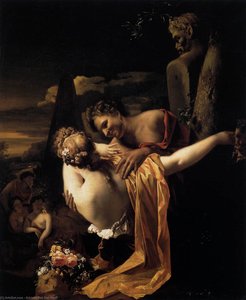
To gaze upon Adriaen van der Werff's Amorous Shepherds is to step directly into a moment suspended between pastoral bliss and burgeoning passion. This captivating work, dating from 1690, transports the viewer into a deeply intimate woodland setting. The central tableau features a man kneeling with profound devotion, holding up his beloved in an embrace that speaks volumes without uttering a single word. It is a scene steeped in the rich, evocative tradition of genre painting, yet elevated by Van der Werff's unparalleled technical mastery.
The composition draws the eye immediately to the central couple, their connection palpable even across the centuries. They are enveloped by nature—a backdrop of dense trees and dappled light that speaks of secrecy and shared moments away from the world’s gaze. Yet, it is not merely a portrait of romance; the presence of other figures subtly woven into the foreground and background suggests a community witnessing, or perhaps simply existing alongside, this profound connection.
The Mastery of Dutch Baroque Technique
Van der Werff, a titan of the Dutch Baroque, utilized his skill to achieve an almost tangible sense of atmosphere. His technique is characterized by a breathtaking command of chiaroscuro—the dramatic interplay between light and shadow. Notice how the light seems to emanate from within the scene itself, selectively illuminating the tender gestures and rich textures of the figures' drapery while allowing the surrounding forest to recede into mysterious, velvety darkness. This masterful handling of illumination does more than just model form; it heightens the emotional drama, suggesting that this moment is sacred, almost illuminated by divine grace.
His attention to detail, honed through years studying costume and drapery, gives every fold of fabric and every leaf on the surrounding foliage a lifelike verisimilitude. This meticulous craftsmanship ensures that even in reproduction, the depth and richness of Van der Werff's original vision remain strikingly apparent.
Symbolism and the Pastoral Ideal
The shepherd motif itself carries layers of symbolism. In art history, shepherds often represent innocence, rustic virtue, or the soul guided by love. Here, however, the overt passion suggests a transcendence of mere pastoral simplicity. The forest setting acts as a liminal space—a place outside of societal rules where pure emotion can flourish unchecked. The embrace itself is an allegory for devotion, perhaps even mirroring mythological tales of divine love rediscovered in nature’s quiet corners. It invites contemplation on the nature of true connection versus fleeting fancy.
Bringing Intimate Drama Home
For the collector or designer seeking to infuse a space with history and profound emotion, Amorous Shepherds offers an unparalleled focal point. The piece balances its overt romanticism with the quiet dignity of Baroque artistry. Reproducing this work allows one to curate an atmosphere—a sense of timeless intimacy and cultivated taste. Whether placed in a drawing-room corner or within a gallery setting, it serves as a sophisticated conversation starter, inviting viewers to pause, breathe, and contemplate the enduring power captured by Van der Werff’s brush.
Related Artworks


Artist Biography
Adriaen van der Werff: A Titan of Dutch Baroque
Adriaen van der Werff (1659-1722) stands as one of the most celebrated figures in Dutch Baroque painting, a master whose meticulous technique and profound understanding of human emotion cemented his place among the giants of his era. Born in The Hague, he emerged from a family steeped in artistic tradition—his father was also a painter—and quickly demonstrated prodigious talent, embarking on formal training at a young age under the tutelage of Eglon van der Neer, a renowned specialist in drapery and costume design. This formative influence would shape his distinctive style, characterized by an unparalleled attention to detail and a masterful command of chiaroscuro. His brother, Pieter van der Werff (1661–1722), served as his loyal pupil and collaborator, fostering a creative partnership that produced some of the finest portraits of their time. Together they established a studio in Rotterdam where Van der Werff ascended to leadership of the Saint Luke Guild, a position he held with distinction for decades. This association provided him with invaluable access to influential patrons and fostered an environment conducive to artistic innovation. Van der Werff’s artistic journey began modestly, honing his skills through diligent observation and experimentation. However, it swiftly gained momentum as he captivated audiences with his depictions of biblical narratives and mythological scenes—subjects that demanded both intellectual depth and visual splendor. His ability to convey psychological complexity within exquisitely rendered compositions quickly garnered him recognition throughout Europe. Notably, commissions from Johann Wilhelm, elector palatine and Anna Maria Luisa de' Medici brought him into contact with the Florentine court, resulting in two monumental paintings destined for Cosimo III—a testament to his ambition and artistic prowess. Throughout his prolific career, Van der Werff traveled extensively between Düsseldorf and Rotterdam, absorbing influences from German Baroque art while maintaining a steadfast commitment to Dutch artistic standards. He was appointed official court painter under Johann Wilhelm’s reign, receiving the honorific knighthood and securing substantial patronage—a privilege that allowed him to dedicate himself fully to his craft. His output included numerous portraits of nobility and dignitaries, as well as grand mythological canvases that showcased his mastery of color and form. The elector's unwavering support fueled his artistic endeavors, resulting in breathtaking works like “Nymphes dansant” and “The Judgement of Paris,” which continue to inspire admiration today. Despite criticisms leveled against him in the 19th century—accusations of abandoning Dutch naturalism for stylistic excess—Van der Werff’s legacy endured. Arnold Houbraken, a prominent art historian of his time, hailed him as "the greatest of the Dutch painters," an opinion that resonated throughout the eighteenth century and largely prevailed into the Victorian era. However, much of Van der Werff's oeuvre languished in obscurity until rediscovered in the Alte Pinakothek, where it now commands considerable attention from scholars and connoisseurs alike. He remains a cornerstone of Dutch Baroque art, embodying the ideals of elegance, intellect, and artistic virtuosity—a true testament to the enduring power of talent and dedication.
Adriaen van der Werff
1659 - 1722 , Netherlands
Quick Facts
- Artistic Movement Or Style: Baroque
- Artists Or Movements Influenced By This Artist: ['Dutch Masters']
- Artists Who Influenced This Artist: ['Eglon van der Neer']
- Date Of Birth: The Hague, Netherlands (1659)
- Date Of Death: 1722
- Full Name: Adriaen van der Werff
- Nationality: Dutch
- Notable Artworks:
- SAINTE MADELEINE MEDITANT DANS LA SOLITUDE
- ADAM ET EVE
- SARAH PRESENTE AGAR A ABRAHAM
- Place Of Birth: The Hague
Related Articles

Albertus Verhoesen: Capturing Dutch Pastoral Life with Exquisite Detail
Explore the idyllic rural scenes of Albertus Verhoesen (1806-1881). Discover his charming paintings, renowned for realistic detail and pastoral beauty. Learn about this Dutch Romantic master at AllPaintingsStore.

Myles Birket Foster: Nostalgia, Narrative & the Victorian Pastoral Tradition
Explore the captivating world of Myles Birket Foster, Victorian watercolorist renowned for idyllic rural scenes. Discover his sentimental landscapes, narrative detail & lasting artistic legacy. Learn more at AllPaintingsStore.

Genre Painting: A Window into Daily Life & Societal Values of the Dutch Golden Age
Explore the captivating world of Dutch Golden Age genre painting! Discover realistic depictions of daily life, masterful artists like Ostade & Metsu, and hidden symbolism. Learn about this influential art movement with AllPaintingsStore.

Cornelis van Poelenburch: Bridging Mannerism & the Dutch Baroque Landscape
Discover Cornelis van Poelenburch, a pivotal Dutch Baroque landscape painter bridging Mannerism & Italianate styles. Explore his life, key works, and lasting influence on 17th-century art with AllPaintingsStore.

Adriaen van Ostade: A Master of Dutch Genre Painting & Social Commentary
Explore the life & work of Adriaen van Ostade, a leading Dutch Golden Age painter. Discover his realistic genre scenes, social commentary, and lasting influence on art history. Learn more at AllPaintingsStore.