Preview
 Send
Send Share
Share
 Details
 Guide
Guide

 Download
 Similars
 X-Ray
X-Ray Diaporama
 Stats
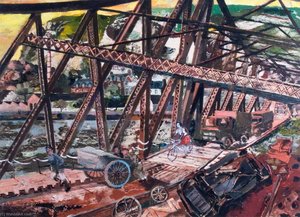
StatsRoyal Engineers' Dump
 Contemporary Realism
 56.0 x 76.0 cm
 Read More
Giclée / Art Print
Museum-quality giclée or canvas print with fast production and flexible finish options. ( Buy Hand Made Painting Switch to Digital Image)




































Pick from our preset sizes that match the artwork's original proportions.

Type the width and the height you need, to fit your frame or your wall. A print can only be cut, never made bigger than the picture, so a size with a different shape loses a part of the image. We send you a digital mockup to approve before we print anything. The picture shown on this page does not show the real cut — only the mockup does.
Worldwide Delivery () in 2 weeks instead of standard 4/5 weeks. (28 October)

Free Worldwide Express Shipping

High-Quality Linen Canvas

Full Shipping Insurance

Customs Tax Refund Guarantee

True Color Matching Guarantee

100-Day Return Policy (Defects Only)

100% Money-Back Guarantee

Bulk Discount Offer
 Glass option is only available in size under 110 CM

Royal Engineers' Dump
Giclée / Art Print
Reproduction Size
-


Total Price
$ 65
Related Artworks


Artist Biography
A Soldier Painter’s Vision of War
The life of Albert Richards was a poignant intersection of artistic devotion and the brutal realities of mid-twentieth-century conflict. Born in Liverpool on December 13, 1919, to Hannah Beatty and George Richards, his early years were shaped by the quiet strength of a working-class household in Wallasey, Cheshire. His father, a veteran of the Great War, instilled in him a profound sense of duty and resilience—virtues that would later define both his military service and his approach to the canvas. From a young age, Richards found solace and inspiration in the landscapes surrounding his home, developing an eye for the subtle nuances of light and terrain that would eventually become the hallmark of his wartime documentation.
His formal journey into the world of fine art began at Wallasey Central School, leading him to the prestigious Wallasey School of Art and Crafts. His talent was so undeniable that he secured a scholarship from the Borough of and Wallasey to attend the Royal College of Art, beginning his studies in early 1940. It was within these hallowed halls that Richards was exposed to the cutting-edge movements of the era, including Cubism and Surrealism. These modernist influences provided him with an experimental toolkit, allowing him to move beyond mere representation toward a more visceral, textured way of capturing the world around him.
The Canvas of Conflict
The outbreak of World War II fundamentally redirected the trajectory of Richards’s life, transforming him from a student of art into a chronicler of combat. In May 1941, the War Artists Advisory Committee (WAAC) recognized his unique ability to merge technical skill with the raw immediacy of a soldier's perspective and recruited him for a commission. Though he initially found great fulfillment in the Parachute Regiment—a role that offered both physical challenge and artistic stimulation—he ultimately accepted the call to document the unfolding struggle. This period saw him translating the adrenaline of airborne operations into enduring works of art.
Richards’s work from this era is characterized by a remarkable ability to capture movement and atmosphere. During his extensive parachute training at RAF Ringway, he produced evocative pieces such as “Kilkenny’s Circus” and “Parachute Training Over Tatton Park,” which meticulously detail the physicality of the descent. His later commissions took him into the heart of major military operations, including Operation Mush, where he participated in large-scale parachute drops over Gloucestershire. Whether depicting the chaotic energy of a sky filled with silk or the somber stillness of a frozen trench, his paintings possess an emotional weight that transcends simple reportage.
Legacy and Artistic Mastery
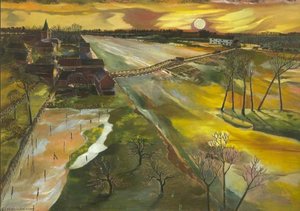
The technical breadth of Richards’s oeuvre is nothing short of extraordinary, ranging from the expressionistic to the deeply realistic. In works like “Take Off and Landing Field,” one can witness his use of impasto textures and dramatic sunset hues to convey a sense of cinematic grandeur. Conversely, his more somber compositions, such as “Sappers Erecting Pickets in the Snow” or “Royal Engineers’ Dump,” utilize geometric forms and a muted palette to evoke the stark, often harrowing reality of life on the front lines. His ability to find beauty within the grim machinery of war remains his most significant contribution to the history of British art.
Tragically, Richards’s life was cut short in 1945, making him the youngest of the three British official war artists killed during the conflict. Yet, through his surviving works, his vision remains undimmed. He left behind a legacy that serves as both a historical record and a profound meditation on human endurance. His paintings do more than just show us what the war looked like; they allow us to feel the tension of the drop, the chill of the winter trenches, and the unwavering spirit of those who served.

Albert Richards
1919 - 1945
Quick Facts
- Full Name: Albert Richards
- Nationality: British
- Date Of Birth: 1919
- Date Of Death: 1945
- Place Of Birth: Liverpool, England
- Notable Artworks:
- A Covering for a Gun Site
- The Drop
- Take off and Landing Field
- Artistic Movement Or Style: Expressionism
- Artists Who Influenced This Artist:
- Turner
- Ruskin
- Artists Or Movements Influenced By This Artist: ['Luminism']
Related Articles

Evocations of Place: A Historical Journey Through Landscape Art
Explore the rich history of landscape art with AllPaintingsStore. Discover renowned artists, movements like Impressionism & Romanticism, and expert guidance for collecting timeless pieces. Find your perfect serene escape today!

Evocations of Place: A Historical Journey Through Landscape Art
Explore the rich history of landscape art with AllPaintingsStore. Discover renowned artists, movements like Impressionism & tonalism, and expert guidance for collecting timeless pieces. Find your perfect serene escape today!

Romantic Landscapes: 10 Masterpieces for Your Home | AllPaintingsStore
Journey through 10 Romantic landscape masterpieces by Friedrich, Turner & Cole. Explore emotional art, sublime nature scenes & iconic 19th-century paintings. Find museum-quality reproductions for your home at AllPaintingsStore.com – discover the full collection online!

William Trost Richards: Luminism, Spirituality & the American Landscape Tradition
Explore the captivating landscapes of William Trost Richards, a master of Luminism associated with both the Hudson River School & American Pre-Raphaelite movements. Discover his spiritual connection to nature and lasting influence on American art.

Capturing Stillness: A Curated Exploration of the Most Iconic Lake Landscapes in Art History
Journey through art history's most serene lake landscapes. From Romantic vistas to light-drenched Impressionist waters, discover the stories behind these iconic masterpieces and find museum-quality, hand-painted oil reproductions for your private collection.