


 Preview
 Send
Send Share
Share
 Details
 Guide
Guide

 Download
 Similars
 X-Ray
X-Ray Diaporama
 Stats
StatsMary
 Oil On Canvas
- WallArt
- Baroque
 1646
1646 49.0 x 43.0 cm
 Szépművészeti Múzeum
 Read More
Giclée / Art Print
Museum-quality giclée or canvas print with fast production and flexible finish options. ( Buy Hand Made Painting Switch to Digital Image)




P118B $10

P118H $10

P118W $10

P438Z $10

P508JH $12

P508YH $12

P805H $10

P805Z $10

P919BZ $10

P919G $10

P919XJ $10

P959ZH $10

P968JZ $12

W106C $8

W218G $10

W218JH $8

W218Y $10

W307PJ $10

W316G $10

W316PJ $8

W316Y $10

W398PJ $8

W4111J $10

W500HY $15

W500JH $15

W692G $12

W849H $8

W940BG $15

W953PJ $8




Pick from our preset sizes that match the artwork's original proportions.

Type the width and the height you need, to fit your frame or your wall. A print can only be cut, never made bigger than the picture, so a size with a different shape loses a part of the image. We send you a digital mockup to approve before we print anything. The picture shown on this page does not show the real cut — only the mockup does.
Worldwide Delivery () in 2 weeks instead of standard 4/5 weeks. (23 October)

Free Worldwide Express Shipping

High-Quality Linen Canvas

Full Shipping Insurance

Customs Tax Refund Guarantee

True Color Matching Guarantee

100-Day Return Policy (Defects Only)

100% Money-Back Guarantee

Bulk Discount Offer
 Glass option is only available in size under 110 CM

Mary
Giclée / Art Print
Reproduction Size
-


Total Price
$ 65
A Baroque Revelation: Exploring Alonso Cano’s “Mary”
Alonso Cano’s “Mary,” housed at Budapest's Szépmûvészeti Múzeum, isn’t merely a depiction of the Virgin Mary; it’s an embodiment of the turbulent spirit of Baroque art—a testament to its audacious embrace of emotion and its masterful manipulation of light. Painted in 1646-50, this oil on canvas work represents a pivotal moment in Cano’s oeuvre, showcasing his unparalleled ability to distill profound spiritual contemplation into deceptively simple visual form.The Artist's Vision: Cano's Bold Experimentation
Guido Cagnacci, Cano’s mentor and fellow innovator, instilled in him a rebellious spirit that would permeate his artistic endeavors. Unlike many of his contemporaries who adhered rigidly to established conventions, Cano actively challenged societal expectations through his art, particularly concerning the portrayal of female figures. “Mary” exemplifies this defiance with its unsettling honesty—a woman lost in reverie, her gaze downward as if grappling with an unspoken truth. This isn’t a passive Madonna; it's a figure wrestling with existential questions, mirroring the anxieties prevalent during Cano’s lifetime – a period marked by religious upheaval and intellectual ferment.Technique and Style: Baroque Mastery Illuminated
Cano’s technique is characterized by its meticulous attention to detail and its masterful use of chiaroscuro—the dramatic interplay between light and shadow—a hallmark of Baroque painting. The subdued sky serves as a canvas for this luminous effect, casting delicate highlights across Mary's face and drapery, subtly emphasizing her inner turmoil. Layers upon layers of thinly applied paint create an illusionistic depth that draws the viewer into the scene, fostering a palpable sense of intimacy and contemplation. The artist skillfully employs tonal gradations to convey not just visual information but also emotional resonance—a profound stillness punctuated by unspoken yearning.Historical Context: Spain Under Habsburg Rule
“Mary” emerged during the reign of Philip IV in Spain, a time when the Habsburg monarchy sought to solidify its prestige through artistic patronage. Cano’s work reflects the broader cultural currents of the era – an obsession with religious iconography and a fervent desire to express spiritual fervor. However, unlike many other commissions of the period, “Mary” transcends mere decorative function; it engages in a complex dialogue with theological concepts, prompting viewers to consider themes of faith, doubt, and divine grace. The Szépmûvészeti Múzeum’s acquisition underscores the enduring significance of Cano's artistic legacy—a reminder that beauty can coexist with unsettling psychological depth.Symbolism: Inner Reflection Embodied
The downward gaze of Mary is laden with symbolic weight. It represents not merely physical posture but also a state of mind—a preoccupation with matters beyond the visible realm, an acknowledgement of the mysteries inherent in human existence. The serene sky serves as a counterpoint to this inner turmoil, suggesting that true understanding requires transcending superficial appearances and delving into the depths of consciousness. Cano’s “Mary” invites contemplation on the nature of spirituality and challenges viewers to confront their own vulnerabilities—a timeless masterpiece that continues to resonate with audiences centuries after its creation.Emotional Impact: A Moment Frozen in Time
Ultimately, “Mary” succeeds in capturing a fleeting moment of profound emotional intensity—a palpable stillness imbued with unspoken longing. It’s a painting that lingers in the memory long after viewing, prompting reflection on themes of faith and introspection. The Szépmûvészeti Múzeum's careful preservation ensures that this Baroque revelation remains accessible to generations of art lovers—a testament to Cano’s enduring artistic vision and its ability to evoke empathy and wonder.Questions & Answers
What is the recommended print size for "Mary" by Alonzo Cano?
"Mary" is recommended at a large print size. Other sizes are available with the same proportions.
How light is "Mary" overall?
In terms of perceived brightness, "Mary" by Alonzo Cano is balanced.
What atmosphere would a reproduction of "Mary" by Alonzo Cano bring to a room?
With its romantic mood, "Mary" is suggested for a hotel lobby.
Related Artworks


Artist Biography
A Renaissance Man of Granada
Alonso Cano Almansa stands as a singular figure in the Spanish Golden Age, a true polymath whose creative spirit refused to be confined to a single medium. Born in Granada, Spain, he was a rare talent who mastered the distinct disciplines of painting, sculpture, and architecture with equal fervor. His artistic journey began under the guidance of his father, Miguel Cano, from whom he inherited the foundational principles of architecture. This structural understanding would later inform the spatial depth and monumental presence found in his visual works.
His education was a tapestry of the finest influences available in the Spanish art world. In the realm of painting, he refined his brushwork within the academy of Juan del Castillo and studied under Francisco Pacheco, the esteemed teacher of Velázquez. This lineage connected him directly to the heart of the Baroque movement, infusing his canvases with a sense of dramatic tension and spiritual luminosity. Simultaneously, his sculptural prowess was forged under the tutelage of Juan Martínez Montañés, allowing him to breathe life into stone and wood with a profound sense of anatomical grace and emotional resonance.
The Mastery of Form and Spirit
Cano’s body of work is characterized by an extraordinary ability to capture the divine within the human form. As a sculptor, he achieved lasting renown through pieces such as the Madonna and Child in the church of Lebrija and his colossal, commanding figures of San Pedro and San Pablo. These works demonstrate a mastery of scale and a capacity to evoke deep religious devotion through physical presence.
In his paintings, Cano utilized the dramatic techniques of the Baroque era to create moments of intense spiritual encounter. His compositions often feature:
- The interplay of light and shadow, where unseen light sources illuminate sacred figures, such as in his depiction of St John the Evangelist on Pathmos.
- Emotional intimacy, seen in works like Noli me Tangere, where the tension between divine grace and human yearning is palpable.
- The weight of sacrifice, captured through the somber and dramatic tableau of The Dead Christ Supported by an Angel.
Legacy and Royal Recognition
The significance of Alonso Cano’s talent was recognized at the highest levels of the Spanish court. His prestige led to his appointment as the first royal architect and a painter to Philip IV. His influence even extended to the education of the next generation, serving as an instructor to the prince, Balthasar Charles. This proximity to power allowed him to leave an indelible mark on the architectural landscape of Spain; notably, he served as the chief architect of the Granada Cathedral, designing its magnificent façade which was eventually erected following his passing.
Beyond his official titles, Cano’s legacy is preserved in the very fabric of Andalusian culture. His ability to weave together the structural rigor of architecture, the tactile emotion of sculpture, and the luminous storytelling of painting ensures his place as one of the most versatile and essential masters of the Spanish Baroque.

Alonzo Cano
1601 - 1667 , Spain
Quick Facts
- Artistic Movement Or Style: Baroque
- Artists Who Influenced This Artist:
- Miguel Cano
- Juan del Castillo
- Francisco Pacheco
- Juan Martínez Montañés
- Full Name: Alonso Cano Almansa
- Nationality: Spanish
- Notable Artworks:
- St John the Evangelist on Pathmos
- The Dead Christ Supported by an Angel
- Noli me Tangere
- The Crucifixion
- Madonna and Child
- Place Of Birth: Granada, Spain
- Date Of Birth: 1601
- Date Of Death: 1667
Related Articles

The Golden Age Reforged: Dramatic Realism & Religious Zeal in Spanish Baroque Art
Explore the dramatic world of Spanish Baroque art! Discover masters like Zurbarán & the powerful influence of religious zeal on painting techniques – a guide for collectors and enthusiasts.

Baroque Classicism: The Grandeur of Order and Drama in 17th-Century Art History
Explore the profound elegance of Baroque Classicism. Discover how 17th-century masters synthesized dramatic emotion with classical order through the lens of the Counter-Reformation and the works of legends like Carlo Maratta and Andrea Sacchi.

The Dramatic Flourish: Exploring the Baroque Movement's Enduring Legacy in Art History
Explore the dramatic world of Baroque art! Discover iconic artists like Caravaggio & Rubens, defining techniques, and its lasting impact on art history. Expert insights for collectors & enthusiasts at AllPaintingsStore.
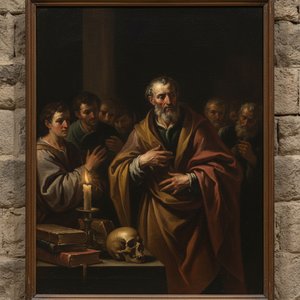
Spanish Baroque Art: The Dramatic Mastery of Light and Shadow in the Age of Velázquez
Explore the profound drama of Spanish Baroque art. Delve into the mastery of light, shadow, and realism through the legendary works of Diego Velázquez and the Spanish Golden Age.

The Visceral Stage: Exploring Dramatic Narratives & Emotional Intensity in Baroque Art
Explore the dramatic world of Baroque art! Discover iconic masters like Caravaggio & Rembrandt, their techniques, and the movement's lasting impact. Expert insights for collectors & enthusiasts at AllPaintingsStore.


