


 Preview
 Send
Send Share
Share
 Details
 Guide
Guide

 Download
 Similars
 X-Ray
X-Ray Diaporama
 Stats
Statsuntitled (694)

 Read More
The artwork displayed on this page is protected by copyright law, which means we cannot legally create or sell an identical reproduction. This protection is enforced under international agreements such as the Berne Convention and by national laws, including those outlined by the U.S. Copyright Law - Title 17.
This method fully complies with copyright regulations because it does not involve copying or duplicating the protected artwork. Instead, it is a creative reinterpretation - a new painting that is influenced by the original but not identical to it.
Giclée / Art Print
Museum-quality giclée or canvas print with fast production and flexible finish options. ( Buy Hand Made Painting Switch to Digital Image)




P118B $10

P118H $10

P118W $10

P438Z $10

P508JH $12

P508YH $12

P805H $10

P805Z $10

P919BZ $10

P919G $10

P919XJ $10

P959ZH $10

P968JZ $12

W106C $8

W218G $10

W218JH $8

W218Y $10

W307PJ $10

W316G $10

W316PJ $8

W316Y $10

W398PJ $8

W4111J $10

W500HY $15

W500JH $15

W692G $12

W849H $8

W940BG $15

W953PJ $8




Pick from our preset sizes that match the artwork's original proportions.

Type the width and the height you need, to fit your frame or your wall. A print can only be cut, never made bigger than the picture, so a size with a different shape loses a part of the image. We send you a digital mockup to approve before we print anything. The picture shown on this page does not show the real cut — only the mockup does.
Worldwide Delivery () in 2 weeks instead of standard 4/5 weeks. (26 October)

Free Worldwide Express Shipping

High-Quality Linen Canvas

Full Shipping Insurance

Customs Tax Refund Guarantee

True Color Matching Guarantee

100-Day Return Policy (Defects Only)

100% Money-Back Guarantee

Bulk Discount Offer
 Glass option is only available in size under 110 CM

untitled (694)
Giclée / Art Print
Reproduction Size
-


Total Price
$ 65
The Enigmatic Face: Deconstructing Andy Warhol’s Untitled (694)
Andy Warhol's "Untitled (694)" isn’t merely a painting; it’s an invitation into the vibrant, chaotic heart of Pop Art and a profound meditation on image, identity, and the relentless bombardment of visual stimuli that defined the 1960s. This striking close-up portrait, rendered in Warhol's signature silkscreen technique, immediately commands attention with its audacious color palette – a riot of red, blue, yellow, green, orange, and purple colliding to form an abstracted human face. The deliberate lack of detail, the flattened planes, and the almost mechanical application of paint create a sense of detachment, forcing the viewer to confront the image not as a realistic representation but as a carefully constructed symbol.
Warhol’s fascination with celebrity culture and mass media is palpable here. The face itself feels both familiar and utterly alien, reminiscent of a magazine cover or a billboard advertisement – fragments of popular imagery seamlessly blended together. This deliberate blurring of the lines between high art and low culture was central to Warhol's artistic philosophy, challenging traditional notions of beauty and elevating everyday subjects to the status of icons. The piece speaks to a world saturated with images, where recognition is often based on superficial appearances rather than genuine connection.
Silkscreen Technique & The Process of Deconstruction
Warhol’s mastery of silkscreen printing was crucial to his distinctive style. He meticulously prepared the screen, applying stencils to create layers of color and texture. This process, while seemingly simple, demanded incredible precision and control – a testament to Warhol's meticulous nature. The vibrant colors are achieved through multiple layers of ink, each carefully applied and burnished to create a smooth, almost photographic effect. The flatness of the surface is deliberate; it rejects traditional notions of depth and perspective, mirroring the flattened, two-dimensional world of advertising and mass media.
Interestingly, Warhol often used photographs as his starting point for these portraits. He would select images from magazines or newspapers – faces of celebrities, advertisements, or even mundane objects – and then transform them through the process of silkscreening. This act of repetition and transformation is key to understanding Warhol’s work; he wasn't simply reproducing images but reinterpreting them, stripping away their original context and imbuing them with a new meaning.
Symbolism & The American Psyche
While the specific symbolism within "Untitled (694)" remains open to interpretation, several elements contribute to its broader significance. The fragmented nature of the face suggests a sense of fractured identity – reflecting the anxieties and uncertainties of the era. The bold colors evoke both excitement and unease, mirroring the frenetic energy of 1960s America. Some art historians have linked the color choices to Warhol’s own experiences with homosexuality in a society that often suppressed such identities.
Furthermore, the piece can be viewed as an exploration of fame and celebrity. Warhol was deeply interested in the cult of personality that surrounded figures like Marilyn Monroe and Elvis Presley, and "Untitled (694)" captures this fascination with its stylized representation of a recognizable face. The image becomes a symbol of the fleeting nature of notoriety – a reminder that even iconic figures are ultimately reduced to mere images in the collective consciousness.
A Legacy of Influence & Reproduction
"Untitled (694)" stands as a cornerstone of Pop Art, influencing generations of artists and designers. Its bold colors, innovative technique, and provocative subject matter continue to resonate today. AllPaintingsStore’s hand-painted reproductions offer a unique opportunity to experience the raw energy and captivating complexity of this iconic work. By meticulously recreating Warhol's original process – using archival quality materials and employing skilled artisans – we ensure that the vibrant hues and subtle nuances of "Untitled (694)" are faithfully preserved, allowing you to bring this extraordinary piece into your own space.
Questions & Answers
What placement suits the format of "untitled (694)" by Andy Warhol?
The portrait format of "untitled (694)" by Andy Warhol is recommended for a living room. Format and space together guide the placement of a reproduction.
Is "untitled (694)" by Andy Warhol a painting, a drawing or a print?
"untitled (694)" is a wall art piece.
What use and space are recommended for "untitled (694)" by Andy Warhol?
Use (statement) and space (living room) are the two recommendations recorded for "untitled (694)" by Andy Warhol.
Related Artworks


Artist Biography
The Industrial Roots of a Visual Language
Born Andrew Warhola Jr. in 1928 within the industrial landscape of Pittsburgh, Pennsylvania, the man who would become Andy Warhol spent much of his early years shaped by confinement and quiet observation. A childhood bout with Sydenham's chorea, or St. Vitus’ Dance, kept him indoors for long stretches. During these periods, he turned to the imagery provided by his mother: comic books and movie magazines. These were the first seeds of a visual vocabulary that would later embrace the mass-produced. He eventually moved toward formal training at the Carnegie Institute of Technology, earning a degree in Pictorial Design in 1949.
His arrival in New York City marked a transition from the private world of sketches to the public sphere of commercial illustration. Working for names such as Tiffany & Co., Vogue, and Harper's Bazaar, he mastered the precision required by advertising. This period of professional service instilled in him an understanding of how images are manufactured and distributed. He learned the mechanics of the brand before he ever attempted to deconstruct it.
The Factory and the Mechanics of Fame
By the 1960s, his focus shifted from illustrating products to treating the products themselves as subjects. Through the adoption of the silkscreen printing process, he introduced a method that mirrored the repetitive nature of consumer culture. This technique allowed for a detachment from the hand of the artist, favoring a flattened, mechanical aesthetic. His studio, known as The Factory, became a central point for a specific New York social circle. It was a space where musicians, poets, and film personalities gathered, often blurring the lines between their private lives and their public personas.
His work during these years explored several distinct themes:
- The commodification of everyday objects, such as his 1962 depictions of Campbell’s Soup Cans.
- The construction of celebrity through portraits of figures like Marilyn Monroe and Elizabeth Taylor.
- The darker side of the American experience, including his series on car crashes and electric chairs.
This era was not without physical consequence. In 1968, a radical feminist writer named Valerie Solanas entered his Manhattan studio and shot him, leaving him with lasting injuries. This event altered the trajectory of his studio life, moving it toward a more business-oriented enterprise.
Cinema and the Expanded Image
Beyond the canvas, Warhol was an active filmmaker who produced over 600 films between 1963 and 1968. Many of these were experimental or static in nature. He utilized long, unblinking takes in works like Sleep and Empire to challenge how an audience consumes moving images. His filmic output often featured his "superstars," a group of personalities from the Factory scene who became part of the cultural fabric of the time.
His influence reached into the music industry through his management of The Velvet Underground. He even designed the famous banana cover for their debut album, further merging the boundaries between fine art and popular media. By the time of his death in 1987, he had moved through various media—photography, publishing, and television—leaving behind a body of work that interrogated the very nature of what it means to be seen in a media-saturated age.
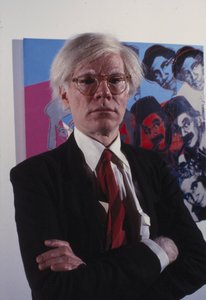
Andy Warhol
1928 - 1987 , United States of America
Quick Facts
- Artistic Movement Or Style: Pop Art
- Artists Or Movements Influenced By This Artist:
- Conceptualism
- Performance Art
- Full Name: Andrew Warhola Jr.
- Notable Artworks:
- Campbell's Soup Cans
- Marilyn Diptych
- Coca-Cola (3)
- Gold Marilyn
- Brillo Box sculptures
- Place Of Birth: Pittsburgh, United States of America
- Date Of Birth: 1928
- Date Of Death: 1987
Related Articles

The Mass Media Muse: How Pop Art Redefined the Modern Masterpiece
Explore how Pop Art revolutionized the modern masterpiece by embracing mass media and consumer culture. Discover the profound impact of Warhol and Lichtenstein on contemporary art history and design through this expert-led deep dive into the era of the mass media muse.


