Preview
 Send
Send Share
Share
 Details
 Guide
Guide

 Download
 Similars
 X-Ray
X-Ray Diaporama
 Stats
StatsThe Virgin and Child
 Oil
Oil- WallArt
- Romanist Renaissance
 1520
1520- Renaissance
 24.0 x 18.0 cm
 National Gallery of Canada
 Read More
Hand Made Oil Reproduction
Hand-painted oil on canvas in your size and frame, made to order by our artists. ( Switch to Print Switch to Digital Image)




P118B $10

P118H $10

P118W $10

P438Z $10

P508JH $12

P508YH $12

P805H $10

P805Z $10

P919BZ $10

P919G $10

P919XJ $10

P959ZH $10

P968JZ $12

W106C $8

W218G $10

W218JH $8

W218Y $10

W307PJ $10

W316G $10

W316PJ $8

W316Y $10

W398PJ $8

W4111J $10

W500HY $15

W500JH $15

W692G $12

W849H $8

W940BG $15

W953PJ $8




Pick from our preset sizes that match the artwork's original proportions.

You may enter your own dimensions to fit a specific frame or space. If your selected size does not match the original image's proportions, we will either crop the artwork or extend the painting with additional hand-painted elements. A digital mockup will be sent for your approval before production begins.
Please note that the on-screen preview does not reflect the actual cropping or extension. Only the mockup will accurately show the final composition.
While custom sizes are available, we recommend selecting a dimension from the predefined list to preserve the original proportions.
After order, AllPaintingsStore.com team will email client for instructions and provide a mockup preview
Worldwide Delivery () in 3/4 weeks instead of standard 5 weeks. (21 September). No compromise on quality.

Free Worldwide Express Shipping

High-Quality Linen Canvas

Full Shipping Insurance

Customs Tax Refund Guarantee

True Color Matching Guarantee

100-Day Return Policy (Defects Only)

100% Money-Back Guarantee

Bulk Discount Offer
 Glass option is only available in size under 110 CM

The Virgin and Child
Reproduction Medium
Reproduction Size
-


Total Price
$ 258
A Tender Encounter in the Flemish Renaissance
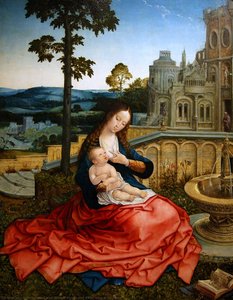
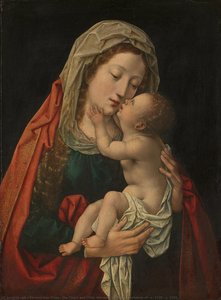
In the quiet intimacy of The Virgin and Child, we are invited into a moment of profound tenderness that transcends the centuries. This exquisite work by the Brussels master Barend van Orley captures the essence of maternal devotion through the delicate interaction between the Virgin Mary and her infant son. As the child nurses, there is a palpable sense of warmth and vulnerability, a humanizing touch that anchors the divine subject in a relatable, earthly reality. The composition is masterfully balanced by the soft infusion of natural light streaming through an adjacent window, which illuminates the figures with a gentle radiance, highlighting the subtle textures of skin and fabric. This play of light does more than just reveal form; it breathes life into the scene, creating an atmosphere of serene sanctity that draws the viewer into a state of quiet contemplation.
Beyond the central figures, the artist skillfully employs a sense of depth to suggest a larger world existing just beyond our immediate gaze. The presence of secondary figures in the background hints at a communal or perhaps even public setting, suggesting that this sacred moment is being witnessed by the faithful. This layering of space—from the intimate foreground to the softly blurred background—is a hallmark of the Flemish Renaissance, where artists sought to marry the meticulous detail of Northern realism with the grander, more harmonious compositions inspired by the Italian masters. For the discerning collector or interior designer, this painting offers a sophisticated focal point that brings both historical weight and a sense of peaceful elegance to any curated space.
The Synthesis of Northern Detail and Romanist Grace
To understand the brilliance of this piece, one must look to the unique position Barend van Orley held within the artistic landscape of the sixteenth century. Often identified as a leader of the Romanist movement, Van Orley possessed the rare ability to synthesize the rigorous, observational precision of his Flemish heritage with the idealized beauty and structural grace emerging from Raphael’s Rome. In The Virgin and Child, this duality is evident in the way every fold of the Virgin's drapery is rendered with tactile accuracy, yet the overall arrangement of the figures possesses a rhythmic, classical harmony. He does not merely paint a scene; he constructs a vision where the meticulous craftsmanship of the Brussels tapestry tradition meets the lofty ideals of the High Renaissance.
The technique employed here serves to elevate the emotional impact of the subject matter. The artist’s mastery over light and shadow—the chiaroscuro effect—creates a sculptural quality in the figures, making their presence feel almost tangible within the room. This level of detail makes a high-quality reproduction particularly captivating; when captured through skilled hand-painting, the nuances of Van Orley's brushwork can be felt, allowing the textures of the cloth and the softness of the infant's skin to resonate with modern viewers. It is an artwork that does not demand attention through sheer scale, but rather earns it through a quiet, persistent beauty that rewards prolonged study.
A Timeless Addition to the Refined Interior
For those looking to infuse their homes or galleries with a sense of historical continuity and soulful grace, The Virgin and Child serves as an incomparable inspiration. The painting carries a symbolic weight—representing purity, nurturing, and the eternal cycle of life—that remains deeply resonant in contemporary design. Its palette, characterized by soft tones and naturalistic light, allows it to integrate seamlessly into various aesthetic environments, from classical, traditional studies to more modern, minimalist settings that crave a touch of Old World soul.
Investing in a reproduction of such a significant work is an opportunity to possess a fragment of the Flemish Renaissance. It is more than mere decoration; it is an invitation to experience the same awe and tranquility that moved viewers five centuries ago. Whether placed as a centerpiece in a grand salon or as a contemplative piece in a private library, this masterpiece continues to fulfill its original purpose: to elevate the spirit through the sublime union of art, faith, and human emotion.
Related Artworks


Artist Biography
The Renaissance Soul of Brussels
In the heart of a burgeoning Brussels, where the scent of damp wool and the rhythmic clatter of looms defined the urban landscape, Barend van Orley emerged as a titan of the Flemish Renaissance. Born into an era of profound artistic transition, his very lineage was woven into the fabric of the arts; as the son of the esteemed tapestry designer Valentin van Orley, his childhood was likely an immersive education in the intricate textures and grand narratives required for the great tapestries of Europe. This early exposure to the meticulous craftsmanship of the Brussels workshops provided a foundation that would eventually allow him to transcend the boundaries of mere decoration, elevating the medium of tapestry to a level of painterly sophistication previously unseen in the Low Countries.
A Synthesis of Northern Realism and Italian Grace
While many of his contemporaries embarked on arduous pilgrimages to the sun-drenched studios of Italy, van Orley achieved a remarkable feat of artistic osmosis, absorbing the revolutionary aesthetics of Raphael’s Rome from afar. He became a leading figure of the Romanist movement, a stylistic bridge that married the unflinching, microscopic realism characteristic of the Netherlandish tradition with the idealized proportions and classical grandeur of the Italian Renaissance. In his hands, the heavy, tactile world of Flemish painting—where every fold of velvet and glint of gold could be felt through the gaze—met the harmonious compositions and balanced grace of the South. This synthesis created a visual language that was both intimately familiar to Northern patrons and breathlessly modern, characterized by a profound command over light, shadow, and the human form.
A Legacy Woven in Paint and Thread
Van Orley’s genius lay in his extraordinary versatility, an ability to command the brush, the loom, and the stained-glass window with equal mastery. His oeuvre is a testament to a creator who saw no distinction between the monumental scale of a tapestry design and the delicate intimacy of a religious oil painting. Whether depicting the profound gravity of the Last Judgement or the tender grace of a Virgin and Child, his work consistently radiated a sense of divine order and earthly beauty. Beyond his individual masterpieces, his historical significance is cemented by his role as a pivotal link in the evolution of Northern art, ensuring that the traditions of his ancestors were not merely preserved but transformed for a new age. Through his prolific output and the continuation of his family’s artistic lineage, Barend van Orley left an indelible mark on the cultural identity of the Flemish Renaissance, leaving behind a legacy as enduring as the very tapestries he helped to define.

Quick Facts
- Artistic Movement Or Style: Italianizing Flemish Renaissance
- Artists Or Movements Influenced By This Artist: ['Romanists']
- Artists Who Influenced This Artist: ['Raphael']
- Date Of Birth: c.1487
- Date Of Death: January 6, 1541
- Full Name: Bernard van Orley
- Nationality: Flemish
- Notable Artworks:
- The Haneton Triptych
- Portrait of Margareta van Oostenrijk
- Altarpiece of Calvary
- Place Of Birth: Brussels, Belgium
Related Articles

Early Netherlandish Masters: 10 Paintings That Revolutionized Art & Decor
Journey into the world of Early Netherlandish painting! Explore 10 masterpieces by Jan van Eyck, Rogier van der Weyden & more. Discover stunning detail, symbolism & Renaissance art for your home decor. Find museum-quality reproductions on AllPaintingsStore.com
Émile Bernard: Pioneering Synthetism & the Post-Impressionist Quest for Essence
Explore the life & work of Émile Bernard, a pivotal Post-Impressionist pioneer of Synthetism. Discover his influence on Van Gogh & Gauguin and learn about collecting his art with AllPaintingsStore.
Rembrandt's Masterpieces: Explore 25 Iconic Paintings & Prints | AllPaintingsStore
Journey through Rembrandt van Rijn's 25 most iconic paintings & etchings. Explore Dutch Golden Age masterpieces, dramatic chiaroscuro, and timeless portraits. Find museum-quality art reproductions to elevate your home decor on AllPaintingsStore.com.

Early Netherlandish Masters: 10 Paintings That Revolutionized Art & Decor
Journey into the Early Netherlandish Renaissance! Explore 10 iconic paintings by Jan van Eyck, Rogier van der Weyden & more. Discover stunning detail, symbolism, and oil painting techniques. Find museum-quality art reproductions for your home at AllPaintingsStore.com.

Charles-André van Loo: A Study in Rococo Portraiture & the French Court's Artistic Dynamics
Explore the elegant world of Charles-André van Loo, a master of Rococo portraiture at the French court. Discover his life, techniques, and enduring influence on 18th-century art. Hand-painted reproductions available.