- Home

- Oil Painting Reproduction
- Cindy Sherman
- Untitled #566
 Buy print
 Send
Send Share
Share
 Details

 Download
 Similars
 X-Ray
X-Ray Diaporama
Untitled #566
 Acrylic On Canvas
- WallArt
- Contemporary Realism
 2016
2016- Modern
 121.0 x 128.0 cm
 The Feminist Institute
 Read More
Hand Made Oil Reproduction
Hand-painted oil on canvas in your size and frame, made to order by our artists.




P118B ₴10

P118H ₴10

P118W ₴10

P438Z ₴10

P508JH ₴12

P508YH ₴12

P805H ₴10

P805Z ₴10

P919BZ ₴10

P919G ₴10

P919XJ ₴10

P959ZH ₴10

P968JZ ₴12

W106C ₴8

W218G ₴10

W218JH ₴8

W218Y ₴10

W307PJ ₴10

W316G ₴10

W316PJ ₴8

W316Y ₴10

W398PJ ₴8

W4111J ₴10

W500HY ₴15

W500JH ₴15

W692G ₴12

W849H ₴8

W940BG ₴15

W953PJ ₴8




Pick from our preset sizes that match the artwork's original proportions.

You may enter your own dimensions to fit a specific frame or space. If your selected size does not match the original image's proportions, we will either crop the artwork or extend the painting with additional hand-painted elements. A digital mockup will be sent for your approval before production begins.
Please note that the on-screen preview does not reflect the actual cropping or extension. Only the mockup will accurately show the final composition.
While custom sizes are available, we recommend selecting a dimension from the predefined list to preserve the original proportions.
After order, AllPaintingsStore.com team will email client for instructions and provide a mockup preview
Worldwide Delivery () in 3/4 weeks instead of standard 5 weeks. (16 July). No compromise on quality.

Free Worldwide Express Shipping

High-Quality Linen Canvas

Full Shipping Insurance

Customs Tax Refund Guarantee

True Color Matching Guarantee

60-Day Return Policy (Defects Only)

100% Money-Back Guarantee

Bulk Discount Offer
 Glass option is only available in size under 110 CM

Untitled #566
Reproduction Medium
Reproduction Size
-


Total Price
-
Artwork Description
Cindy Sherman’s Deconstruction of Identity: Exploring “Untitled #566”
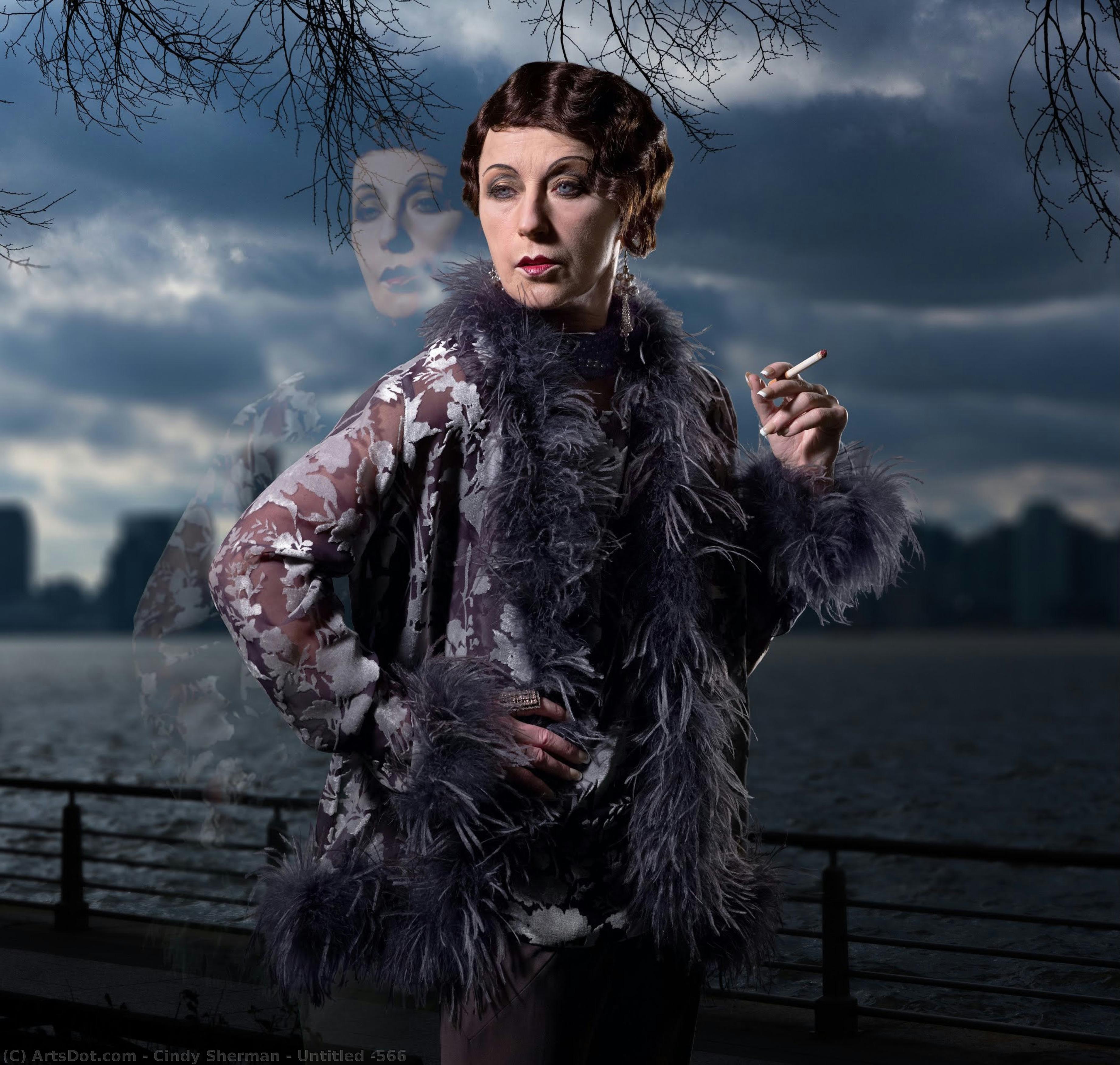
The photograph "Untitled #566" by Cindy Sherman stands as a cornerstone of feminist art and a masterful demonstration of conceptual filmmaking—a technique that transcends mere visual representation to delve into the complexities of performance and identity. Captured in 2016, this black and white image depicts a woman standing on a pier, her back turned towards the viewer, absorbed in contemplation while puffing on a cigarette. It’s not simply a portrait; it's an interrogation of how we perceive femininity and selfhood within societal frameworks.The Style and Technique: Appropriation and Persona
Sherman’s signature approach is appropriation—she meticulously recreates iconic film stills, transforming herself into characters drawn from cinematic history. In “Untitled #566,” she embodies a figure reminiscent of Marlene Dietrich, channeling the glamour and defiance associated with Hollywood actresses of the 1930s and 40s. This isn’t about impersonation; it's about inhabiting a persona—a carefully constructed illusion designed to expose the artificiality inherent in portraying gender roles. Sherman achieves this through painstaking costume design, makeup artistry, and meticulous staging, creating an environment that reinforces the chosen character’s narrative. The stark black and white palette amplifies the image’s emotional resonance, stripping away distracting color hues and focusing attention on texture and form—elements crucial to conveying mood and psychological depth.Historical Context: Challenging Hollywood Stereotypes
Sherman's work emerged during a period of significant feminist discourse surrounding representations of women in cinema. The film stills she selects serve as visual anchors for broader conversations about gender inequality, objectification, and the pressures faced by women aspiring to success in traditionally male-dominated fields. Dietrich’s character—a glamorous femme fatale—represented a powerful archetype of female ambition and vulnerability simultaneously. Sherman cleverly utilizes this image to critique Hollywood's tendency to portray women as either passive victims or manipulative seducers, highlighting the limitations imposed upon female characters within cinematic narratives.Symbolism: Pier, Cigarette, Reflection
The pier itself functions as a potent symbol—representing isolation, contemplation, and perhaps even vulnerability. The woman’s posture conveys stillness and introspection, suggesting she is grappling with internal anxieties or confronting uncomfortable truths about her identity. Crucially, her back turned to the camera emphasizes her detachment from an external gaze, mirroring the core concept of Sherman's artistic project: the awareness that our perceptions of ourselves are shaped by how others see us. The cigarette—a recurring motif in Sherman’s oeuvre—represents defiance and rebellion against societal expectations; it’s a visual shorthand for asserting agency amidst constraints. Furthermore, the subtle reflection in the water adds another layer of complexity, hinting at an inner landscape mirroring the external world – a visual representation of self-awareness and confronting one's own biases.Emotional Impact: An Invitation to Reflection
Ultimately, “Untitled #566” compels viewers to confront questions about gender identity and performance. Sherman doesn’t offer answers; instead, she presents a carefully crafted scenario designed to provoke contemplation. The photograph lingers in the mind long after viewing, prompting reflection on how societal pressures influence our self-perception and challenging us to reconsider conventional representations of femininity. It's an artwork that speaks volumes without uttering a word—a testament to Sherman’s ability to harness visual language as a tool for intellectual and emotional engagement.


Artist Biography
A Deconstruction of Identity: The World of Cindy Sherman
Born in Glen Ridge, New Jersey, in 1954, Cynthia Morris Sherman emerged as a pivotal figure in late 20th and early 21st-century art, not through traditional portraiture, but through its deliberate dismantling. More commonly known as Cindy Sherman, she didn’t seek to capture likeness; instead, she sought to expose the constructed nature of identity itself – how it is formed by media, societal expectations, and the very act of being looked at. Her work isn't about *who* someone is, but rather *how* we perceive them, and the roles we assign based on superficial cues. Growing up in a relatively strict household with an engineer father and a mother who worked with children facing learning difficulties, Sherman’s early life provided a quiet backdrop for a mind that would later become intensely focused on observation and performance. This formative period instilled within her a keen awareness of social dynamics and the subtle pressures of conformity – themes that would permeate her artistic practice.From Painting to Photographic Performance
Sherman’s artistic journey began with painting at Buffalo State University in 1972, but she quickly grew frustrated by what she perceived as the limitations of the medium. It wasn't enough to simply *represent* reality; she wanted to dissect it, to expose its underlying mechanisms. Photography offered her a new language – one that allowed for direct engagement with representation and the manipulation of image. This shift marked a turning point, leading to her groundbreaking series, Bus Riders (1976), where she began experimenting with disguises and characterizations, observing and embodying everyday people on public transportation. However, it was the Untitled Film Stills (1977-1980) that catapulted her to international recognition. This seminal series of 70 black-and-white photographs presented Sherman herself as archetypal female characters lifted directly from the visual vocabulary of B-movies and television. These weren’t recreations, but rather evocations – carefully constructed scenarios that hinted at narratives without ever fully revealing them. Each image felt simultaneously familiar and unsettling, prompting viewers to question their own assumptions about gender roles and cinematic tropes. The series wasn't simply *about* these characters; it was a commentary on the very act of representation, exposing how images shape our understanding of identity.Exploring Archetypes and Societal Roles
Throughout the 1980s and beyond, Sherman continued to explore the themes of constructed identity and societal expectations through diverse series. Her Centerfolds & Fashion Series directly confronted the objectification of women in media, recreating images reminiscent of magazine spreads with a critical eye. Fairy Tales and Disasters (mid-to-late 1980s) saw her move into more fantastical and grotesque territory, utilizing prosthetics and elaborate makeup to create unsettling imagery that challenged conventional notions of beauty and narrative. The History Portraits (early 1990s) were particularly striking – recreations of historical paintings with subtle but significant alterations, questioning the authenticity and power dynamics inherent in traditional portraiture. She wasn’t simply copying these works; she was interrogating them, exposing their constructed nature and challenging the very notion of artistic “masterpieces.” Later work continued this exploration, often incorporating large-format color photography and digital manipulation to further blur the lines between reality and illusion.Influences and Lasting Legacy
Sherman’s work is deeply rooted in Conceptual Art, prioritizing ideas over traditional artistic skills. She draws heavily from Feminist Theory, engaging with critiques of representation and the male gaze, particularly as articulated by Laura Mulvey in her influential essay “Visual Pleasure and Narrative Cinema.” Mulvey’s concept of "to-be-looked-at-ness" – the objectification of women within cinematic structures – became a central concern in Sherman's work. While pinpointing direct influences is difficult, one can also see echoes of Surrealism in her exploration of the subconscious and the unsettling juxtaposition of images. Her impact on contemporary art has been profound. She’s considered a key figure in the “Pictures Generation,” a group of artists who explored the impact of mass media on culture. Recognition came with prestigious awards like the MacArthur Fellowship (1995), and her photographs are now held by major museums worldwide, including MoMA and the Nelson-Atkins Museum of Art. Cindy Sherman’s innovative approach to self-portraiture has not only redefined the genre but also continues to provoke critical dialogue about identity, representation, and the pervasive power of images in shaping our perceptions of ourselves and the world around us. Her work remains remarkably relevant today, prompting ongoing discussions about authenticity, performance, and the ever-evolving nature of selfhood in a media-saturated society.
Cindy Sherman
1954 - , United States of America
Quick Facts
- Artistic Movement Or Style: Conceptual art, Photography
- Artists Or Movements Influenced By This Artist: ['Pictures Generation']
- Artists Who Influenced This Artist: ['Laura Mulvey']
- Date Of Birth: 1954-01-19
- Full Name: Cindy Sherman
- Nationality: American
- Notable Artworks:
- Untitled Film Stills
- Bus Riders
- Centerfolds
- Fairy Tales
- History Portraits
- Place Of Birth (City And Country): Glen Ridge, USA
Related Articles
Monochrome Visions: Exploring the Aesthetic & Historical Significance of Black & White Photography
Explore the rich history & artistic power of black and white photography. From early techniques to iconic masters like Ansel Adams, discover why monochrome continues to captivate art lovers today. Expert insights for collectors.

Chromatic Absence: Exploring the Aesthetic Power of Black & White Art
Explore the captivating world of monochrome art! Discover its rich history, influential artists like Malevich & Klein, and profound emotional impact. Expert insights for collectors & design enthusiasts.
From Snapshot to Statement: Elevating Personal Photography Through Black & White Fine Art Reproduction
Transform cherished photos into timeless black & white fine art with AllPaintingsStore. Our expert artists create museum-quality reproductions – a lasting legacy for your home and family. Discover the artistry today.

Beyond the Lens: Photography's Enduring Influence on Modern & Contemporary Art
Explore photography's pivotal role in shaping modern & contemporary art. Discover key movements, influential artists like Stieglitz, and expert collecting advice from AllPaintingsStore.

The Enduring Muse: Women as Subject & Symbol in Art History
Explore the rich history of women in art – from archetypal representations to contemporary voices challenging norms. Discover iconic artists & movements, and learn about reclaiming female narratives through painting and beyond.