


 Preview
 Send
Send Share
Share
 Details
 Guide
Guide

 Download
 Similars
 X-Ray
X-Ray Diaporama
 Stats
StatsLee Nevin


 Read More
The artwork displayed on this page is protected by copyright law, which means we cannot legally create or sell an identical reproduction. This protection is enforced under international agreements such as the Berne Convention and by national laws, including those outlined by the U.S. Copyright Law - Title 17.
This method fully complies with copyright regulations because it does not involve copying or duplicating the protected artwork. Instead, it is a creative reinterpretation - a new painting that is influenced by the original but not identical to it.
Giclée / Art Print
Museum-quality giclée or canvas print with fast production and flexible finish options. ( Buy Hand Made Painting Switch to Digital Image)




P118B $10

P118H $10

P118W $10

P438Z $10

P508JH $12

P508YH $12

P805H $10

P805Z $10

P919BZ $10

P919G $10

P919XJ $10

P959ZH $10

P968JZ $12

W106C $8

W218G $10

W218JH $8

W218Y $10

W307PJ $10

W316G $10

W316PJ $8

W316Y $10

W398PJ $8

W4111J $10

W500HY $15

W500JH $15

W692G $12

W849H $8

W940BG $15

W953PJ $8




Pick from our preset sizes that match the artwork's original proportions.

Type the width and the height you need, to fit your frame or your wall. A print can only be cut, never made bigger than the picture, so a size with a different shape loses a part of the image. We send you a digital mockup to approve before we print anything. The picture shown on this page does not show the real cut — only the mockup does.
Worldwide Delivery () in 2 weeks instead of standard 4/5 weeks. (24 October)

Free Worldwide Express Shipping

High-Quality Linen Canvas

Full Shipping Insurance

Customs Tax Refund Guarantee

True Color Matching Guarantee

100-Day Return Policy (Defects Only)

100% Money-Back Guarantee

Bulk Discount Offer
 Glass option is only available in size under 110 CM

Lee Nevin
Giclée / Art Print
Reproduction Size
-


Total Price
$ 65
Lee Nevin by Frederick Sommer
Frederick Sommer’s “Lee Nevin” stands as a poignant testament to the artist's exploration of vulnerability and introspection amidst the stark beauty of the American desert landscape. Executed in 1965, this gelatin silver print captures a moment of quiet contemplation—a woman gazing downwards with her hand resting on her forehead—against an abstracted architectural backdrop that speaks volumes about both form and emotion.- Subject Matter: The artwork centers around portraiture, specifically focusing on conveying the mood and emotional state of an individual subject. Sommer’s masterful composition draws the viewer into Lee Nevin's gaze, inviting contemplation on themes of melancholy and inner reflection.
- Style & Technique: Sommer’s style aligns with mid-century desert landscape photography—a genre characterized by its deliberate use of tonal contrasts and textural layering. The print utilizes a close-up perspective, prioritizing detail and capturing the subtle nuances of expression. Notably, the textured background employs impasto techniques, suggesting brushstrokes that contribute to the artwork's overall visual richness.
- Historical Context: Created during the formative years of American experimental photography—particularly following Sommer’s diagnosis with tuberculosis—the piece embodies a spirit of resilience and artistic exploration. It reflects the broader movement toward challenging conventional photographic practices and prioritizing emotional resonance over purely representational accuracy.
- Color Palette & Composition: The monochrome palette—primarily shades of black, white, and gray—amplifies the artwork’s tonal range and underscores its solemn mood. The woman's head is positioned slightly off-center, creating visual balance while directing the viewer’s attention to her face and gesture.
- Symbolism & Emotional Impact: The bowed head and hand gesture are laden with symbolic significance—representing sadness, vulnerability, and a yearning for solace. Simultaneously, the abstract architectural background serves as a metaphor for internal struggles and complexities, mirroring the subject's emotional journey.
Detailed Examination
The photograph’s meticulous attention to detail is evident in its use of lighting—diffused and even—which illuminates the contours of Lee Nevin's face and emphasizes textural nuances. The photographer skillfully employs perspective, presenting an intimate view that draws viewers into her emotional state. Depth is achieved through layering shapes and textures; the architectural background recedes subtly behind the woman’s figure, creating a sense of spatial separation. Sommer’s technique—characterized by careful control over composition and tonal manipulation—results in an image that transcends mere visual representation, communicating profound feelings of introspection and melancholy.Provenance & Reproduction
“Lee Nevin” was produced using photographic film and subsequently printed on silver gelatin paper—a process renowned for its archival qualities and ability to faithfully reproduce subtle tonal variations. The resulting print measures 36.2 x 29.5 cm (14 1/4 x 11 5/8 in.) and is mounted securely within a frame. AllPaintingsStore offers high-quality reproductions of this iconic artwork, allowing collectors and enthusiasts alike to experience its beauty and emotional power firsthand.Questions & Answers
Can I watch "Lee Nevin" as a full-screen slideshow?
"Lee Nevin" by Frederick Sommer can be viewed as a slideshow on the artwork's Diaporama page.
How strong is the contrast in "Lee Nevin" by Frederick Sommer?
"Lee Nevin" by Frederick Sommer shows a statement contrast between its light and dark areas.
How does the subject of "Lee Nevin" relate to Frederick Sommer's usual themes?
"Lee Nevin" depicts desert landscape, portraiture, minimalism, texture, introspection, architecture, monochrome, while Frederick Sommer's recorded themes are desert visionary, experimental photography, collaborative endeavor, landscape architecture, anatomical illustrations. Comparing the two shows how the work relates to the artist's usual subjects.
Related Artworks


Artist Biography
Frederick Sommer: A Desert Visionary
Frederick Sommer (1905 – 1999) stands as a singular figure in American photography and visual art, recognized for his hauntingly beautiful desert landscapes and his pioneering exploration of photographic techniques. Born in Cornell University where he met Frances Elisabeth Watson—whom he married in 1928—Sommer’s life was marked by intellectual curiosity and artistic dedication, culminating in the establishment of the Center for Creative Photography at Arizona State University alongside Ansel Adams, Harry Callahan, Wynn Bullock, and Aaron Siskind. This collaborative endeavor cemented his legacy as a champion of experimental photography and fostered a vibrant community of artists committed to pushing creative boundaries.- Early Life & Tuberculosis Diagnosis: Sommer’s artistic journey began unexpectedly in 1931 when he was diagnosed with tuberculosis. Seeking solace and expression amidst illness, he turned to photography as a medium—a decision that profoundly shaped his artistic vision. This formative experience instilled within him a sensitivity to vulnerability and resilience, themes that would permeate much of his subsequent work.
- The Advent of Photography & Influences: Photography’s transformative power captivated Sommer, leading him to acquire an 8×10 Century Universal Camera in 1938. Inspired by the monumental landscapes of Ansel Adams—particularly Yosemite Valley’s El Capitan and Half Dome—Sommer embarked on a quest to capture the grandeur and subtle complexities of the American desert. His artistic sensibilities were further enriched by collaborations with luminaries like Max Ernst, Aaron Siskind, Richard Nickel, and Minor White, who shared his fascination for exploring unconventional photographic approaches.
Desert Landscapes & Surreal Composition
Sommer’s photographs are characterized by an arresting stillness—a deliberate rejection of conventional compositional strategies. Rather than striving for dramatic vistas or theatrical lighting effects, he favored horizonless landscapes and jarred subjects—techniques that demanded meticulous observation and a profound understanding of visual perception. As Robert C. Morgan eloquently described, Sommer's images “were sommer’s seemingly infinite desert landscapes, some of which he referred to as 'constellations.'" These compositions weren’t merely representations of the natural world; they functioned as meditations on solitude, contemplation, and the sublime—reflecting a deep engagement with existential themes.- Innovative Techniques & Collage Exploration: Sommer relentlessly pursued new methods of artistic expression, experimenting with cliché-verre negatives and pushing the boundaries of photographic printing. Notably, he transitioned to collage in his final years—creating intricate assemblages based on anatomical illustrations—a stylistic choice that underscored his enduring interest in exploring visual metaphors and conveying complex ideas.
- Institutional Recognition & Legacy: His contribution to photography was formally acknowledged through the founding of the Center for Creative Photography, a testament to his unwavering belief in collaborative artistic endeavors. Sommer’s archive—containing extensive photographic negatives and correspondence—became an invaluable resource for scholars and artists alike, furthering the dissemination of experimental photographic practices.
Musical Score Drawings & Artistic Dialogue
Beyond his monumental desert landscapes, Sommer produced a series of drawings inspired by musical scores—a practice that reveals his artistic sensitivity to rhythm, texture, and visual harmony. These compositions weren’t intended as literal transcriptions of music; instead, they functioned as symbolic representations of emotional states and intellectual concepts—demonstrating Sommer's ability to translate abstract ideas into tangible forms.- Notable Collaborations & Artistic Influences: Sommer’s artistic journey intersected with the careers of influential figures such as Ansel Adams, Harry Callahan, Wynn Bullock, and Aaron Siskind, fostering a dynamic exchange of ideas and techniques. His work continues to inspire artists today—serving as a reminder that true innovation arises from embracing unconventional approaches and engaging in meaningful dialogue across disciplines.
Concluding Reflections: A Master’s Enduring Vision
Frederick Sommer passed away in 1999, leaving behind an extraordinary artistic legacy. His photographs—particularly his desert landscapes—remain among the most evocative and intellectually stimulating images of the twentieth century—a testament to his unwavering commitment to artistic exploration and his profound understanding of the human condition. Today’s reproductions of Sommer's work continue to captivate audiences worldwide—affirming his enduring influence on American art history.
Frederick Sommer
1905 - 1999
Quick Facts
- Artistic Movement Or Style: Photography, Surrealism
- Artists Or Movements Influenced By This Artist: ['Yosemite Valley Views']
- Artists Who Influenced This Artist:
- Ansel Adams
- Edward Weston
- Aaron Siskind
- Date Of Birth: 1905
- Date Of Death: 1999
- Full Name: Frederick Sommer
- Nationality: American
- Notable Artworks:
- Giant
- Max Ernst
- Untitled (213)
- Place Of Birth: Cornell University
Related Articles

Timeless Shadows: The Artistry, History, and Emotional Resonance of Black and White Photography
Explore the profound artistry of black and white photography. From historical mastery to the interplay of light and shadow, discover how monochrome captures timeless emotion and form through a sophisticated lens of art history.

Dark Masterpieces: 10 Iconic Paintings Dominated by Black Tones |
Explore 10 iconic paintings dominated by black tones, from Rembrandt’s chiaroscuro to Goya's dark expressions. Discover the stories behind these masterpieces & find museum-quality art reproductions for your home at .

Beyond Color: The Timeless Power and Artistry of Black and White Photography
Explore the profound artistry of black and white photography. From the chemistry of gelatin silver to the chiaroscuro of the Old Masters, discover how monochrome captures the eternal essence of light, form, and emotion for the discerning art collector.

Beyond the Lens: Photography's Enduring Influence on Modern & Contemporary Art
Explore photography's pivotal role in shaping modern & contemporary art. Discover key movements, influential artists like Stieglitz, and expert collecting advice from AllPaintingsStore.
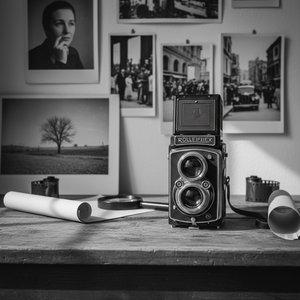
Monochrome Visions: Exploring the Aesthetic & Historical Significance of Black & White Photography
Explore the rich history & artistic power of black and white photography. From early techniques to iconic masters like Ansel Adams, discover why monochrome continues to captivate art lovers today. Expert insights for collectors.


