- Home

- Oil Painting Reproduction
- frederick william elwell
- The Butler Takes a Glass of Port (All Things Come to the Man That Waits)

 Buy print
 Send
Send Share
Share
 Details

 Download
 Similars
 X-Ray
X-Ray Diaporama
The Butler Takes a Glass of Port (All Things Come to the Man That Waits)
 Oil
Oil- WallArt
- Realism
 1899
1899- 19th Century
 94.0 x 75.0 cm
 Beverley Art Gallery
 Read More
Hand Made Oil Reproduction
Hand-painted oil on canvas in your size and frame, made to order by our artists.




P118B $10

P118H $10

P118W $10

P438Z $10

P508JH $12

P508YH $12

P805H $10

P805Z $10

P919BZ $10

P919G $10

P919XJ $10

P959ZH $10

P968JZ $12

W106C $8

W218G $10

W218JH $8

W218Y $10

W307PJ $10

W316G $10

W316PJ $8

W316Y $10

W398PJ $8

W4111J $10

W500HY $15

W500JH $15

W692G $12

W849H $8

W940BG $15

W953PJ $8




Pick from our preset sizes that match the artwork's original proportions.

You may enter your own dimensions to fit a specific frame or space. If your selected size does not match the original image's proportions, we will either crop the artwork or extend the painting with additional hand-painted elements. A digital mockup will be sent for your approval before production begins.
Please note that the on-screen preview does not reflect the actual cropping or extension. Only the mockup will accurately show the final composition.
While custom sizes are available, we recommend selecting a dimension from the predefined list to preserve the original proportions.
After order, AllPaintingsStore.com team will email client for instructions and provide a mockup preview
Worldwide Delivery () in 3/4 weeks instead of standard 5 weeks. (16 July). No compromise on quality.

Free Worldwide Express Shipping

High-Quality Linen Canvas

Full Shipping Insurance

Customs Tax Refund Guarantee

True Color Matching Guarantee

60-Day Return Policy (Defects Only)

100% Money-Back Guarantee

Bulk Discount Offer
 Glass option is only available in size under 110 CM

The Butler Takes a Glass of Port (All Things Come to the Man That Waits)
Reproduction Medium
Reproduction Size
-


Total Price
-
Artwork Description
A Moment of Refined Solitude
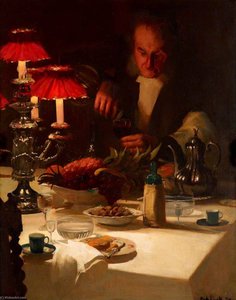
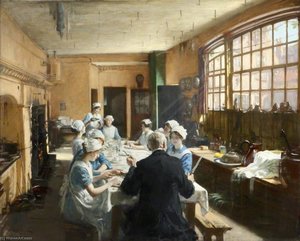
In the quiet, amber-hued atmosphere of Frederick William Elwell’s 1899 masterpiece, The Butler Takes a Glass of Port (All Things Come to the Man That Waits), we are invited into a scene of profound, dignified indulgence. The painting captures a singular, stolen moment of respite within the rigid structures of late Victorian service. A man, dressed in the formal attire of his station, sits at a table laden with the remnants of a fine meal. As he lifts a glass of deep, crimson port to his lips, there is a palpable sense of relief and quiet triumph. The composition draws the viewer into this intimate circle, where the clatter of the household has faded into the background, leaving only the sensory delights of rich food, polished silver, and the heady aroma of fine wine.
Elwell, a master of capturing the interplay between light and life, utilizes a technique that breathes warmth into every corner of the canvas. The lighting is particularly evocative; it does not merely illuminate the subject but seems to emanate from the very textures of the scene—the glint of light on glassware, the soft sheen of a well-pressed suit, and the heavy, inviting shadows that suggest a room filled with history. His brushwork, rooted in the realism of the Yorkshire tradition, manages to balance meticulous detail with an atmospheric softness that prevents the scene from feeling static. This delicate balance ensures that the viewer feels not just like an observer, but a silent guest at this private banquet.
Symbolism and the Art of Patience
The subtitle of the work, All Things Come to the Man That Waits, provides a poignant layer of narrative depth that elevates the painting from a mere genre scene to a philosophical meditation. The butler, typically a figure of invisibility and constant motion, is here captured in a state of stillness. This pause represents more than just a break from labor; it symbolizes the reward of discipline and the quiet dignity found in patience. The abundance on the table—the bowls, cups, and lingering feast—serves as a visual metaphor for the fruits of a life lived with order and dedication. There is a subtle tension between his professional role and this personal indulgence, suggesting that even within the most structured lives, there exists a profound human need for sweetness and repose.
For the discerning collector or interior designer, this piece offers an unparalleled sense of sophistication. It is a work that commands attention through its narrative weight rather than through garish color. When placed in a curated space—perhaps a study, a library, or a formal dining room—the painting acts as an anchor of elegance. Its rich, warm palette and classical subject matter provide a timeless quality that complements both traditional period interiors and contemporary settings seeking a touch of historical gravitas. To possess a reproduction of this work is to bring into one's home not just a beautiful image, but a celebrated moment of human grace and the enduring beauty of the quiet life.
Related Artworks


Artist Biography
Frederick William Elwell: A Yorkshire Painter of Life and Light
Frederick William Elwell, born in Beverley, East Riding of Yorkshire, on June 29th, 1870, was a pivotal figure in late nineteenth and early twentieth-century British art. More than just a painter, he captured the essence of his home county – its landscapes, its people, and its everyday moments – with a realism imbued with a distinctly Aesthetic sensibility. His legacy rests not only on a substantial body of work but also on his embodiment of Yorkshire’s artistic spirit, earning him recognition within both local communities and the prestigious Royal Academy. Elwell's early life was deeply rooted in Beverley’s artistic traditions. His father, James Edward Elwell, was a respected wood carver, instilling in young Frederick an appreciation for craftsmanship and detail. Recognizing his son’s innate talent, James encouraged Fred’s artistic pursuits, providing him with drawing lessons and fostering a love of art from a young age. This foundation led to Fred's enrollment at Lincoln Grammar School, where he honed his skills before receiving the coveted Gibney Scholarship, allowing him to pursue formal training at the Lincoln School of Art. It was here that Elwell’s interest in French Impressionism began to blossom, influencing his use of light and color – a departure from the prevailing academic styles of the time. He sought to capture not just what he saw, but also *how* it felt, imbuing his paintings with an emotional resonance. Elwell's artistic journey took him beyond Lincoln, culminating in a period of study at the Royal Academy of Fine Arts in Antwerp and later, the Académie Julien in Paris. These experiences broadened his technical skills and exposed him to diverse artistic movements. However, he always returned to the familiar landscapes and subjects of Yorkshire, finding inspiration in its rolling hills, quaint villages, and the lives of its people. His work during this period reflects a careful balance between Impressionistic techniques – particularly in his use of broken color and fleeting light – and a grounded realism that rooted him firmly within his regional context. He was particularly adept at portraying domestic scenes, capturing the warmth and intimacy of family life with remarkable sensitivity. A significant aspect of Elwell’s artistic development involved his engagement with the Aesthetic movement. This influential cultural current valued beauty, art for art's sake, and a rejection of purely utilitarian values. Elwell embraced this philosophy, creating works that were not merely representations of reality but rather explorations of mood, atmosphere, and subjective experience. His paintings are often characterized by a quiet contemplation, inviting the viewer to share in his observations and emotions. He frequently depicted scenes from rural life – farmers tending their fields, villagers gathering at the local pub, or families enjoying simple pleasures – transforming these ordinary moments into works of art. His subject matter was deliberately chosen to reflect the values of the Aesthetic movement: a celebration of beauty, nature, and human connection. Elwell’s career spanned several decades, during which he exhibited his work both in England and abroad. He achieved considerable success at the Paris Salon and, more notably, gained Royal Academy membership in 1938 – a testament to the recognition of his artistic merit by one of Britain's most prestigious art institutions. His paintings were acquired by prominent collectors, including members of the Royal Family, demonstrating the esteem in which he was held within the art world. Amongst his notable works are “The Landlord,” a vibrant depiction of a Yorkshire pub scene, and "The Wedding Dress," a poignant portrayal of grief and loss that showcases Elwell’s ability to convey complex emotions through subtle details and evocative color palettes. His self-portrait, “Self Portrait”, offers a glimpse into the artist's own personality and artistic process. Frederick William Elwell passed away in Beverley on January 3rd, 1958, leaving behind a rich legacy of paintings that continue to resonate with viewers today. His work is now housed in various collections across the UK, including the Ferens Art Gallery in Hull, where it remains a beloved and celebrated part of the local art heritage. Elwell’s enduring appeal lies not only in his technical skill but also in his ability to capture the spirit of Yorkshire – its beauty, its people, and its timeless charm—making him one of the most important regional artists of the early 20th century.Key Works & Notable Achievements
- The Landlord (1935): A quintessential depiction of Yorkshire pub life, capturing the warmth and conviviality of a local watering hole. The painting’s meticulous detail and vibrant colors are characteristic of Elwell's style.
- The Wedding Dress (1911): A deeply moving portrayal of grief and loss, showcasing Elwell’s ability to evoke powerful emotions through subtle details and evocative color palettes. The model was Violet Prest, a costumier in Beverley who tragically lost her husband during the First World War.
- The Big Top (1928): A lively scene depicting a traveling circus, capturing the energy and excitement of this itinerant spectacle.
- The First Born (1913): An intimate portrait of a young mother and child, demonstrating Elwell’s skill in capturing human emotion and portraying domestic scenes with warmth and tenderness.
- Self Portrait (1911): A revealing self-portrait that offers insight into the artist's personality and artistic process.
Legacy & Influence
Elwell’s work is considered a significant contribution to British landscape painting, particularly within the context of the Aesthetic movement. His paintings are characterized by their realism, emotional depth, and skillful use of light and color. He was a respected member of the Royal Academy, and his works continue to be exhibited and admired today. His influence can be seen in the work of later Yorkshire artists who followed in his footsteps, establishing him as a key figure in the region’s artistic history. The Ferens Art Gallery in Hull plays a vital role in preserving and promoting Elwell's legacy through its extensive collection of his paintings.
frederick william elwell
1870 - 1958
Quick Facts
- Artistic Movement Or Style: Realism, Aesthetic
- Artists Or Movements Influenced By This Artist: ['Aesthetic Movement']
- Artists Who Influenced This Artist:
- French Impressionists
- Dutch Masters
- Date Of Birth: June 29, 1870
- Date Of Death: January 3, 1958
- Full Name: Frederick William Elwell
- Nationality: English
- Notable Artworks:
- The Landlord
- The Big Top
- Wedding Dress
- First Born
- Place Of Birth: Beverley, East Riding
Related Articles

William Powell Frith: Narratives of Victorian Society & the Rise of Realist Painting
Explore the life & works of William Powell Frith, the 'greatest British painter of social scenes.' Discover his iconic Victorian genre paintings and learn about his lasting impact on realist art. Hand-painted reproductions available.

Myles Birket Foster: Nostalgia, Narrative & the Victorian Pastoral Tradition
Explore the captivating world of Myles Birket Foster, Victorian watercolorist renowned for idyllic rural scenes. Discover his sentimental landscapes, narrative detail & lasting artistic legacy. Learn more at AllPaintingsStore.

The Refined Aesthetic of Victorian Illustration: A Study in Narrative & Technique
Explore the captivating world of Victorian illustration! Discover Pre-Raphaelite influences, key artists like Rossetti & Stephens, and the era's rich narrative detail. A deep dive for art enthusiasts.

Robert Lillie: A Study in Victorian Genre Painting and Domestic Narrative
Explore the captivating Victorian genre paintings of Robert Lillie (1867-1949). Discover his serene Scottish landscapes and intimate domestic scenes, reflecting a unique artistic vision. Learn about his life, style & legacy.

Edward Hopper's Masterpieces: 25 Iconic Paintings & Their Enduring Legacy | AllPaintingsStore
Explore 25 iconic Edward Hopper paintings & their stories. Discover American realism, urban loneliness, and timeless beauty through his masterpieces. Find museum-quality art reproductions & curated decor ideas at AllPaintingsStore.com.