


 Preview
 Send
Send Share
Share
 Details
 Guide
Guide

 Download
 Similars
 X-Ray
X-Ray Diaporama
 Stats
StatsMedicine (composition draft)

 Read More
Hand Made Oil Reproduction
Hand-painted oil on canvas in your size and frame, made to order by our artists. ( Switch to Print Switch to Digital Image)




P118B $10

P118H $10

P118W $10

P438Z $10

P508JH $12

P508YH $12

P805H $10

P805Z $10

P919BZ $10

P919G $10

P919XJ $10

P959ZH $10

P968JZ $12

W106C $8

W218G $10

W218JH $8

W218Y $10

W307PJ $10

W316G $10

W316PJ $8

W316Y $10

W398PJ $8

W4111J $10

W500HY $15

W500JH $15

W692G $12

W849H $8

W940BG $15

W953PJ $8




Pick from our preset sizes that match the artwork's original proportions.

Type the width and the height you need, to fit your frame or your wall. This is hand-painted, so for a size with a different shape the artist can paint a bit more around the picture, or cut a bit — you choose. We send you a digital mockup to approve before the painting starts. The picture shown on this page does not show the real result — only the mockup does.
After order, AllPaintingsStore.com team will email client for instructions and provide a mockup preview
Worldwide Delivery () in 3/4 weeks instead of standard 5 weeks. (25 October). No compromise on quality.

Free Worldwide Express Shipping

High-Quality Linen Canvas

Full Shipping Insurance

Customs Tax Refund Guarantee

True Color Matching Guarantee

100-Day Return Policy (Defects Only)

100% Money-Back Guarantee

Bulk Discount Offer
 Glass option is only available in size under 110 CM

Medicine (composition draft)
Reproduction Medium
Reproduction Size
-


Total Price
$ 258
Medicine (composition draft): A Vision of Fertility and Mortality
Gustav Klimt’s “Medicine,” created in 1897, stands as a cornerstone of his Symbolist oeuvre and embodies the opulent aesthetic sensibilities characteristic of Art Nouveau. This enigmatic sketch—designated ‘Jusisprudenz’—offers a glimpse into Klimt's creative process and foreshadows the grandeur of his later masterpieces like *The Kiss*. It’s more than just an image; it’s a carefully constructed meditation on themes of life, death, and regeneration.
The artwork depicts a woman draped in crimson robes—a striking visual choice that immediately draws attention. Her posture exudes serenity and grace, yet she is crowned with a floral wreath, symbolizing fertility and divine protection. Surrounding her are figures representing angels and skeletons – a deliberate juxtaposition highlighting the duality of existence. Klimt’s masterful use of gold leaf lends an ethereal glow to the composition, elevating it beyond mere representation into a realm of symbolic significance.
Symbolism and Artistic Technique
Klimt's technique is instantly recognizable: he employs intricate patterns interwoven with textured surfaces achieved through cloisonné enamel—a method pioneered by Tiffany Studios in America. This painstaking process involved applying thin layers of metal foil onto a glass substrate, creating cells that were then filled with enamel pigment. The resulting surface possesses remarkable depth and luminosity, mirroring the spiritual richness conveyed by the artwork.
The inclusion of horses – one positioned prominently on the upper right corner and another centrally located—adds to the painting’s narrative complexity. Horses have historically symbolized strength, nobility, and divine power within European iconography. Their presence reinforces Klimt's exploration of mythological themes and contributes to the overall sense of grandeur.
Historical Context: Vienna Secession and Artistic Rebellion
"Medicine" emerged during a period of profound artistic upheaval in Vienna—the era of the Vienna Secession. Founded in 1897 by Klimt, Josef Maria Olbrich, and Emil Körner, the Secession rejected the conservative academic traditions dominating Viennese art circles. They championed individualism, experimentation, and a rejection of historical imitation.
This rebellious spirit is palpable in “Medicine,” which aligns perfectly with the Secession’s ethos. Klimt sought to express profound psychological truths through symbolic imagery—a departure from the idealized depictions favored by earlier generations of artists. The painting reflects the broader cultural anxieties surrounding mortality and rebirth prevalent at the time, cementing its place as a seminal work of Symbolist art.
Emotional Impact: Beauty Amidst Darkness
"Medicine" captivates viewers with its harmonious blend of beauty and melancholy. The shimmering gold leaf creates an atmosphere of otherworldly splendor, while the juxtaposition of angelic figures and skeletons evokes contemplation on the cyclical nature of life and death. Klimt’s masterful composition invites introspection—encouraging us to consider our own place within the grand tapestry of existence.
A high-quality reproduction allows you to experience this artistic legacy firsthand. Meisterdrucke offers exceptional prints crafted with archival materials, ensuring that the brilliance of Klimt's vision endures for generations to come.
Questions & Answers
What feeling do the colors of "Medicine (composition draft)" by Gustav Klimt create?
"Medicine (composition draft)" by Gustav Klimt combines an earthy palette with a mysterious tone.
What subject and atmosphere does "Medicine (composition draft)" by Gustav Klimt combine?
"Medicine (composition draft)" shows floral composition, female figure, symbolism, ornamental art, mythological elements, religious imagery, gold leaf detail, and its recorded mood is elegant.
Can I see "Medicine (composition draft)" by Gustav Klimt under different lights?
The X-Ray view of "Medicine (composition draft)" by Gustav Klimt is on the artwork's X-Ray page: an interactive examination of the image through eleven optical layers.
Related Artworks


Artist Biography
A Life Forged in Gold and Shadow
Born on July 14, 1862, in Baumgarten, near Vienna, Gustav Klimt entered a world where the boundaries of art and craft were intimately linked. His father, Ernst Klimt, worked as a gold engraver, a profession that left an indelible mark on his son’s visual language. The young Gustav learned to appreciate the weight of precious metals and the precision of fine detail long before he ever held a brush. This early exposure to the luster of gold leaf would later define his most famous period. Despite the financial hardships that forced his family through frequent moves within Vienna, his talent was undeniable. By 1876, he had entered the Vienna Kunstgewerbeschule, focusing on architectural painting under Ferdinand Laufberger.
His early professional years were marked by a steady, academic success. Alongside his brother Ernst and Franz von Matsch, Klimt formed a partnership that secured essential commissions for decorative murals and ceilings. These works required a disciplined hand and an eye for large-scale ornamentation. He found himself working on significant projects, such as the staircases of the Burgtheater in Vienna, earning the Gold Cross of Merit from Emperor Franz Joseph I. During this time, he looked toward the historical styles of Hans Makart, yet a restless energy was already beginning to stir beneath his formal training.
The Rebellion of the Secession
By the late 1890s, the constraints of the Viennese academic establishment had become stifling. Klimt sought a space where innovation could exist outside the rigid dictates of tradition. In 1897, he became the first president of the Vienna Secession, a movement designed to embrace new currents like Art Nouveau, Symbolism, and Japonism. This was an era of profound change, and Klimt stood at its center. He rejected the heavy, historical academicism in favor of organic lines and symbolic depth. His work began to explore the complexities of human intimacy, sexuality, and mortality with a frankness that often unsettled the conservative public.
This period of defiance brought both significant friction and profound creative growth. A notable instance occurred around 1900, when his commissions for the University of Vienna ceiling paintings—specifically Philosophy—were criticized as being too provocative. The backlash was severe enough that Klimt eventually withdrew from further public commissions, choosing instead to focus on private patronage. This shift allowed him to refine a more personal, decorative style. He drew heavily from the flattened perspectives and patterned aesthetics of Japanese art, integrating these elements into compositions that blurred the distinction between fine painting and ornamental design.
The Golden Era and Final Transitions
Around 1900, Klimt entered his most recognizable phase, often called his golden period. Inspired by the mosaics of Ravenna and medieval manuscripts, he began using gold leaf to create surfaces that seemed to radiate their own light. Works such as The Kiss (1907-1908) demonstrate this mastery, featuring figures enveloped in a shimmering, patterned aura. His portraits from this time, including the Portrait of Adele Bloch-Bauer I, captured more than mere physical likeness; they conveyed a psychological weight through the use of intricate, mosaic-like textures.
As his life drew toward its end, Klimt’s style underwent another subtle transformation. The heavy ornamentation of the golden phase began to give way to a more restrained and angular aesthetic. In works completed in 1918, such as The Jurisprudence, there is a move toward expressive simplification and sharper lines, perhaps reflecting the influence of the burgeoning Expressionist movement. His final years were marked by this continued evolution, even as he faced the physical toll of the Spanish Flu pandemic. He passed away on February 6, 1918, leaving behind a body of work that fundamentally altered the trajectory of Austrian modernism.
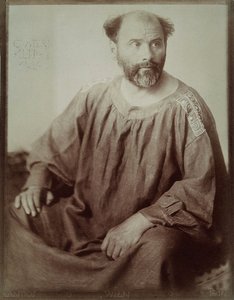
Gustav Klimt
1862 - 1918 , Austria
Quick Facts
- Artistic Movement Or Style:
- Symbolism
- Art Nouveau
- Vienna Secession
- Artists Or Movements Influenced By This Artist:
- Egon Schiele
- Art Nouveau
- Artists Who Influenced This Artist: ['Hans Makart']
- Full Name: Gustav Klimt
- Nationality: Austrian
- Notable Artworks:
- The Kiss
- Portrait of Adele Bloch-Bauer I
- Place Of Birth: Baumgarten, Austria
- Date Of Birth: 1862
- Date Of Death: 1918
Related Articles

Transform Your Walls: Top Trending Mural Styles from Botanical Jungles to Gold Leaf Geometry
Elevate your hospitality projects with our expert trend forecast on luxury mural styles. From biophilic botanical jungles to sophisticated gold leaf geometry, discover how bespoke architectural art transforms hotel interiors into immersive, high-end experiences.

Art Nouveau Guide: Integrating Elegant Curves and Organic Design into Luxury Hotel Interiors
Master Art Nouveau integration for luxury hotel interiors. Discover expert strategies for utilizing organic curves, whiplash lines, and botanical motifs to create sophisticated, high-end hospitality spaces with scalable, professional art procurement solutions.


