Early Life, Family and Training
In the small town of Baumgarten, near Vienna, Gustav Klimt was born into a world where the shimmer of metal was a constant presence. His father, Ernst Klimt, spent his days as a gold engraver, a craft that required a steady hand and an eye for the finest details. This early intimacy with precious metals and the precision of engraving would eventually find its way into the very soul of his later compositions. Yet, life was not always a matter of luster and ease. The family faced frequent financial hardships, which forced them to move often through the streets of Vienna. These transitions and the struggle to find stability shaped a young man who understood both the weight of poverty and the allure of ornament.
By the age of fourteen, his talent had become too evident to ignore. In 1876, he entered the Vienna Kunstgewerbeschule, seeking to turn his innate ability into a formal discipline. He did not begin his path by painting the human form in all its complexity, but rather by mastering the structured world of architectural painting. Under the guidance of Ferdinand Laufberger, he learned to decorate the grand spaces of buildings, focusing on the decorative needs of the era. This rigorous training provided the technical foundation upon which he would later build his more personal and experimental visions.
The Rise of the Vienna Secession
By the late 1890s, a restless energy began to stir beneath the surface of Klimt’s formal training. The heavy, historical academicism that had long governed the Viennese art establishment felt increasingly stifling to him. He sought a space where innovation could exist outside these rigid dictates of tradition, a place where the artist might finally breathe. This desire for creative freedom led him to become a founding member of the Vienna Secession, a movement born from a need to embrace new currents like Art Nouveau, Symbolism, and Japonism. In 1897, he was chosen as the first president of this defiant group, helping to steer a new direction for the city's artistic soul.
This rebellion was not merely a matter of style, but a rejection of the old ways of seeing. Klimt turned away from the predictable, grand narratives of the past, favoring instead organic lines and a profound symbolic depth. He sought to dissolve the boundaries between fine painting and ornamental design, drawing heavily from the flattened perspectives and patterned aesthetics found in Japanese art. This shift allowed him to explore the complexities of human intimacy and mortality with a frankness that often unsettled the conservative public. His work began to move toward a more personal, decorative language that prioritized the psychological weight of the subject over mere physical likeness.
Patrons, Workshop and Commissions
As his reputation grew, Klimt found himself working within a collaborative spirit, forming a partnership with his brother Ernst and Franz von Matsch. This trio of artists operated with a shared purpose, securing significant commissions to decorate the grand spaces of Vienna. They spent much of their early professional years focused on large-scale decorative murals and ceilings, tasks that required a disciplined hand and an eye for ornamentation. Their work in these public spaces brought them into the direct orbit of the imperial court. It was for his contributions to the murals of the Burgtheater that Emperor Franz Joseph I bestowed upon him the Gold Cross of Merit, a high honor that signaled his acceptance into the upper echelons of Austrian society.
However, the very public nature of these grand projects eventually brought friction. The tension between his evolving, more provocative vision and the expectations of the state became a heavy burden. Following the controversy surrounding his ceiling paintings for the University of Vienna, Klimt made a decisive change in his professional life. He chose to withdraw from further public commissions, turning his back on the rigid dictates of state-sponsored art. Instead, he sought the support of private patronage. This shift allowed him to move away from the constraints of academic tradition and focus on a more personal, intimate style that would define his most celebrated years.
- The Burgtheater murals
- University of Vienna ceiling paintings
The Golden Era and Technique
Around 1900, a transformation took hold of his brush, ushering in a period that would define his legacy. He moved away from the heavy, academic shadows of his youth to embrace a luminous, decorative language. This was a time when his canvases began to radiate their own light, as if the paint itself held a celestial glow. He achieved this through the meticulous application of gold leaf, a technique that lent his figures a shimmering, otherworldly presence. This obsession with light and surface was not born of a vacuum; he drew deep inspiration from the ancient mosaics of Ravenna and the intricate, sacred patterns found in medieval manuscripts. He sought to capture a sense of the eternal through these precious, reflective materials.
His vision was further shaped by the quiet elegance of Japanese art. He adopted the flattened perspectives and the rhythmic, patterned aesthetics of ukiyo-e prints, weaving these elements into his compositions. This fusion allowed him to blur the lines between the physical world and a more symbolic, ornamental realm. The figures in his paintings often seemed to emerge from a sea of geometric shapes and organic swirls, caught in a dance of texture and color. He did not merely depict a subject; he enveloped it in a complex, mosaic-like environment that challenged the viewer's sense of depth and space.
Key Works and Iconic Masterpieces
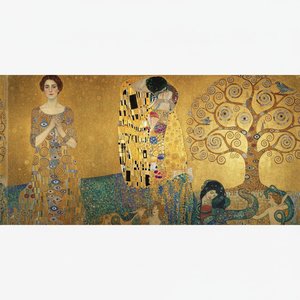
The artist’s brush found its most profound expression when he allowed gold to become a living part of his subjects. In the years between 1907 and 1908, he produced The Kiss, a work where a couple is enveloped in a shimmering, patterned aura. The figures seem to emerge from a floral meadow, their forms entwined in an intimate embrace that defies the simple boundaries of the canvas. This period of intense ornamentation was not merely a decorative choice but a way to capture the psychological weight of human connection. He achieved a similar, though more somber, effect in The Three Ages of Woman, painted in 1905. Here, he used contrasting auras—one of blue, fluid patterns for the younger figures and another of warm, earthy tones for the elderly woman—to trace the inevitable cycle of life and the physical reality of aging.
His ability to blend the human form with complex, mosaic-like textures reached a peak in his portraiture. The Portrait of Adele Bloch-Bauer I remains a central part of his legacy, capturing a sense of presence through intricate, shimmering surfaces. He often looked toward the flattened perspectives of Japanese art to inform these compositions, creating a sense of depth through pattern rather than traditional shadow. This fascination with organic, swirling lines is perhaps most evident in The Tree of Life, which he completed in 1909. The work uses spirals and gold to suggest a sense of continuous growth and movement, a theme that echoed his interest in the mysteries of the soul.
- The Three Ages of Woman, 1905
- The Kiss, 1907-1908
- The Tree of Life, 1909
Later Years and Final Transitions
As the years progressed, the heavy, shimmering ornamentation that had once defined his presence began to recede. A new, more restrained aesthetic emerged, trading the dense gold leaf of his earlier triumphs for a style marked by angularity and expressive simplification. This shift suggested a man looking toward a more direct, perhaps more stark, way of seeing the world. His brushstrokes grew more rapid and free, moving away from the meticulous precision of his youth toward a more fluid, almost urgent, application of color.
This period of stylistic evolution coincided with a time of profound personal and global hardship. The world was gripped by the Spanish Flu pandemic, a shadow that cast a heavy toll upon many lives, including his own. Even as he grappled with the physical exhaustion of the era, his creative spirit continued to seek new forms. In 1918, he completed The Jurisprudence, a work that reflected a complex, almost anxious exploration of judgment and fate. It was a painting that moved away from the decorative toward something more somber and psychologically weighted.
The end came swiftly in the early months of 1918. After suffering a stroke and facing the onset of pneumonia, he passed away on February 6, 1918. He left behind a studio filled with works in transition, including portraits that captured a sense of quiet introspection and a fascination with the delicate details of feminine mystique. His final years were a period of constant movement, a restless search for a new visual language that even death could not fully silence.
- The Jurisprudence, 1918
- Lady with a Fan, 1917
Legacy and Influence
The ripples of his creative rebellion reached far beyond the borders of Austria, helping to define the Art Nouveau style across Europe. By breaking away from the heavy, historical academicism of the past, he opened a door for a new visual language that embraced organic lines and symbolic depth. This shift fundamentally altered the trajectory of Austrian modernism, moving the focus from rigid tradition toward a more personal and psychological exploration of the human experience. His influence was felt most keenly by those who followed in his footsteps, such as his younger peer Egon Schiele, who drew from the expressive possibilities Klimt had carved out.
Even long after his passing, the value of his vision remained immense. His paintings have brought some of the highest prices recorded at auction, reflecting a lasting fascination with his unique ability to marry decorative pattern with profound emotion. The way he used gold and texture to map the unseen landscapes of the soul ensured that his name would remain central to the history of modern art. His presence is still felt in the way artists approach the tension between the physical and the spiritual.
Where to See the Works Today
To witness the physical presence of his vision, one must travel to the heart of Vienna, where the Austrian Gallery Belvedere preserves much of his luminous output. Within those walls, the gold leaf seems to retain a warmth that defies the passage of time. Nearby, the Leopold Museum also holds significant pieces, offering a different perspective on his evolution. These collections allow a viewer to trace the shift from his early academic training to the decorative intensity that defined his most celebrated years.
The reach of his influence extends far beyond the borders of Austria. In Rome, the Galleria Nazionale d'Arte Moderna houses works that speak to his profound psychological depth. Meanwhile, the National Gallery in Prague provides a space to encounter his later, more restrained aesthetic. These various repositories ensure that his exploration of the human form and the complexities of life remains accessible to those who seek it.
- The Kiss
- Portrait of Adele Bloch-Bauer I
- The Three Ages of Woman
- The Virgin
- Lady with a Fan


 Read More


 Switch to Print


 For artworks or reproductions larger than 105 cm (approximately 41 inches) on any side, the frame will be shipped as a kit, disassembled. This method ensures safe delivery and prevents damage during transport.