


 Preview
 Send
Send Share
Share
 Details
 Guide
Guide

 Download
 Similars
 X-Ray
X-Ray Diaporama
 Stats
Statsuntitled

 Read More
Hand Made Oil Reproduction
Hand-painted oil on canvas in your size and frame, made to order by our artists. ( Switch to Print Switch to Digital Image)




P118B $10

P118H $10

P118W $10

P438Z $10

P508JH $12

P508YH $12

P805H $10

P805Z $10

P919BZ $10

P919G $10

P919XJ $10

P959ZH $10

P968JZ $12

W106C $8

W218G $10

W218JH $8

W218Y $10

W307PJ $10

W316G $10

W316PJ $8

W316Y $10

W398PJ $8

W4111J $10

W500HY $15

W500JH $15

W692G $12

W849H $8

W940BG $15

W953PJ $8




Pick from our preset sizes that match the artwork's original proportions.

Type the width and the height you need, to fit your frame or your wall. This is hand-painted, so for a size with a different shape the artist can paint a bit more around the picture, or cut a bit — you choose. We send you a digital mockup to approve before the painting starts. The picture shown on this page does not show the real result — only the mockup does.
After order, AllPaintingsStore.com team will email client for instructions and provide a mockup preview
Worldwide Delivery () in 3/4 weeks instead of standard 5 weeks. (25 October). No compromise on quality.

Free Worldwide Express Shipping

High-Quality Linen Canvas

Full Shipping Insurance

Customs Tax Refund Guarantee

True Color Matching Guarantee

100-Day Return Policy (Defects Only)

100% Money-Back Guarantee

Bulk Discount Offer
 Glass option is only available in size under 110 CM

untitled
Reproduction Medium
Reproduction Size
-


Total Price
$ 258
A Tempest of Emotion: Decoding Klimt’s Untitled Masterpiece
This captivating, untitled work by Gustav Klimt plunges the viewer into a swirling vortex of human emotion and symbolic representation. Executed with Klimt's signature blend of impressionistic fervor and nascent expressionism, this painting is not merely a visual experience but an invitation to contemplate the complexities of the human condition.Subject & Composition: A Scene of Turmoil
The composition immediately draws the eye into a dynamic, unbalanced scene. Figures – some nude or partially draped – are caught in what appears to be a tempestuous swirl. A central female figure reaches outwards, her gesture imbued with longing or perhaps desperation. Beside her stands another figure adorned with a wreath, potentially symbolizing victory, mourning, or spiritual attainment. The surrounding figures writhe and twist, their states ranging from distress to ecstatic abandon. This isn’t a narrative frozen in time; it's a moment of intense, unfolding drama.Style & Technique: Echoes of Symbolism & Early Expressionism
Klimt’s technique is immediately recognizable. The painting showcases heavy brushstrokes and a blurred, dreamlike quality achieved through *impasto* – the thick application of paint that creates texture and depth. Lines are loose and expressive, contributing to the overall feeling of turbulence. Colors blend and overlap, eschewing sharp delineation in favor of amorphous shapes. This approach aligns with the Symbolist movement prevalent in the late 19th century, which sought to express subjective emotions and ideas through evocative imagery rather than realistic representation. Hints of early Expressionism are also present in the distorted forms and heightened emotional intensity.Historical Context: Klimt & The Vienna Secession
Gustav Klimt (1862-1918) was a pivotal figure in the Viennese art scene, and a founding member of the Vienna Secession – a group of artists who rebelled against the conservative academic traditions of the time. Klimt’s work often challenged societal norms and explored themes of love, death, and sexuality with unprecedented frankness. While this particular piece doesn't exhibit the overt gold leaf ornamentation for which Klimt is most famous (as seen in *The Kiss*), it shares his commitment to decorative richness and symbolic depth. The Stoclet Frieze, a monumental work from 1905-1909, demonstrates Klimt’s mastery of complex allegorical compositions, a skill clearly evident here.Symbolism & Interpretation: Unraveling the Meaning
The symbolism within this painting is open to interpretation, adding to its enduring allure. The swirling forms could represent chaos, passion, or even transformation – the tumultuous journey of life itself. The central figure’s outstretched arm suggests a reaching for something beyond grasp, while the wreath-adorned figure hints at a possible resolution or acceptance. The obscured background further enhances the sense of disorientation and invites viewers to project their own emotions and experiences onto the scene.Emotional Impact & Interior Design
This artwork evokes a powerful emotional response – a blend of anxiety, longing, and perhaps even hope. Its dramatic composition and rich textures make it a compelling focal point for any interior space. The painting’s muted color palette would complement both modern and traditional décor styles, adding depth and sophistication to a living room, study, or bedroom. A high-quality reproduction allows art lovers to experience the emotional resonance of Klimt's vision without the constraints of acquisition cost.Key Features
- Artist: Gustav Klimt (1862-1918)
- Style: Symbolism, Early Expressionism
- Technique: Oil on Canvas, Impasto, Expressive Brushwork
- Themes: Chaos, Passion, Transformation, Human Emotion
- A powerful and evocative work that invites contemplation and adds a touch of artistic drama to any space.
Questions & Answers
What technique and style characterize "untitled" by Gustav Klimt?
In "untitled", the acrylic on canvas technique meets the Symbolism movement.
What is "untitled" about?
"untitled" by Gustav Klimt depicts: nudity, symbolism, turbulence, vortex, passion, allegory, dreamlike, dynamic.
From which country does the Symbolism work "untitled" come?
The Symbolism work "untitled" was made by an artist born in Austria.
Related Artworks


Artist Biography
A Life Forged in Gold and Shadow
Born on July 14, 1862, in Baumgarten, near Vienna, Gustav Klimt entered a world where the boundaries of art and craft were intimately linked. His father, Ernst Klimt, worked as a gold engraver, a profession that left an indelible mark on his son’s visual language. The young Gustav learned to appreciate the weight of precious metals and the precision of fine detail long before he ever held a brush. This early exposure to the luster of gold leaf would later define his most famous period. Despite the financial hardships that forced his family through frequent moves within Vienna, his talent was undeniable. By 1876, he had entered the Vienna Kunstgewerbeschule, focusing on architectural painting under Ferdinand Laufberger.
His early professional years were marked by a steady, academic success. Alongside his brother Ernst and Franz von Matsch, Klimt formed a partnership that secured essential commissions for decorative murals and ceilings. These works required a disciplined hand and an eye for large-scale ornamentation. He found himself working on significant projects, such as the staircases of the Burgtheater in Vienna, earning the Gold Cross of Merit from Emperor Franz Joseph I. During this time, he looked toward the historical styles of Hans Makart, yet a restless energy was already beginning to stir beneath his formal training.
The Rebellion of the Secession
By the late 1890s, the constraints of the Viennese academic establishment had become stifling. Klimt sought a space where innovation could exist outside the rigid dictates of tradition. In 1897, he became the first president of the Vienna Secession, a movement designed to embrace new currents like Art Nouveau, Symbolism, and Japonism. This was an era of profound change, and Klimt stood at its center. He rejected the heavy, historical academicism in favor of organic lines and symbolic depth. His work began to explore the complexities of human intimacy, sexuality, and mortality with a frankness that often unsettled the conservative public.
This period of defiance brought both significant friction and profound creative growth. A notable instance occurred around 1900, when his commissions for the University of Vienna ceiling paintings—specifically Philosophy—were criticized as being too provocative. The backlash was severe enough that Klimt eventually withdrew from further public commissions, choosing instead to focus on private patronage. This shift allowed him to refine a more personal, decorative style. He drew heavily from the flattened perspectives and patterned aesthetics of Japanese art, integrating these elements into compositions that blurred the distinction between fine painting and ornamental design.
The Golden Era and Final Transitions
Around 1900, Klimt entered his most recognizable phase, often called his golden period. Inspired by the mosaics of Ravenna and medieval manuscripts, he began using gold leaf to create surfaces that seemed to radiate their own light. Works such as The Kiss (1907-1908) demonstrate this mastery, featuring figures enveloped in a shimmering, patterned aura. His portraits from this time, including the Portrait of Adele Bloch-Bauer I, captured more than mere physical likeness; they conveyed a psychological weight through the use of intricate, mosaic-like textures.
As his life drew toward its end, Klimt’s style underwent another subtle transformation. The heavy ornamentation of the golden phase began to give way to a more restrained and angular aesthetic. In works completed in 1918, such as The Jurisprudence, there is a move toward expressive simplification and sharper lines, perhaps reflecting the influence of the burgeoning Expressionist movement. His final years were marked by this continued evolution, even as he faced the physical toll of the Spanish Flu pandemic. He passed away on February 6, 1918, leaving behind a body of work that fundamentally altered the trajectory of Austrian modernism.
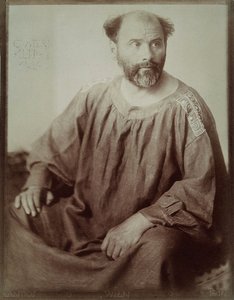
Gustav Klimt
1862 - 1918 , Austria
Quick Facts
- Artistic Movement Or Style:
- Symbolism
- Art Nouveau
- Vienna Secession
- Artists Or Movements Influenced By This Artist:
- Egon Schiele
- Art Nouveau
- Artists Who Influenced This Artist: ['Hans Makart']
- Full Name: Gustav Klimt
- Nationality: Austrian
- Notable Artworks:
- The Kiss
- Portrait of Adele Bloch-Bauer I
- Place Of Birth: Baumgarten, Austria
- Date Of Birth: 1862
- Date Of Death: 1918
Related Articles

Contemporary Abstract Art: A Professional Buyer's Guide to Large-Scale Modern Decor for Hospitality and Corporate Interiors
A professional procurement guide for hotel designers and architects. Discover how to integrate large-scale contemporary abstract art into hospitality projects through high-volume, custom-sized oil reproductions, multi-panel layouts, and reliable global logistics.

Expressionist Abstraction: A Procurement Guide to Bold Colors and Emotional Impact for Modern Hotel Interiors
Elevate hospitality spaces with Expressionist Abstraction. A professional procurement guide for hotel designers on sourcing bold, large-scale abstract oil paintings to create impactful, high-end modern interiors through reliable bulk-order art solutions.


